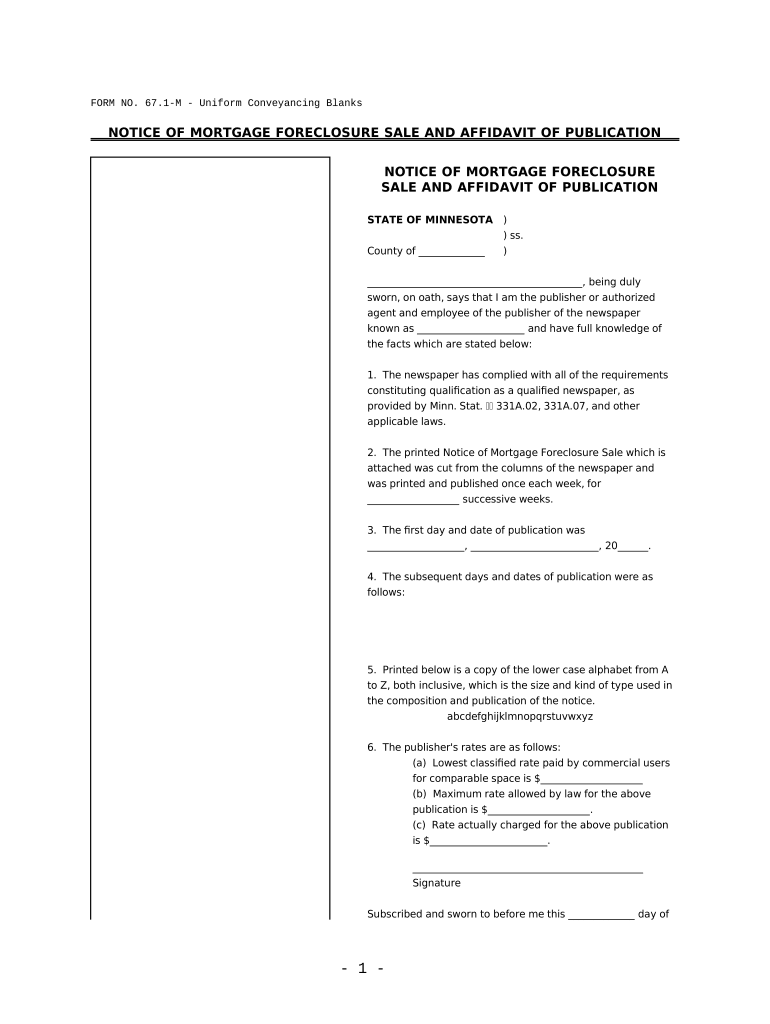
Minnesota Mortgage Foreclosure
What the Minnesota Mortgage Foreclosure document covers
Why a properly prepared foreclosure form matters
Accurate foreclosure paperwork preserves lender remedies, protects borrower rights, and reduces the risk of delays, dismissal, or successful challenges. A clear record improves enforceability, supports required notifications and recordings, and helps court or title examiners determine priorities and deficiencies efficiently.
Typical parties involved in a Minnesota mortgage foreclosure
Several stakeholders commonly prepare, review, or receive foreclosure paperwork depending on the case and jurisdiction.
- Mortgage holders and servicers: Prepare notices, file court complaints, or initiate trustee sales and maintain loan and title records.
- Borrowers / homeowners: Receive notices, can cure defaults, appear in court, and may exercise redemption or loss mitigation options.
- Attorneys and trustees: Draft pleadings, represent parties in court or trustee sale, handle service and recording logistics.
Who typically signs or approves foreclosure filings
Mortgage Lender
A lender or its authorized representative completes and signs documents asserting the loan holder’s claim and authority to accelerate and seek foreclosure; documentation must match loan records and chain of assignment to be enforceable.
Trustee / Attorney
A trustee named in the security instrument or an attorney-in-fact often signs trustee sale notices, affidavits of default, and court pleadings; signatory authority should be documented and, for electronic signing, supported by an audit trail and any required notarization.
Step-by-step: preparing and filing a Minnesota foreclosure
-
01Case assessment: Confirm loan documents, assignments, and outstanding balances
-
02Notice requirements: Prepare statutory notices and cure opportunities
-
03File or publish: Submit complaint or notice of sale per local rules
-
04Sale and recording: Complete trustee sale or judgment and record outcomes
Where foreclosure paperwork is filed and how it moves
-
Court clerk: File complaints and case documents in district court when judicial foreclosure applies
-
County recorder: Record assignments, notices, and trustee deeds with the county recorder
-
Service to borrower: Serve notices and pleadings by allowed methods (mail, personal service) per local rules
-
Title companies: Provide sale results and recorded instruments to title examiners for closing
How to configure an online workflow for foreclosure documents
| Field | Configuration |
|---|---|
| Signature fields | Place signer and notary fields with date stamps |
| Authentication | Use email + SMS or additional KBA for identity |
| Attachments | Require mortgage, assignment, and payoff exhibits |
| RON / Notary | Enable audio‑video recording where remote notarization is permitted |
Digital delivery and technical requirements
Choose a platform that supports required file formats, signer authentication, and an audit trail for each signing event.
- Supported formats: PDF and DOCX for recordable output
- Integrations: Connectors for CRM, title systems, and storage
- Authentication: Email, SMS, and optional KBA
Ensure the platform preserves tamper evidence, provides exportable audit logs, and meets any applicable compliance obligations for your industry.
Typical timing items to monitor during foreclosure
Cure period:
Time to cure default varies; check loan documents and state law
Notice before sale:
Statutory notice requirements differ by jurisdiction
Sheriff/trustee sale timing:
Sale dates scheduled per local practice and court orders
Redemption window:
Post-sale redemption rights depend on state law and case type
Recording deadlines:
Record trustee deed or judgment promptly after sale
Key milestones in a foreclosure timeline
Pre-filing review
Validate note, mortgage, assignments, and loan balance
File and serve
File complaint or notice, then serve defendants per rules
Sale or hearing
Conduct trustee sale or court hearing to resolve default
Post-sale recording
Record trustee deed and notify title insurers
Common errors that delay or invalidate foreclosure filings
- Using inconsistent party names between loan records and filing documents, which can lead to title defects and service disputes.
- Failing to attach or correctly record the mortgage assignment chain, making the filer’s standing subject to challenge in court.
- Skipping required statutory notices or using improper service methods, which may result in dismissal or re-scheduling of sale dates.
- Providing an incomplete legal description or incorrect parcel data, causing recording rejections and delays in title transfer.
Potential legal and financial consequences of incomplete filings
Pricing comparison for common eSignature platforms (signNow listed first)
| signNow | DocuSign | Adobe Sign | PandaDoc | HelloSign | |
|---|---|---|---|---|---|
| Starting Price | $8/user/mo | $15/user/mo | $14/user/mo | $19/user/mo | $15/user/mo |
| Free Trial | 7-day free trial | Varies by vendor | Varies by vendor | Varies by vendor | Varies by vendor |
| Bulk Send | Yes | Yes | Yes | Yes | No |
| Audit Trail | Yes | Yes | Yes | Yes | Yes |
| HIPAA Compliant | Yes | Yes | Yes | No | No |
| Envelope Cap | No cap | 100 envelopes/user/year | Varies by plan | Varies by plan | Varies by plan |
Real-world examples of digital document workflows in property cases
Martin Properties
Martin Properties streamlined remote closings and foreclosure-related forms with an online workflow.
- They processed documents on mobile and offline.
- "I can process and execute all of these documents online with 100% compliance and built-in security," the founder reported, highlighting reduced physical handling and faster returns.
Optica Ventures
A real estate operator centralized signatures for portfolio transactions to improve consistency.
- Templates reduced drafting time per asset.
- The COO said the interface was easy for staff and customers, enabling timely filings and clearer audit trails for each recorded instrument.
Frequently asked questions about Minnesota mortgage foreclosure documents
-
Can foreclosure forms be signed electronically?
Yes. Electronic signatures are legally recognized under the ESIGN Act and state UETA rules for most foreclosure-related documents, provided the signature shows intent, consent, attribution, and records are retained.
-
Is notarization required for foreclosure filings?
Many recorded instruments (assignments, trustee deeds) require a notary acknowledgement. Remote online notarization may be allowed where state law permits; otherwise use in-person notarization.
-
What happens if a filed document has an error?
Minor clerical errors may be correctable by submitting an amended or corrected document; substantive mistakes can lead to delays or challenges. Consult counsel promptly to determine corrective steps.
-
Can a foreclosure be paused or reversed?
Yes. Bankruptcy filings, court orders, or successful borrower defenses can stay or derail a foreclosure; lenders should monitor dockets and confirm service and standing to minimize risk.
-
How should parties serve foreclosure notices?
Service methods depend on the document and jurisdiction—personal service, certified mail, or court‑approved methods may be required. Follow local rules precisely to preserve proof of service.
-
What records should be retained after sale?
Keep signed documents, recording receipts, sale notices, and audit trails for the longest applicable statutory period; retention supports title insurance, audits, and potential litigation.