Establishing secure connection…Loading editor…Preparing document…

Louisiana Petition to Quiet Tax Title

This template is fully customizable. Edit the text, fill out the fields, and send it for signature. Give it a try!
Louisiana Petition to Quiet Tax Title

What the Louisiana Petition to Quiet Tax Title Is

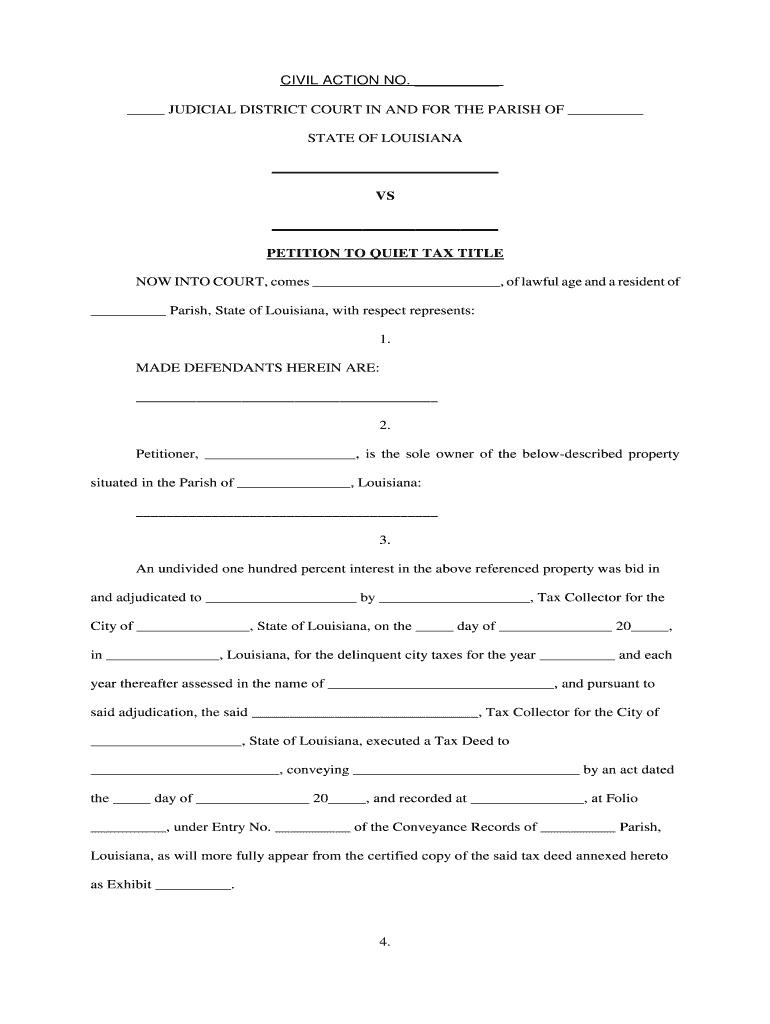
The Louisiana Petition to Quiet Tax Title is a civil pleading filed in a parish district court to obtain a judicial determination that a claimant holds title free of competing claims arising from tax adjudication or tax sale events. The petition identifies the property, recites the tax-sale history and any redemption efforts, names adverse claimants, and requests that the court declare rights, cancel or subordinate competing instruments, and authorize recordation of the judgment. Typical exhibits include certified tax-sale certificates, recorded instruments, proof of notice or publication, and an affidavit of facts supporting the petition.

Why a Quiet Tax Title Petition Matters

A successful petition removes clouds created by tax sales or adjudications, allows issuance of an insurable title opinion, and clears the way for sale, refinance, or development while securing priority for the tax purchaser or owner.

Why a Quiet Tax Title Petition Matters

Who Typically Files or Uses This Petition

Common filers include purchasers at parish tax sales, property owners seeking marketable title, title insurers, and litigators representing investors or municipalities.

  • Property purchasers: owners who acquired property at tax sale needing judicial confirmation of title.
  • Title companies: clear clouds to issue title insurance for sale or refinance.
  • Municipalities and tax buyers: parties protecting tax-sale investments and extinguishing competing claims.

How This Petition Works in Practice

Two representative scenarios show common outcomes when a petition is used to resolve tax-sale irregularities or competing liens.

Tax-Sale Purchaser

A purchaser at parish tax sale sought judicial confirmation after the redemption period expired and several stray liens were discovered.

  • The petitioner filed to quiet title and attach the sale certificate and notices of publication.
  • The court granted a default judgment quieting title, enabling the purchaser to secure an insurable deed and place the property for sale with a clear record.

Title Company

A title company required a quiet title judgment to clear conflicting lien notations discovered during underwriting.

  • Escrow was delayed while the parties litigated priority and defects in the record.
  • After a contested hearing and record review, the court ordered competing claims extinguished and directed the clerk to annotate records, allowing the insurer to issue a policy and close the loan.

Step-by-Step: Preparing and Filing the Petition

Follow these core steps to prepare, file, and pursue a Louisiana Petition to Quiet Tax Title in district court.

  • 01
    Prepare Petition: Draft complaint, legal description, tax-sale details, and list of adverse claimants.
  • 02
    Attach Exhibits: Include tax sale certificates, notices, deed records, and redemption affidavits.
  • 03
    File With Court: File in the parish district court clerk’s office; pay filing fee.
  • 04
    Service & Notice: Serve named defendants and publish notice if required by statute.

Configuring an Online Petition Template

Standardize a fillable PDF template to reduce errors, attach exhibits, and capture signer authentication and audit trail data.

Field Configuration
Document Template PDF form with fillable fields and placeholders
Authentication Email link or SMS code for signer verification
Exhibits Upload Attach scanned tax certificates and recorded documents
Signature Workflow Signer order: petitioner, counsel, title agent

Where to File and How the Process Moves

A concise filing flow: prepare documents, file with parish court, serve claimants, and secure judgment and recording.

  • Prepare Petition: Assemble pleadings, exhibits, and verification affidavit.
  • File Petition: Submit to parish district court clerk and pay fees.
  • Serve Defendants: Complete personal or constructive service per Louisiana rules.
  • Obtain Judgment: Request default or contested judgment with title clearing language.

Timing Expectations and Common Deadlines

Key timing expectations include confirming redemption expiration, completing service, waiting for answers, and recording any judgment to perfect title.

Redemption Window Expired:

Confirm statutory redemption has ended before filing

Filing Date:

File promptly after redemption or title discovery

Service Deadline:

Complete service per court rules within required period

Answer Period:

Defendants typically have 15–30 days to respond

Recording Judgment:

Record court judgment to clear public land records

Key Milestones from Filing to Recordation

A sequential view of core milestones from initial filing through judgment and public recording.

01

File Petition

Petitioner files complaint and pays filing fee.

02

Serve Defendants

Provide notice to owners, lienholders, and interested parties.

03

Court Hearing

Court schedules hearing or sets default for absent parties.

04

Record Judgment

Clerk records judgment to perfect marketable title.

Common Mistakes to Avoid

  • Incomplete Property Description: Using an informal address instead of a recorded legal description can cause dismissal or competing claims.
  • Missing Tax Sale Exhibits: Failing to attach certified tax sale documents or proof of notice often leads to continuance or denial.
  • Improper Service: Service defects, such as serving an incorrect party or failing to publish where required, can void judgments.
  • Incorrect Venue: Filing in the wrong parish wastes time and expense and typically requires refiling in the proper forum.

Risks and Consequences of Errors

Clouded Title: Impairs sale or financing
Monetary Loss: Potential loss of tax investment
Legal Costs: Court and attorney fees
Delayed Closing: Transaction delays for buyers
Voidable Deeds: Risk of invalid conveyance
Appeals: Opposing parties may appeal

Essential Filing Data and Security Considerations

Petitioner Name: Enter exact legal name
Property ID: Use recorded parcel or cadastral ID
Tax Certificate: Attach certified tax sale document
Service List: List all known lienholders and owners
Dates: Use MM/DD/YYYY for all dates
Signatures: Original or eSignature with audit trail

Technical Requirements for eFiling and eSignatures

Digital signing and e-submission require compatible file formats, strong signer authentication, and integrations with case management or title platforms.

  • Formats: PDF, DOCX, TIFF accepted
  • Integrations: Salesforce, NetSuite, Google Workspace
  • Security: AES-256 at rest; TLS in transit

eSignature Pricing Comparison for Petition Workflows

High-level pricing and capability comparison for eSignature platforms commonly used to manage petitions, exhibits, and signer workflows.

signNow DocuSign Adobe Sign PandaDoc HelloSign
Starting Price $8/user/mo $15/user/mo $14/user/mo $19/user/mo $15/user/mo
Free Trial 7-day free trial Varies Varies Varies Varies
Bulk Send Yes Yes Yes Yes No
Audit Trail Yes Yes Yes Yes Yes
HIPAA Compliant Yes Yes Yes No No
Envelope Cap No cap 100 envelopes/user/year Varies Varies Varies

Frequently Asked Questions

Concise answers to frequent questions about preparing, filing, and litigating a Louisiana Petition to Quiet Tax Title in district court.


Need help? Contact support

be ready to get more
Join over 28 million airSlate SignNow users