Caption
Complete court caption and case number at the top to identify the matter and ensure the document is associated with the correct file.
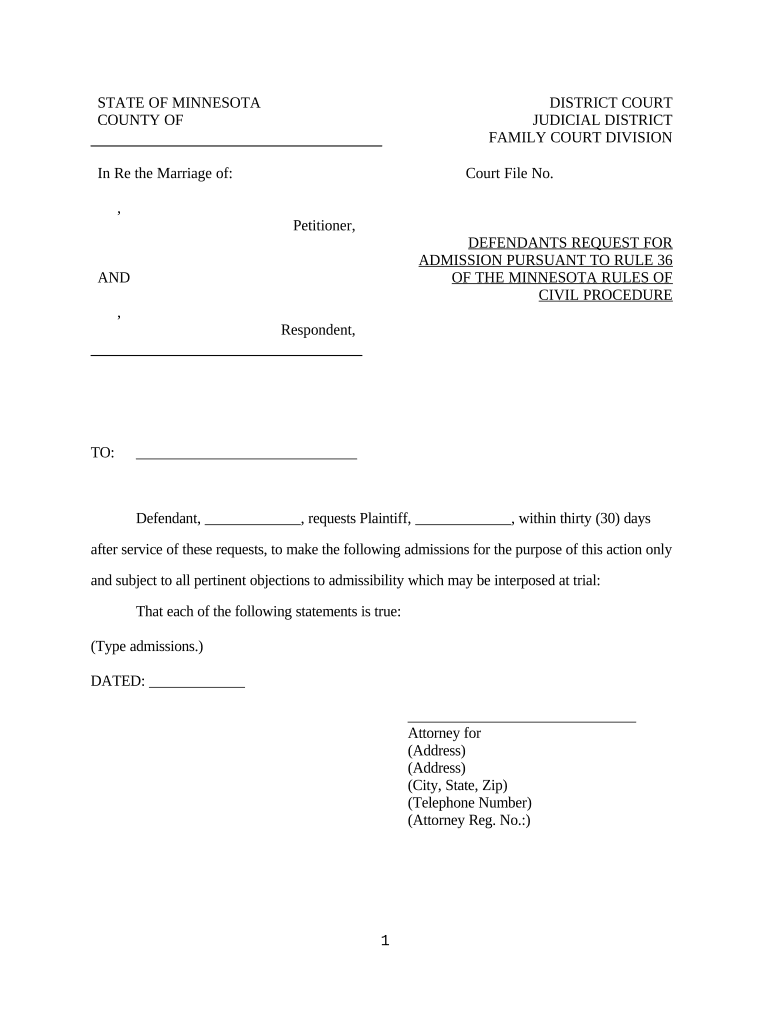
Requests for admission narrow issues, lock in uncontested facts, and reduce trial preparation by converting contested facts into judicially accepted admissions when appropriate.

Common users include defense counsel, pro se defendants, and litigation paralegals responsible for discovery management.
Complete court caption and case number at the top to identify the matter and ensure the document is associated with the correct file.
Short instructions explain how to respond (admit, deny, explain lack of information) and reference relevant rules such as Minn. R. Civ. P. 36.
Define key terms or dates once to keep individual requests concise and reduce disputes over scope or meaning.
Each request should state a single fact; compound statements invite objections and can be partially admitted or denied.
Place clear response lines and require brief factual explanations for denials or qualified responses to avoid evasive answers.
A signed service certificate specifying method, date, and recipients shows compliance with service rules and supports enforceability.
Attach numbered exhibits referenced by request. Include a brief exhibit index that describes each document and its source for authentication.
Include a copy of the envelope, e-mail transmission header, or e-file confirmation to document the service method and date.
Save master copies as PDF/A for long-term preservation; retain original editable file (DOCX) for redaction or revisions.
When using e-sign or e-service, retain the platform's audit trail showing delivery, IP address, and timestamps for evidentiary support.
30 days from service under Minn. R. Civ. P. 36 unless the court or local rule sets a different period.
Parties may stipulate a longer response period; memorialize extensions in writing to avoid disputes.
File promptly after an evasive or absent response; delays can lessen remedial options.
An unanswered request may be treated as admitted and binding at trial under Minn. R. Civ. P. 36.
A court may shorten, lengthen, or otherwise modify timing for good cause shown.
| Criteria | Admissions | Interrogatories | Document Requests |
|---|---|---|---|
| Purpose | narrow facts | obtain narrative answers | obtain documents |
| Response Type | admit/deny | written answer | produce/objection |
| Effect if Unanswered | deemed admitted | court may compel | court may compel |
| Typical Time Limit | 30 days | 30 days | 30 days |
| signNow | DocuSign | Adobe Sign | PandaDoc | HelloSign | |
|---|---|---|---|---|---|
| Starting Price | $8/user/mo | $15/user/mo | $14/user/mo | $19/user/mo | $15/user/mo |
| Free Trial | 7-day trial | No | No | Yes, limited | Yes, limited |
| Bulk Send | Yes | Yes | Yes | Yes | No |
| Audit Trail | Yes | Yes | Yes | Yes | Yes |
| HIPAA Compliant | Yes | Yes | Yes | No | No |
Small-firm or in-house counsel who drafts targeted requests to focus trial issues, coordinates document exhibits, and monitors responses to determine whether to file motions to compel or rely on admissions at summary judgment or trial.
Non‑lawyers responding or preparing requests who must follow procedural rules, use plain language, and seek limited legal advice to avoid inadvertent admissions or missed deadlines that can bind them at trial.