Establishing secure connection…Loading editor…Preparing document…

Mississippi Affidavit

This template is fully customizable. Edit the text, fill out the fields, and send it for signature. Give it a try!
Mississippi Affidavit

What a Mississippi Affidavit Is and When It’s Used

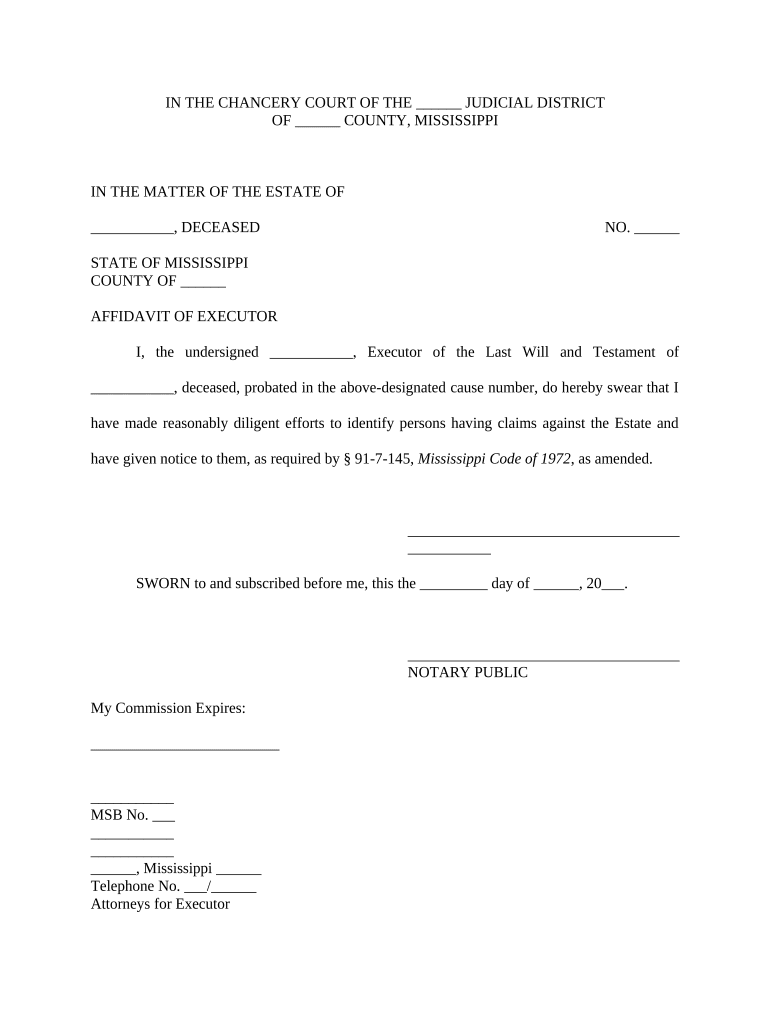
A Mississippi Affidavit is a sworn written statement used in Mississippi to attest to facts, events, or identities for legal, administrative, or transactional purposes. It is typically signed under penalty of perjury and executed before a notary public or other authorized official. Affidavits support matters such as proof of residency, lost-title claims, small estate proceedings, and verification of factual statements when sworn testimony is unnecessary or impractical. Although content varies by use, a well-prepared affidavit clearly identifies the affiant, states facts in plain language, includes dates and attachments where relevant, and contains an explicit jurat or acknowledgment.

Why Use a Mississippi Affidavit

A Mississippi Affidavit provides a formal, sworn record that can substitute for in-person testimony and establish facts for courts, agencies, and private parties. It reduces the need for live witnesses, clarifies key dates and statements, and creates an evidentiary paper trail under oath.

Why Use a Mississippi Affidavit

Who Commonly Prepares or Signs This Affidavit

Typical users include individuals, attorneys, title agents, and government staff preparing sworn statements for legal or administrative matters.

  • Private individuals asserting facts for court or agency processes, such as proof of residency or lost-title claims.
  • Real estate and title professionals verifying chain-of-title events, possession, or continuous occupancy.
  • Attorneys preparing affidavits for litigation, affidavits of service, or verification of client statements.

Core Elements That Make an Affidavit Effective

Key elements that make a Mississippi Affidavit legally sound, clear, and admissible in administrative, agency, or court settings while supporting verification and recordkeeping.

Affiant ID

Full legal name, date of birth when relevant, and a copy of government-issued photo ID. Clear identification minimizes disputes and is often required for notarization and agency acceptance.
Statement of Facts

Numbered paragraphs that describe specific, observable facts, not legal conclusions. Use timelines and exact dates to connect events and corroborating documents for evidentiary strength where available.

Jurat

Include jurat language showing the affiant swore or affirmed the statements under oath before the notary, with date and location. Jurat confirms the oath required for admissibility.

Exhibit list

Provide an indexed list of exhibits referenced in the affidavit, label each exhibit, and attach copies. Exhibit clarity helps reviewers and demonstrates documentary support for each factual claim.

Notary block

Use a notary block appropriate to Mississippi law, showing notary printed name, commission number, commission expiration, and the jurat or acknowledgment language for the executed oath.

Signature details

Affiant signs and dates the document; include printed name and, if signing for an entity, title and basis of authority. Witness signatures if required by jurisdiction.

Step-by-Step: Prepare and Execute the Affidavit

Follow these sequential steps to prepare, verify, and file a Mississippi Affidavit correctly with notarization and proper attachments.

  • 01
    Draft affidavit: Write clear numbered facts with dates and specific details.
  • 02
    Attach evidence: Label exhibits and attach copies of supporting documents.
  • 03
    Notarize: Sign in presence of notary; provide ID for verification.
  • 04
    File or deliver: Submit to the requesting agency, court clerk, or retain for records.

How Digital Execution and Notarization Work

Digital execution streamlines affidavit signing while preserving notarization and audit trails when state laws permit remote notarization.

  • Prepare document: Upload template and add required fields.
  • Add signers: Specify affiant and any witnesses or agents.
  • Authenticate: Use email, SMS code, or stronger MFA.
  • Notarize: Invoke RON or schedule in-person as required.

Typical eSignature Workflow Settings for an Affidavit

Typical digital workflow settings for completing and delivering a Mississippi Affidavit using an eSignature platform and notarization features.

Field Configuration
Signer Order Sequential: affiant signs before notarization.
Authentication Email + SMS code; KBA optional for high assurance.
Notary Mode RON enabled where allowed; otherwise in-person.
Document Retention Retain signed PDF and audit trail for records.

Platform Features to Confirm Before Electronic Execution

Ensure the signing platform supports notarization workflows, secure storage, required authentication options, and provides a tamper-evident audit trail for the affidavit record.

  • File formats: Accepts PDF, DOCX, and PDF/A
  • Integrations: Connects with cloud storage and CRM
  • Security: AES-256 encryption, SOC 2 compliance

Security and Compliance Considerations

Encryption: TLS 1.2/1.3 in transit; AES-256 at rest
Certifications: SOC 2 Type II, ISO 27001, PCI DSS
HIPAA: BAA available for covered workflows
Audit Trail: Detailed timestamps, IPs, and action logs
Authentication: Email, SMS, SSO, and advanced options
Retention: Encrypted storage with configurable retention policies

Common Preparation Pitfalls to Avoid

  • Using ambiguous language or legal conclusions instead of concrete, observable facts undermines the affidavit's evidentiary value and increases the chance of challenge.
  • Failing to attach referenced documents or mislabeling exhibits leads reviewers to question assertions and can delay administrative or court processing.
  • Signing before notarization, signing with inconsistent names, or omitting the jurat can render the affidavit unacceptable to some authorities.
  • Submitting an electronically signed affidavit without confirming RON or e-signature acceptance with the recipient causes avoidable rejections.

Key Legal Risks and Consequences

Perjury risk: Intentional false statements may be felony
Invalid affidavit: Missing jurat or notary voids effect
Identity mismatch: Triggers verification, delays, or rejection
Tax consequences: Incorrect facts can affect withholding
Evidence weight: Vague wording reduces admissibility
Data privacy: Sensitive data requires HIPAA compliance

Basic Pricing and Feature Comparison Among Common eSignature Vendors

Basic pricing and feature comparison among common eSignature vendors. signNow appears first per vendor listing and pricing summaries for easy reference.

signNow DocuSign Adobe Sign PandaDoc HelloSign
Starting Price $8/user/mo $15/user/mo $14/user/mo $19/user/mo $15/user/mo
Free Trial 7-day free trial (no card) Varies by plan Varies by plan Varies by plan Varies by plan
Bulk Send Yes (Business Premium) Varies by plan Varies by plan Varies by plan Varies by plan
Audit Trail Yes, detailed audit trails Yes, audit trails Yes, audit trails Yes, audit trails Yes, audit trails
HIPAA Compliant Yes (BAA available) Varies by plan Varies by plan Varies by plan Varies by plan
Envelope Cap No envelope cap 100 envelopes per user per year Varies by plan Varies by plan Varies by plan

Practical Examples of Mississippi Affidavit Use

Real-world usage examples showing how Mississippi Affidavits resolve common title, residency, and administrative issues efficiently.

Title Recovery

A vehicle owner used a Mississippi Affidavit to document continuous possession after losing the original title and prior to applying for a bonded title.

  • Affidavit accompanied by police report and repair receipts.
  • The affidavit, notarized and supported by labeled exhibits, allowed the motor vehicle division to accept the owner's sworn statement and issue a bonded title without a court case, significantly reducing processing time and avoiding litigation.

Residency Verification

A homeowner used a Mississippi Affidavit to confirm residency for a local benefit program when utility records were in a spouse's name.

  • Affidavit included lease and mail evidence.
  • Presenting a notarized affidavit with corroborating documents enabled the agency to grant benefits without additional in-person interviews; the clear exhibit labeling and jurat helped expedite verification and reduced back-and-forth requests.

Practical Tips to Improve Acceptance and Enforceability

Practical tips to improve the clarity, enforceability, and acceptance of a Mississippi Affidavit in administrative or court contexts.

Write concise, plain factual sentences
Avoid legal conclusions; state observable facts in numbered paragraphs, include dates, locations, and who did what. This reduces ambiguity, improves admissibility, and makes notarization and review faster for clerks or agencies.
Label every exhibit and reference it clearly
Number and label each exhibit (Exhibit A, B), reference them in the affidavit text, and attach copies. Well-organized exhibits prevent misplacement, help notaries confirm document contents, and speed administrative review or court acceptance.
Provide government ID and identity proof at signing
Present unexpired government-issued photo ID to the notary and ensure the name on the affidavit matches ID. If using an authorized representative, include a power of attorney or corporate resolution to document signing authority.
Check court or agency notarization and format rules
Before submitting, confirm whether the receiving court or agency accepts RON, requires additional jurat language, or mandates specific exhibit formats. Early verification prevents rejections and avoids needless re-execution or delays.

Frequently Asked Questions About Mississippi Affidavits

Common questions and answers about preparing, signing, and using a Mississippi Affidavit, including notarization, evidence, and e-signature considerations.


Need help? Contact support

be ready to get more
Join over 28 million airSlate SignNow users