Establishing secure connection…Loading editor…Preparing document…

Mississippi Nonprofit Corporation By-Laws

This template is fully customizable. Edit the text, fill out the fields, and send it for signature. Give it a try!
Mississippi Nonprofit Corporation By-Laws

What the Mississippi Nonprofit Corporation By-Laws Are

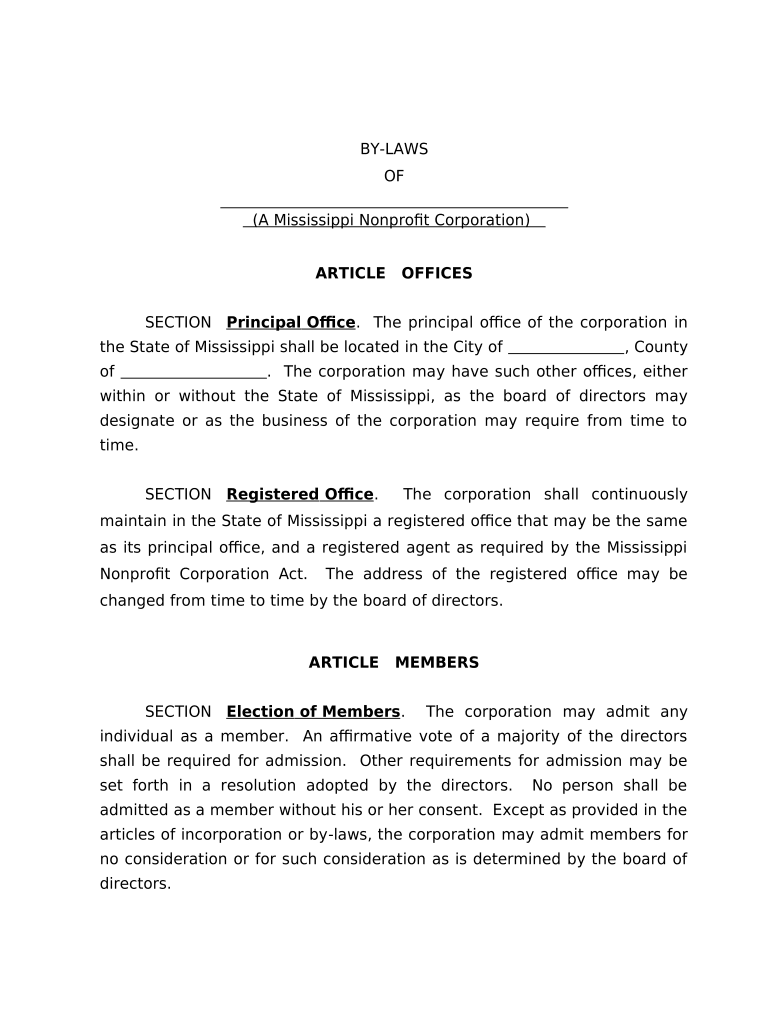
Mississippi Nonprofit Corporation By-Laws are the internal rules that govern how a nonprofit corporation operates: membership (if any), board structure, officer duties, meetings, voting, committees, and amendment procedures. They sit alongside the Articles of Incorporation filed with the Mississippi Secretary of State but are typically adopted and maintained internally by the board. Well-drafted bylaws clarify authority, minimize disputes, and document governance practices required for compliance with state law and federal tax-exempt rules.

Why clear bylaws matter for your organization

Well-crafted bylaws provide legal clarity about governance, protect tax-exempt status by documenting operational controls, reduce board disputes, and show donors and regulators that the nonprofit follows recognized corporate formalities.

Why clear bylaws matter for your organization

Who typically prepares and relies on nonprofit bylaws

The following parties commonly prepare, review, or depend on nonprofit bylaws in Mississippi.

  • Volunteer-led nonprofit boards who need clear governance rules and officer roles.
  • Founders and incorporators drafting initial organizational governance documents.
  • Executive directors and legal counsel responsible for compliance and recordkeeping.

Each group uses bylaws for slightly different purposes—founders to set initial rules, boards to govern operations, and staff or counsel to ensure ongoing compliance and consistent recordkeeping.

Core sections to include in Mississippi nonprofit bylaws

A professional set of bylaws addresses key governance areas to prevent ambiguity and support legal compliance.

Name & Purpose

State the corporation's exact legal name and concise charitable purpose consistent with Articles of Incorporation and IRS tax-exempt requirements; include primary mission and any restricted purposes.
Membership

Define whether the nonprofit has members, membership classes, voting rights, admission criteria, dues (if any), and removal procedures to avoid later disputes.

Board Composition

Specify number of directors, term lengths, eligibility, selection and removal processes, quorum and voting rules, and any staggered-term provisions.

Officers & Duties

Identify officer positions (president, secretary, treasurer), appointment method, duties, delegation authority, and temporary vacancies handling.

Meetings & Notices

Set rules for annual and special meetings, required notices, quorum thresholds, remote participation (telephone/video), and minutes retention practices.

Amendment Process

Describe how bylaws may be amended, including notice requirements, voting thresholds, and any board vs. member approval distinctions.

Step-by-step: creating and adopting your bylaws

Follow these sequential steps to draft, approve, and maintain Mississippi nonprofit bylaws.

  • 01
    Draft the document: Prepare initial draft aligned with Articles of Incorporation and IRS 501(c)(3) guidance.
  • 02
    Board review: Circulate to directors and counsel for comments and legal compliance checks.
  • 03
    Adopt by board: Hold a board vote with proper notice and record adoption in meeting minutes.
  • 04
    Store corporate records: File the adopted bylaws with minutes and retain copies in corporate records.

How to configure a digital workflow for your bylaws

Set up a simple electronic workflow to prepare, approve, and store the adopted bylaws.

Field Configuration
Document Template Save a reusable bylaws template for consistent future updates
Access Control Restrict edit rights to officers and counsel
Signer Authentication Require name and email verification; enable stronger methods if needed
Retention Policy Automatically archive adopted versions in governing records folder

Where to keep and how to distribute adopted bylaws

Use a controlled sequence to finalize adoption and ensure stakeholders have the correct copies.

  • Prepare and finalize: Draft, review, and finalize the bylaws document before circulation.
  • Board adoption: Adopt at a properly noticed meeting and record minutes of the vote.
  • Internal distribution: Provide signed copies to directors, officers, and retained counsel for records.
  • Public accessibility: Make an executive summary available to donors; retain the official bylaws internally.

Technical considerations for e-signing and storing bylaws

Ensure your chosen platform supports secure signing, audit trails, and record retention for governance documents.

  • File formats: PDF and DOCX accepted; preserve original formatting
  • Authentication: Email verification, SMS code, or stronger MFA options
  • Integrations: Connects with cloud storage and ERPs like NetSuite

Select tools that provide tamper-evident signed PDFs, complete audit trails, and integrations with your document repository for long-term governance recordkeeping.

eSignature vendor comparison for signing bylaws

Comparison of common vendor features and pricing to consider when choosing an eSignature solution for governance documents.

signNow DocuSign Adobe Sign PandaDoc HelloSign
Starting Price $8/user/mo $15/user/mo $14/user/mo $19/user/mo $15/user/mo
Free Plan 7-day free trial No No Yes, limited Yes, limited
Bulk Send Yes (Premium tier) Yes Yes Yes No
Audit Trail Yes Yes Yes Yes Yes
HIPAA Compliant Yes Yes Yes No No

Principal risks if bylaws are incomplete or incorrect

Loss of clarity: General confusion over authority
Board disputes: Governance conflicts and litigation risk
Tax exposure: IRS issues for governance failures
Contract invalidity: Questions about signatory authority
Recordkeeping fines: State penalties for missing corporate records
Credibility loss: Donor and funder confidence harmed

Common mistakes organizations make preparing bylaws

  • Using overly generic language that fails to address board size, quorum, or term limits, which creates gaps when disputes arise.
  • Confusing articles (filed with the Secretary of State) and bylaws (internal rules), leading to incorrect filing or duplication.
  • Failure to include amendment procedures and notice requirements, resulting in disputes over the validity of later changes.
  • Not aligning bylaws with IRS tax-exempt requirements or conflict-of-interest policies, risking adverse tax or grant outcomes.

Security and compliance elements to record with your bylaws

Signature method: E-signature or wet signature
Document retention: Retention period noted
Access controls: Restricted to officers
Audit trail: Timestamp and signer attribution
HIPAA note: Addendum if health data present
Record copies: Master copy and backups

Practical tips for accurate, efficient bylaws completion

Adopt these practical habits to reduce errors and keep governance documentation defensible.

Use a template reviewed by counsel
Start with a state-aware template and obtain a one-time legal review to ensure bylaws meet Mississippi corporate law and IRS expectations; this reduces rework and risk.
Record adoption in minutes
Always document the board vote, date, and attending directors in meeting minutes and attach the adopted bylaws to the minutes for a clear chain of governance evidence.
Version control
Number each adopted version and keep an amendment log with dates and approval votes to simplify audits and transitions among officers.
Limit frequent amendments
Avoid frequent or ad hoc changes; require a supermajority for amendments where stability is needed to reassure funders and regulators.

Real-world scenarios showing how bylaws solve governance issues

Two concise examples illustrate common nonprofit governance challenges and how bylaws provided a clear resolution.

Small Community Shelter

A fledgling shelter lacked quorum rules, causing meeting delays and stalled decisions.

  • Board adopted quorum and remote participation clauses.
  • After adoption, the board resolved staffing and funding decisions promptly and produced documented minutes used for a grant application review.

Regional Arts Council

An arts council had unclear officer duties, creating duplication of work and budget oversight gaps.

  • Bylaws were revised to define officer responsibilities and reporting.
  • The clarified roles improved financial controls and satisfied a foundation's due diligence request during a funding round.

Who signs and certifies adopted bylaws

Board President

The board president typically signs adopted bylaws to certify board approval; the signature confirms the governing body's action and is often countersigned by the secretary for corporate records.

Corporate Secretary

The corporate secretary maintains the minute book and signs to attest that the attached minutes reflect the adoption and vote count, supporting the official corporate record.

Frequently asked questions about Mississippi nonprofit bylaws and signing

Answers to common questions about validity, amendment, e-signing, and recordkeeping for nonprofit bylaws in Mississippi.


Need help? Contact support

be ready to get more
Join over 28 million airSlate SignNow users