Establishing secure connection…Loading editor…Preparing document…

Missouri Beneficiary Deed

This template is fully customizable. Edit the text, fill out the fields, and send it for signature. Give it a try!
Missouri Beneficiary Deed

What the Missouri Beneficiary Deed Is and when it applies

A Missouri Beneficiary Deed (also called a transfer-on-death deed or TOD deed in some jurisdictions) is a recorded real-estate instrument that names one or more beneficiaries to receive title to real property on the owner’s death without probate. It is executed by the owner (grantor), acknowledged before a notary, and recorded with the county recorder. While the deed takes effect only at death, the owner retains full control during life and may revoke or change beneficiaries by recording an instrument achieving that effect. Recording procedures and practical effects vary by county and should be confirmed with the local recorder.

Why a Missouri Beneficiary Deed can simplify transfer at death

A beneficiary deed transfers real property outside probate, preserves owner control during life, and can reduce time and expense for heirs. It is a simple estate planning tool for clear-title transfers when state and county rules permit.

Why a Missouri Beneficiary Deed can simplify transfer at death

Who typically prepares and benefits from a beneficiary deed

Use the deed when the property owner wants to retain full control during life but ensure the deed matches state recording requirements and creditor considerations.

  • Individual homeowners managing a single parcel who prefer a nonprobate transfer
  • Estate planning attorneys preparing straightforward real-estate transfers
  • Trust officers and financial advisors coordinating property disposition

Core elements included in a professionally prepared Missouri Beneficiary Deed

A complete deed clearly identifies parties, describes the property with the legal description, specifies beneficiaries and survivorship rules, states whether the transfer is conditional, and includes a notary acknowledgement and recording block for the county recorder.

Grantor

Full legal name of the current owner executing the deed, exactly as on government ID.
Beneficiary

Full legal name(s) of the intended recipient(s) and contingency beneficiaries, if any.

Legal description

Complete recorded legal description or parcel ID; street address alone is insufficient.

Effective language

Clear statement that transfer takes effect on grantor's death, subject to revocation.

Acknowledgement

Notary signature and seal for recording; some counties may require witness lines.

Recording block

County recorder use area with space for recording date, fee and instrument number.

Step-by-step: completing and recording a Missouri Beneficiary Deed

Follow a consistent sequence to minimize errors: prepare the deed, verify legal description, sign before a notary, and record with the county recorder.

  • 01
    Prepare deed: Draft deed with full legal description and beneficiary details.
  • 02
    Verify identity: Match grantor name to government ID before notarization.
  • 03
    Notarize: Sign in notary presence; obtain official acknowledgement.
  • 04
    Record: Submit to county recorder with required fee and copies.

Where to file and how the recording process works

Recording occurs at the county recorder or clerk's office in the county where the property is located; the instrument becomes a public record after acceptance and filing.

  • Submit to County Recorder: Bring original signed deed plus copies for recording.
  • Pay recording fee: Pay the fee required by the county; amounts vary by county.
  • Recorder indexes: Recorder files instrument and assigns recording number.
  • Obtain recorded copy: Get or request a certified copy for the beneficiary and title company.

Technical setup for completing and e-signing online

If you use an electronic workflow, configure fields and signer authentication to match legal and county requirements before sending the document for signature.

Platform Use a PDF-capable e-sign platform that supports audit trails
Authentication Choose email + SMS code or stronger ID verification for identity assurance
Notarization If remote notarization allowed, enable RON session recording and KBA
Retention Save the signed PDF and audit trail for the required retention period
Notifications Configure automatic delivery of the recorded copy to beneficiaries

Digital signing and eSubmission considerations

Ensure any electronic process also accommodates a notarized original for counties that require a wet-ink or notary-stamped paper instrument for recording.

  • File formats: PDF and DOCX supported
  • Authentication: Email + SMS or KBA
  • Recording support: Platform must produce a printable original for recorder

Timing: execution, recording and when the deed takes effect

Key timing points affect enforceability, rollover of title, and tax considerations; record promptly after signing to ensure clear indexing.

Execution date:

Date when grantor signs; use MM/DD/YYYY format

Recording date:

Recorder-stamped date when instrument becomes public record

Effective on death:

Transfer is effective at grantor's death, not at signing

Revocation window:

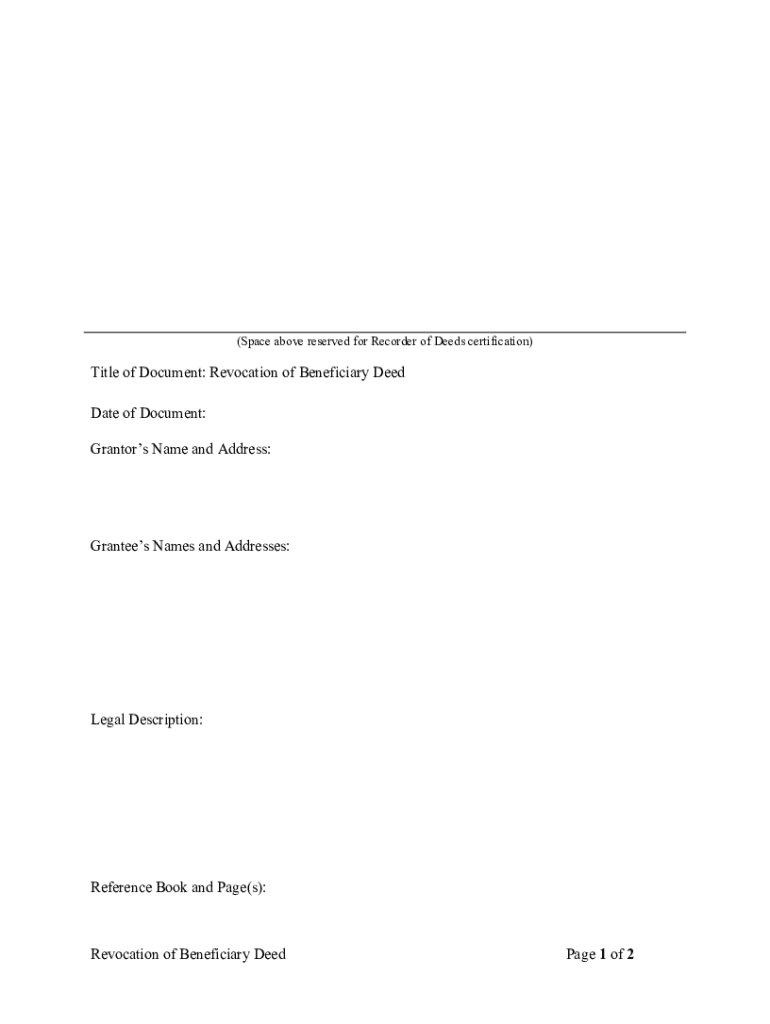
Grantor may revoke anytime before death by executing a recorded revocation

Title update:

Beneficiary should record death certificate and affidavit to obtain recorded title

Key processing milestones from drafting to title transfer

The following sequential stages describe completion, recording, and postmortem transfer actions.

01

Draft and review

Prepare deed and verify legal description and beneficiary details.

02

Sign and notarize

Grantor signs in notary presence; obtain acknowledgment and seals.

03

Record instrument

Submit original to county recorder and pay recording fee.

04

Post-death transfer

Beneficiary supplies death certificate and recorded deed to update title.

Essential data elements to include on the deed

Grantor: Full legal name
Beneficiary: Full legal name(s)
Legal description: Recorded property description
Parcel ID: County tax/parcels ID
Signature date: MM/DD/YYYY format
Notary acknowledgement: Official notary block

Risks and legal consequences of mistakes on the deed

Title defects: Clouded title
Probate exposure: Unintended probate
Creditor claims: Subject to preexisting liens
Recording rejection: Returned by county
Tax issues: Unclear tax basis
Invalid signature: Noncompliant acknowledgement

Common preparation mistakes to avoid

  • Using an incomplete legal description or relying only on street address, which can cause the recorder to reject the deed and delay title transfer.
  • Failing to notarize the deed or signing outside the presence of a notary, which often prevents acceptance by the county recorder.
  • Entering ambiguous beneficiary names without identifiers, such as using nicknames instead of full legal names, creating disputes or duplicate claimant risk.
  • Not checking for existing liens, mortgages, or restrictions; a beneficiary deed does not eliminate outstanding encumbrances and may not achieve clear title.

Practical tips for accurate and efficient completion

Follow these practices to reduce rejections and disputes when preparing a beneficiary deed in Missouri.

Verify legal description
Copy the legal description exactly from the current recorded deed or county records to avoid indexing errors.
Use full legal names
Include middle names or dates of birth for beneficiaries when necessary to eliminate ambiguity.
Confirm county rules
Check county recorder requirements for page formatting, margin size, and fee schedules before submission.
Document revocation
Record any revocation or substitute deed promptly to prevent conflicting claims on death.

Illustrative scenarios showing how a beneficiary deed can be used

Two short examples demonstrate typical use and practical follow-up steps after recording.

Individual homeowner

An elderly homeowner executes a beneficiary deed naming her daughter as the successor

  • The deed is notarized and recorded before the owner dies
  • After death the daughter records the death certificate and obtains title without full probate, but must address a previously undisclosed mortgage before clear title is issued.

Real estate investor

An investor records a beneficiary deed to transfer a rental lot to a trust beneficiary on death

  • The investor keeps management control while alive
  • The beneficiary must notify tenants and update tax records after the owner’s death to fully assume landlord responsibilities.

How a beneficiary deed differs from similar transfer documents

Compare the beneficiary deed to other common instruments used to transfer real property or avoid probate.

Criteria Beneficiary Deed Transfer via Will Life Estate
Probate avoidance partially
Control during life owner retains full control owner retains control until death owner may be limited
Recordation required no (probate files)
Revocable sometimes

eSignature vendor comparison for completing and notarizing deeds

Pricing and feature availability vary; signNow appears first for direct feature alignment when preparing, signing, and retaining beneficiary deeds electronically.

signNow DocuSign Adobe Sign PandaDoc HelloSign
Starting Price $8/user/mo $15/user/mo $14/user/mo $19/user/mo $15/user/mo
Free Trial 7-day free trial Varies by vendor Varies by vendor Varies by vendor Varies by vendor
Bulk Send Yes Yes Yes Yes No
Audit Trail Yes Yes Yes Yes Yes
HIPAA Compliant Yes Yes Yes No No

Frequently asked questions about Missouri Beneficiary Deeds

Answers to common questions about validity, revocation, recording, and e-signature practices when completing a beneficiary deed in Missouri.


Need help? Contact support

be ready to get more
Join over 28 million airSlate SignNow users