Establishing secure connection…Loading editor…Preparing document…

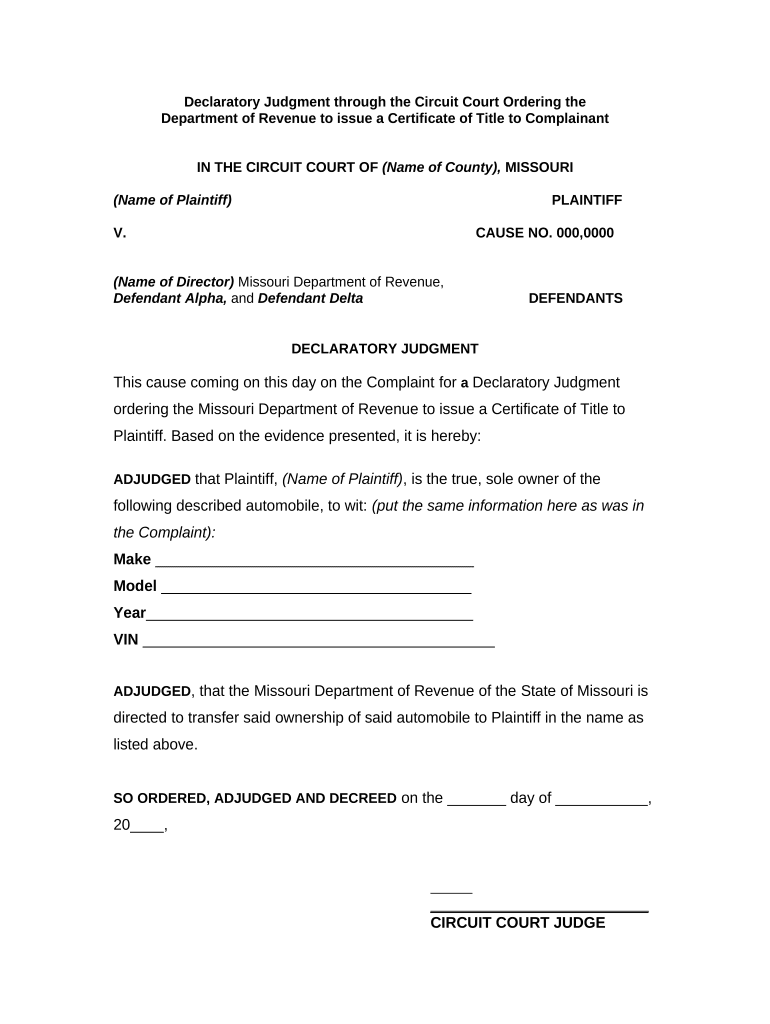
Missouri Declaratory Judgment for Certificate of Title

This template is fully customizable. Edit the text, fill out the fields, and send it for signature. Give it a try!
Missouri Declaratory Judgment for Certificate of Title

What the Missouri Declaratory Judgment for Certificate of Title Is

A Missouri Declaratory Judgment for Certificate of Title is a court filing used to obtain a judicial determination that clarifies ownership or clears defects on a vehicle title. Commonly filed in Missouri circuit court, the petition asks a judge to declare the proper owner or to direct the Department of Revenue or county titling office to issue or reissue a certificate of title. This remedy is used when the chain of title is unclear, when competing claims exist, or when a lien or salvage history prevents normal titling procedures.

Why this filing matters for title clarity

A declaratory judgment creates a public, enforceable court order resolving ownership disputes so titling agencies and third parties can rely on a clear record.

Why this filing matters for title clarity

Who typically prepares or benefits from this petition

Several parties may initiate or rely on a Missouri declaratory judgment for title purposes; the following profiles describe common filers and beneficiaries.

  • Vehicle buyers and sellers who discover title defects during closing or after purchase; they need a court order to clear ownership to complete transfer.
  • Finance companies, lienholders, or repossession agents seeking judicial confirmation to perfect or release security interests before or after sale.
  • Heirs or estate representatives who must clarify ownership when a titled vehicle is part of probate or when original title documents are missing.

Filing steps: how to prepare and submit the petition

Follow these sequential steps to assemble the petition, supporting proof, service materials, and filing requirements for Missouri circuit court.

  • 01
    Gather Records: Collect title, bill of sale, lien statements, and correspondence supporting your ownership claim.
  • 02
    Draft Petition: State parties, VIN, factual history, and specific relief sought in clear, organized paragraphs.
  • 03
    Attach Evidence: Include certified copies, affidavits, and notarized statements that corroborate chain of title.
  • 04
    File & Serve: File with circuit court clerk and serve respondents per Missouri civil procedure rules.

From filing to title issuance: the procedural flow

A typical case moves from petition filing through adjudication to issuance or administrative recording; each stage affects timing and next steps.

  • File Petition: Petitioner files complaint and pays court filing fee to the circuit court clerk.
  • Service of Process: Respondents are served and given time to answer or appear.
  • Hearing / Evidence: Court schedules hearing; parties present evidence and testimony if required.
  • Judgment & Instructions: Court issues declaratory judgment and may direct titling agency to issue certificate.

Digital workflow setup for completing the form reliably

Use a clear, auditable digital workflow for document completion, notarization, and court-ready export to reduce errors and speed processing.

Field Configuration
Name Field Auto-validate against ID; require full legal name
VIN Field Fixed-length validation (17 chars) with checksum hint
Date Fields Require MM/DD/YYYY and auto-format entries
Attachments Require PDF uploads for title, bill of sale, and lien release

Technical considerations for e-filing and e-signing

Confirm platform capabilities and file formats before collecting signatures or preparing court-ready bundles.

  • File Formats: PDF, DOCX supported
  • Audit Trail: IP, timestamp, signer audit
  • Notary Options: Remote and in-person supported

Security and compliance features relevant to electronic submission

In-transit Encryption: TLS 1.2/1.3
At-rest Encryption: AES-256
Major Certifications: ISO 27001, SOC 2 Type II
Healthcare Compliance: HIPAA (BAA available)
Regulatory Support: 21 CFR Part 11 compliant
Privacy Frameworks: GDPR, CCPA compliant

Consequences of incorrect or incomplete filings

Dismissal Risk: Court may dismiss petition for insufficient evidence
Delay in Title: Titling agency may refuse issuance pending clarification
Financial Costs: Additional filing and attorney fees accrue
Unresolved Liens: Liens may remain on title without proper releases
Perjury Exposure: False affidavits may trigger criminal liability
Future Claims: Incomplete orders invite subsequent ownership disputes

Common mistakes to avoid

  • Using an incorrect VIN or truncated title numbers that prevent matching records.
  • Failing to include or notarize required affidavits, causing evidentiary objections.
  • Not serving all potential respondents, which can lead to default judgments being set aside.
  • Relying on unsigned or undated supporting documents that the court may discount.

Practical tips for accurate, efficient completion

Small process controls reduce rework and speed court and titling outcomes; adopt consistent naming, validation, and evidence-check steps.

Verify Critical Data
Confirm VIN, names, and dates against original documents and government records before filing to avoid mismatches.
Organize Exhibits
Number and label attachments clearly and reference them in the petition for straightforward judicial review.
Document Service
Use certified mail or process server and retain proof of service to meet procedural requirements.
Consider Counsel
Consult a title attorney when multiple liens, salvage histories, or cross-jurisdictional issues exist.

Illustrative scenarios where a declaratory judgment resolved title issues

Two anonymized examples show how courts have cleared title problems and enabled issuance of certificates of title.

Private Purchase Dispute

A buyer discovered a lien after purchase and could not transfer title

  • The buyer filed a declaratory judgment and produced a bill of sale plus lien release evidence
  • The court declared ownership and ordered the state to issue a new certificate, enabling resale and closing without further lien encumbrances.

Heirship and Missing Title

An estate lacked a physical certificate and multiple heirs claimed ownership

  • The personal representative petitioned the court with affidavits and probate documentation
  • The court declared the representative authorized to obtain a certificate of title and directed the motor vehicle office to reissue title to the estate.

eSignature vendor pricing and capability snapshot for document signing

Compare common vendor starting prices and core capabilities relevant to signing and managing court-bound documents; signNow is listed first per platform comparison standards.

signNow DocuSign Adobe Sign PandaDoc HelloSign
Starting Price $8/user/mo $15/user/mo $14/user/mo $19/user/mo $15/user/mo
Free Trial 7-day free trial No No Yes, limited Yes, limited
Bulk Send Yes Yes Yes Yes No
Audit Trail Yes Yes Yes Yes Yes
HIPAA Compliant Yes Yes Yes No No

Frequently asked questions about preparing and filing this petition

Answers to key procedural and evidentiary questions commonly encountered when seeking a declaratory judgment for a certificate of title.


Need help? Contact support

be ready to get more
Join over 28 million airSlate SignNow users