Claimant Information
Provide the claimant’s full legal name, business entity type, mailing address, and contact information to ensure proper service and identification.
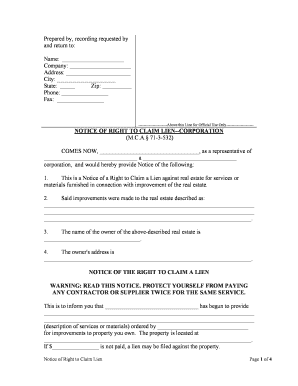
Filing protects payment rights, preserves priority against other creditors, and creates public notice of your claim. A properly prepared lien is a prerequisite to lien enforcement and foreclosure in many cases.

Common filers include contractors, subcontractors, suppliers, and property owners asserting or defending claims.
Different roles have distinct notice and service obligations; confirm statutory steps and deadlines before filing.
A contracting entity that hires or supervises work, often responsible for tracking subcontractor notices and filing liens if the contractor or its subs remain unpaid. The contractor typically compiles support documentation and obtains signatures.
An individual or company (subcontractor, supplier, or lender) asserting the lien; responsible for preparing accurate claimant details, the basis of the claim, amount claimed, and any required pre-filing notices.
Provide the claimant’s full legal name, business entity type, mailing address, and contact information to ensure proper service and identification.
Include the full legal description or parcel number exactly as it appears in county records to avoid recording rejections and to preserve priority.
State the precise dollar amount owed; itemize unpaid invoices or retain a supporting annex to substantiate the figure if required.
Describe the work performed or materials supplied, reference the controlling contract or purchase orders, and note relevant dates of performance.
Designate an authorized signer with title and date; include notary or RON acknowledgment if the county or statute requires notarization.
Record the county clerk recording information, book/page or instrument number, and the date recorded for chain‑of‑title clarity.
Use an e-signature platform that supports necessary authentication, notarization workflows, and file formats accepted by the county recorder.
Confirm the county recorder’s accepted file format and whether remote online notarization (RON) or scanned PDF filings are permitted; choose a platform with audit trails and optional advanced signer authentication when chain of title is at stake.
Compile support documents and complete the lien form prior to filing
File with the county clerk or recorder; processing can take days to weeks
Serve owner and other required parties according to statute after recording
Title companies and lenders may flag recorded liens during transactions
If unpaid, consider foreclosure or suit per state enforcement rules
A small real estate operator digitized lien forms to avoid travel and speed processing.
A service provider standardized templates and signature flows to reduce errors.
| signNow | DocuSign | Adobe Sign | PandaDoc | HelloSign | |
|---|---|---|---|---|---|
| Starting Price | $8/user/mo | $15/user/mo | $14/user/mo | $19/user/mo | $15/user/mo |
| Free Trial | 7-day free trial, no credit card | Varies | Varies | Varies | Varies |
| Bulk Send | Yes | Yes | Yes | Yes | No |
| Audit Trail | Yes | Yes | Yes | Yes | Yes |
| HIPAA Compliant | Yes | Yes | Yes | No | No |