Establishing secure connection…Loading editor…Preparing document…

Montana Motion

This template is fully customizable. Edit the text, fill out the fields, and send it for signature. Give it a try!
Montana Motion

What a Montana Motion Is and when it’s used

The Montana Motion is a formal written request filed in a Montana state court asking the judge to take specific action in a pending case, such as granting relief, setting a hearing, or modifying an order. Motions typically state the requested relief, summarize relevant facts, cite legal authority, attach supporting exhibits, and include a proposed order for the judge to sign. Parties must follow Montana Rules of Civil Procedure and any local court rules for formatting, service, and filing method when submitting a motion.

Why Preparing a Clear Montana Motion Matters

A well-structured Montana Motion focuses the court on the relief sought, frames the legal and factual issues, and can resolve disputes without a full trial. Clear motions improve the judge’s ability to rule promptly and reduce risk of procedural rejection or sanctions.

Why Preparing a Clear Montana Motion Matters

Who commonly prepares or responds to Montana Motions

Parties involved include attorneys, self-represented litigants, and court personnel responsible for intake and docketing.

  • Plaintiffs and defendants filing or opposing requests for relief in civil and family courts.
  • Attorneys of record drafting legal arguments and arranging exhibits and proposed orders.
  • Court clerks and docketing staff managing filing, service, and hearing scheduling.

Each participant has distinct responsibilities for formatting, serving, and preserving proof of filing to meet procedural requirements.

Who can sign and certify the Motion

Attorney of Record

An attorney who appears in the case signs motions, certifies factual assertions, and verifies compliance with local rules; the signature binds the attorney under professional conduct rules and authenticates service.

Self-Represented Party

A party without counsel may sign and file a motion on their own behalf, must follow the same procedural rules, and is responsible for proper service and accuracy of factual statements.

Essential elements to include in a professional Montana Motion

A motion should be concise and include standard courtroom elements so the judge and opposing party can quickly identify the request and supporting basis.

Caption

A complete case caption lists the court name, parties, docket number, and title of the motion so the document is properly filed and associated with the case record.
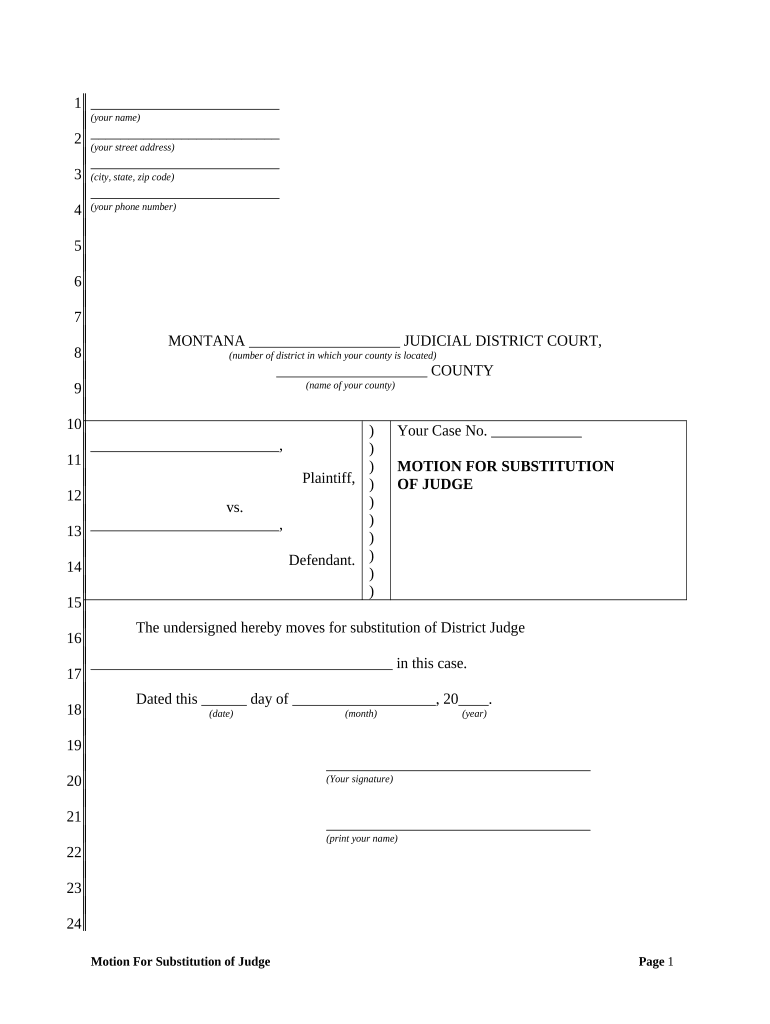
Statement of Relief

Clearly state the specific relief you request, whether temporary or final, and include precise language that the proposed order will implement if the court grants the motion.

Statement of Facts

Provide a concise factual summary focused on matters relevant to the motion; cite admissible evidence and attach exhibits that corroborate the facts asserted.

Legal Argument

Explain the legal basis for relief with citation to controlling statutes or case law, applying law to the facts and addressing foreseeable counterarguments.

Exhibits

Attach numbered exhibits such as affidavits, declarations, contracts, or other evidence; refer to exhibit numbers in the motion and avoid excessive or irrelevant attachments.

Proposed Order

Include a separate proposed order in the format preferred by the court that the judge can sign to implement the motion’s requested relief without further drafting.

Required information and essential fields

Case Caption: Party names and docket number
Title of Motion: Clear short descriptive title
Relief Requested: Specific remedy or order requested
Signature Block: Signer name, bar number, contact
Service Statement: How and when opposing parties were served
Exhibit Index: List and exhibit identifiers

Step-by-step: preparing and filing a Montana Motion

Follow these core steps to prepare a compliant motion and ensure timely filing and proper service under local rules.

  • 01
    Draft the Motion: Assemble caption, facts, legal argument, and proposed order.
  • 02
    Attach Exhibits: Number and reference exhibits inline with the facts and assertions.
  • 03
    Sign and Date: Ensure signature block and service certificate are complete.
  • 04
    File and Serve: Submit to court clerk or e-filing system and serve opposing parties.

Where to file and how to serve a Montana Motion

Motions are filed with the appropriate court clerk and must be served on opposing parties using permitted methods under state and local rules.

  • County Clerk Filing: File in person or by mail according to clerk’s office procedures.
  • Electronic Filing: Use the court’s e-filing portal where available for immediate docketing.
  • Mail or Hand Service: Serve parties by first-class mail or personal delivery where authorized.
  • Electronic Service: Serve by approved electronic means if the recipient consents or rules allow it.

Configuring an online motion workflow

When using an e-filing or e-signing platform, set up fields and routing to match court and service requirements.

Field Configuration
Caption Field Populate from case metadata for consistency
Signature Field Require signer name, date, and attorney bar number
Exhibit Upload Attach as separate numbered files
Service Notice Auto-generate service certificate with timestamps

Digital signing and e-submission considerations

Electronic workflows must produce a court-ready PDF and preserve an audit trail showing who signed, when, and how.

  • File Formats: PDF and DOCX accepted by most e-filing systems
  • Audit Trail: Timestamp, IP, and signer attribution required for proof
  • Integrations: Connectors for case management and cloud storage simplify filing

Verify the court’s e-filing format and signing preferences before submission to prevent rejection or reformatting delays.

Representative e-signature pricing and capability comparison

Common vendor pricing and feature distinctions relevant to preparing and circulating motions; signNow is shown first for comparison purposes.

signNow DocuSign Adobe Sign PandaDoc HelloSign
Starting Price $8/user/mo $15/user/mo $14/user/mo $19/user/mo $15/user/mo
Free Trial 7-day free trial Vendor trial varies Vendor trial varies Vendor trial varies Vendor trial varies
Bulk Send Yes (Business Premium) Yes Yes Yes No
Audit Trail Yes Yes Yes Yes Yes
HIPAA Compliant Yes Yes Yes No No

Common mistakes to avoid when preparing a Montana Motion

  • Failing to include a proposed order or not labeling exhibits clearly, which can slow court action and require refiling.
  • Using informal or argumentative language in the facts section instead of presenting concise, admissible evidence.
  • Missing service requirements or failing to file a certificate of service, causing jurisdictional defects and delays.
  • Ignoring local rules on page limits, font size, or required filing covers that can lead to procedural rejection.

Risks and possible consequences of incorrect or late motions

Motion Denial: Judge may deny relief
Sanctions: Court may impose monetary or other sanctions
Case Delay: Proceedings may be postponed
Refile Requirements: Must correct and refile
Loss of Rights: Missed deadlines can waive issues
Increased Costs: Additional attorney and filing fees

Practical examples of common Montana Motions

Two illustrative scenarios show how motions are used to resolve discrete issues without a full trial.

Discovery Dispute

A party files a motion to compel production after informal requests fail

  • The motion cites discovery rules and lists missing documents
  • The court orders production and allocates costs while setting a new production schedule to avoid trial delays.

Temporary Restraining Order

A requester seeks emergency relief to prevent irreparable harm before a hearing

  • The motion includes sworn affidavit evidence and a proposed order
  • If the court finds imminent harm, it issues a short-term restraining order and schedules a prompt hearing on a preliminary injunction.

Practical tips for accurate and efficient motion drafting

Adopt consistent formatting, anticipate opposing arguments, and verify filing and service protocols to minimize procedural setbacks.

Use a clear structure
Organize the motion with a short introduction, statement of facts, legal argument, and a concise conclusion stating the precise order requested so judges can quickly grasp the relief sought.
Cite controlling authority
Support legal positions with a focused set of statutes or cases directly on point, and avoid overloading the motion with long, tangential citations that obscure the core argument.
Attach admissible evidence
Provide sworn declarations or authenticated documents as exhibits, referencing them in the facts and ensuring each exhibit is Bates-stamped or clearly labeled for the record.
Confirm service and filing rules
Check local court rules for e-filing requirements, service methods, and page limits before submission to prevent rejections and preserve hearing dates.

Frequently asked questions about Montana Motions

Answers to common procedural and technical questions about drafting, signing, and filing motions in Montana courts.


Need help? Contact support

be ready to get more
Join over 28 million airSlate SignNow users