Case caption
Full court name, case number, and party names must match court filings so the subpoena ties to the correct proceeding and docket entry.
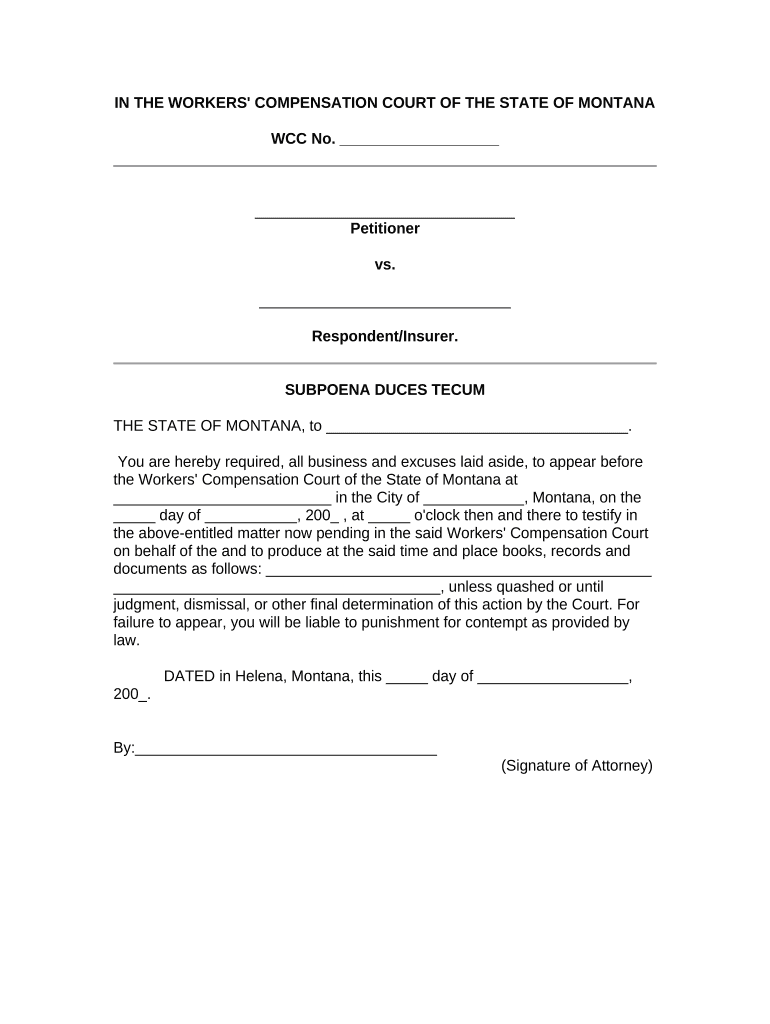
A correct subpoena ensures enforceability, limits grounds for quashal or motion practice, and clarifies the scope of requested testimony or documents so recipients can comply efficiently and preserve privileges when necessary.

Typical issuers and recipients vary by matter type; below are common participant profiles.
Understanding these roles helps you choose correct service methods, prepare supporting affidavits, and anticipate objections or protective order requests.
Full court name, case number, and party names must match court filings so the subpoena ties to the correct proceeding and docket entry.
Name and title of issuing attorney, judge, or clerk plus bar or court identification clarifies authorization to issue process and helps recipients verify legitimacy.
Specify appearance, testimony, or production of documents. Use precise language to avoid overbroad requests and to describe permitted form (originals, copies, certified).
List documents with dates and clear identifiers (e.g., 'email correspondence between X and Y, 01/01/2020–12/31/2020') to focus compliance and reduce objections.
State who will effect service, acceptable delivery methods, and any required proof of service or return of the subpoena to the issuing party or court clerk.
Provide a firm date/time for appearance or production and describe how to request an extension or file objections to avoid default or contempt risks.
| Field | Configuration |
|---|---|
| Authentication method | Email link with SMS code or stronger KBA |
| Delivery method | Personal service, registered mail, or process server |
| Notary option | In-person notary or RON if allowed |
| Audit trail | Capture IP, timestamps, and signer details |
Ensure your eSignature provider supports required formats, secure authentication, and retention to meet court expectations.
Use platforms that preserve an unalterable audit trail, store signed records securely, and export court-ready copies to streamline filings and proof of service.
| signNow | DocuSign | Adobe Sign | PandaDoc | HelloSign | |
|---|---|---|---|---|---|
| Starting Price | $8/user/mo | $15/user/mo | $14/user/mo | $19/user/mo | $15/user/mo |
| Free Trial | 7-day free trial | No | No | Yes, limited | Yes, limited |
| Bulk Send | Yes | Yes | Yes | Yes | No |
| Audit Trail | Yes | Yes | Yes | Yes | Yes |
| HIPAA Compliant | Yes | Yes | Yes | No | No |
A plaintiff seeks transaction records between parties for a damages claim
An agency issues a subpoena for compliance documentation in an industry audit
Serve as soon as practicable before the compliance date to allow adequate response time.
Many subpoenas set production deadlines of 7–21 days, though exact timing depends on scope and court rules.
Recipients should object or move to quash promptly to preserve rights; local practice often governs timeliness.
File proof of service with the clerk promptly after service to document compliance attempts.
If ignored, seek enforcement or contempt after giving the court notice and opportunity to be heard.
Prepare subpoena with precise scope and review for privilege and relevance.
Issuer signs and obtains any required court authorization.
Effect service using permitted methods and document proof of service.
File motions to compel or motions to quash as necessary, then seek court enforcement if warranted.
An attorney of record or authorized counsel typically signs subpoenas on behalf of a party; their signature and contact information establish accountability and enable recipient questions about scope, service, or production.
In some instances the court clerk or judge may issue or endorse subpoenas by court order, providing direct judicial authorization that can streamline enforcement and reduce opportunities for challenge.