Establishing secure connection…Loading editor…Preparing document…

Motion Discovery Form

This template is fully customizable. Edit the text, fill out the fields, and send it for signature. Give it a try!
Motion Discovery Form

What the Motion Discovery Form Is and when it's used

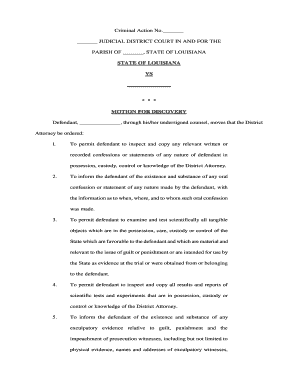
A Motion Discovery Form is a court filing used in civil litigation to request, compel, or schedule discovery-related actions such as document production, interrogatories, depositions, or protective orders. It typically accompanies a motion to compel or a discovery dispute and summarizes the relief sought, relevant parties, timeline, and supporting evidence. The form organizes the request so the court can evaluate scope, proportionality, and privilege issues. Different courts use local templates or e-filing portals that require specific fields for case caption, service information, and proposed order language.

Why a clear, compliant Motion Discovery Form matters

A well-prepared Motion Discovery Form reduces procedural risk, clarifies the relief requested, and helps the court resolve discovery disputes efficiently. Clear forms improve compliance with local rules, limit sanctions risk, and preserve arguments for appeal when necessary.

Why a clear, compliant Motion Discovery Form matters

Who typically prepares and files this form

The Motion Discovery Form is regularly prepared by litigation counsel, paralegals, and litigation support staff prior to filing with the court or serving opposing counsel.

  • Litigation attorneys handling civil disputes and discovery strategy.
  • Paralegals and litigation assistants who assemble exhibits and timelines.
  • Court clerks and e-filing administrators who process submissions.

Smaller firms and individual litigants also use the form; when filing pro se, consult local court rules and clerk guidance before submission.

Representative users who sign or certify the form

Lead Counsel

A licensed trial attorney or supervising partner who certifies the motion, signs declarations, and attests to good-faith meet-and-confer efforts. This person is responsible for ensuring factual accuracy, attaching supporting exhibits, and serving opposing counsel in compliance with court rules.

Paralegal Supervisor

Paralegals often prepare the form, compile exhibits, check citation and local-rule compliance, and manage e-filing or physical service logistics. They coordinate calendaring and ensure responses deadlines are calculated correctly for service and filing.

Core sections a professional Motion Discovery Form should include

A complete form groups related information so judges and clerks can act quickly. Standard sections reduce back-and-forth and demonstrate compliance with meet-and-confer obligations and local rules.

Case Caption

Court name, case number, and party names placed exactly as on the complaint and docket to ensure the filing is associated with the correct case.
Relief Sought

Clear statement of the discovery relief requested (e.g., compel production, extend deadlines, protective order) with precise scope and date ranges.

Good-Faith Effort

A concise description of meet-and-confer attempts, dates, and outcomes to demonstrate compliance with local pre-filing requirements.

Supporting Evidence

Exhibit list and attachments (correspondence, discovery responses, privilege logs) labeled and referenced in the motion text for easy review.

Proposed Order

A short, ready-to-sign order showing the exact relief and timeline requested, formatted per local rule and supplied as a separate file if required.

Certificate of Service

A signed statement noting service method, date, recipients, and addresses that meets the court's service rules.

Step-by-step: preparing and filing a Motion Discovery Form

Use a consistent sequence to prepare, serve, and file the motion to meet procedural and service deadlines.

  • 01
    Assemble Documents: Collect discovery responses, correspondence, and privilege logs.
  • 02
    Draft Motion: Describe relief, facts, and legal basis concisely.
  • 03
    Meet and Confer: Attempt resolution and record efforts.
  • 04
    Serve and File: Serve opposing counsel then e-file per local rules.

Configuring an online workflow for Motion Discovery submissions

When using an e-filing or eSignature platform, set up routing, authentication, and attachments in advance to streamline filings.

Field Configuration
Recipient Order Set signing order: preparer → lead counsel → filer.
Authentication Use email-plus-SMS or firm SSO for attorney verification.
Conditional Fields Show exhibits or dates only when relevant to reduce errors.
Attachments Handling Require exhibit labeling and PDF/A when court requires archival format.

Where to send, how to serve, and where to file

Motion Discovery Forms are served on opposing counsel and filed with the clerk; some courts require simultaneous e-service and e-filing through a portal.

  • Serve Opposing Counsel: Use the method specified by local rules (email, e-service portal, or mail).
  • E-File with Court: Submit via the court's electronic filing system or approved vendor.
  • Provide Proposed Order: Upload a separate proposed order if the court requests it.
  • Certificate of Service: File or attach a certificate stating how and when service occurred.

How digital platforms support Motion Discovery workflows

Use an e-filing or eSignature solution that supports required file formats, role-based signing, and secure storage to meet court and client expectations.

  • Integrations: Connectors for case management and cloud storage (Salesforce, NetSuite, Box)
  • File Formats: Supports PDF, DOCX, and PDF/A for archival submissions
  • Authentication: Options for email, SMS codes, and SAML/SSO verification

Ensure the platform records an audit trail (timestamps, IP, signer identity) and meets applicable compliance standards for client confidentiality and evidentiary support.

Common timelines and deadline considerations

Deadlines for responses and hearings vary by jurisdiction; plan service and filing to allow opposing counsel statutory response time plus any local notice periods.

Response Window:

Typically 21–30 calendar days to respond to discovery motion filings.

Hearing Notice:

Local rules often require several days' notice before a hearing date.

Service Deadline:

Service must precede filing or meet the court's simultaneous-service rule.

Extension Requests:

File stipulated extensions promptly to avoid default or sanctions.

Preservation Duty:

Preserve relevant evidence from the time litigation is reasonably anticipated.

Key milestones in a discovery motion timeline

Track these numbered stages from dispute onset through court ruling to ensure timely filings and responses.

01

Drafting and Review

Prepare motion and exhibits, obtain internal approvals before service.

02

Meet-and-Confer

Attempt resolution and document communications for the court.

03

Filing and Service

File with the court and serve opponents per local practice.

04

Opposition and Hearing

Opposing party files response; court schedules hearing and issues ruling.

Common preparation errors to avoid

  • Using an incorrect case caption or docket number, which can result in the clerk rejecting or misplacing the filing and delaying proceedings.
  • Failing to document or describe meet-and-confer efforts adequately, which can lead to motions being denied as premature or noncompliant.
  • Attaching voluminous exhibits without indexing or references, creating administrative burden and reducing the likelihood the court will review key items promptly.
  • Missing local rule formatting requirements (margins, page limits, line spacing), which can result in chambers striking portions or ordering re-filing.

Penalties and procedural risks for incorrect filings

Sanctions: Monetary fines or cost-shifting orders.
Denial of Motion: Court may dismiss or deny relief.
Waiver: Failure to timely assert objections can waive rights.
Rejection: Clerk may refuse defective filings.
Delay: Erroneous filings often delay case progress.
Credential Risk: Improper e-signatures may be challenged.

Essential information and metadata to include

Case Number: Exact docket number
Filing Court: Court name and division
Party Names: Full legal names
Exhibit IDs: Sequential exhibit numbers
Service List: Recipient names and addresses
Signature Date: MM/DD/YYYY format

Real-world examples of digital workflows supporting discovery motions

Practices and teams have used electronic signing and document routing to streamline discovery motions and recordkeeping in high-volume litigation.

Optica Ventures LLC

Their legal team standardized discovery forms and exhibit labeling to reduce clerk rejections.

  • They used a centralized workflow to manage responses.
  • The change reduced administrative rework and improved consistency across cases while preserving audit trails for each production.

BIS

BIS adopted an e-filing and e-sign workflow for discovery motions to maintain compliance.

  • They emphasized SOC 2 and ESIGN compliance.
  • That approach helped them demonstrate chain-of-custody for electronic exhibits and reduced time to serve and file contentious motions.

How a Motion Discovery Form differs from a civil subpoena

These documents serve related but distinct functions in discovery. The table highlights practical contrasts relevant to preparation and enforceability.

Criteria Motion Discovery Form Subpoena (civil)
Purpose judge-ordered relief request command to produce or testify
Issuer filed by party to court issued by court or clerk on request
Service Method serve counsel per local rule direct service to witness or entity
Enforceability requires court order to compel court-enforceable subpoena power

Sample eSignature vendor comparison for Motion Discovery workflows

This comparison highlights starting price and select capabilities relevant to document-intensive legal workflows. signNow appears first by design and includes available plan indicators.

signNow DocuSign Adobe Sign PandaDoc HelloSign
Starting Price $8/user/mo $15/user/mo $14/user/mo $19/user/mo $15/user/mo
Free Trial 7-day free trial No No Yes, limited Yes, limited
Bulk Send Yes Yes Yes Yes No
Audit Trail Yes Yes Yes Yes Yes
HIPAA Compliant Yes Yes Yes No No

Frequently asked questions about completing and submitting Motion Discovery Forms

Answers below address common procedural, service, and e-filing questions litigants encounter when using Motion Discovery Forms.


Need help? Contact support

be ready to get more
Join over 28 million airSlate SignNow users