Precise Scope
Define custodians, date ranges, file types, and specific search terms to limit disputes over scope and undue burden.
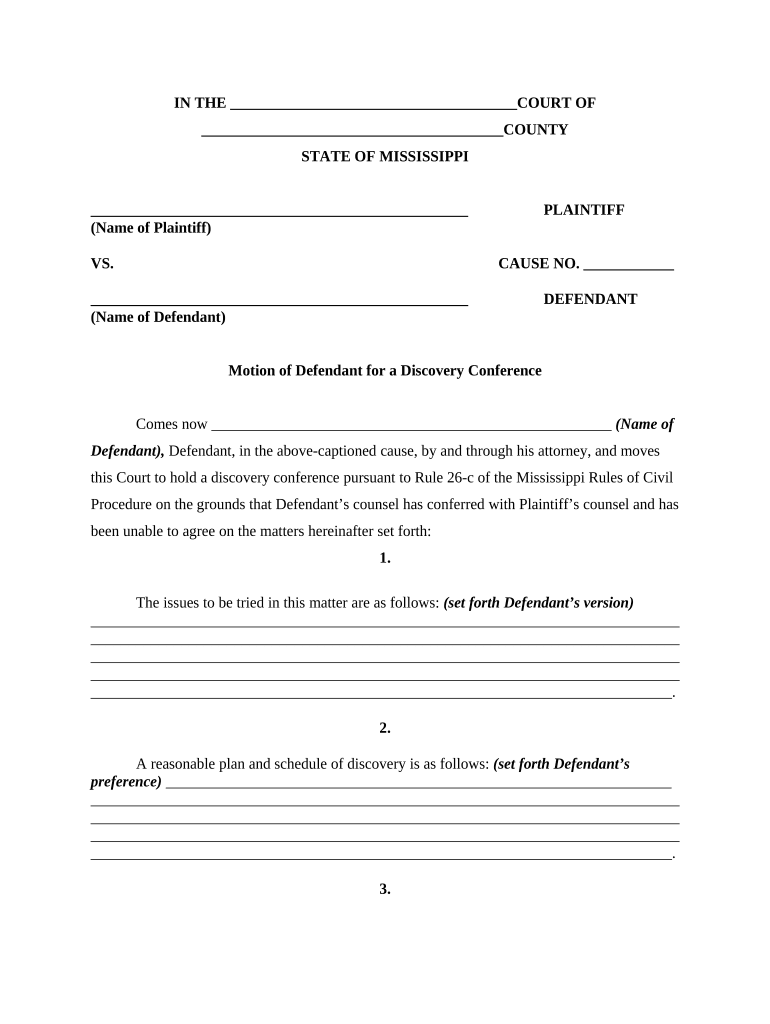
A well-drafted Motion for Discovery narrows disputes, preserves evidence, and positions your case for informed motion practice or settlement. It reduces friction by framing requests to match court rules and by anticipating privilege and burden objections.

The Motion for Discovery is prepared by litigation counsel or parties representing themselves to obtain evidence needed for case preparation.
| Field | Configuration |
|---|---|
| Signature Block | Signer name, title, and date required |
| Reviewer Role | Assign read/edit access to counsel only |
| Audit Trail | Enable full event logging and timestamps |
| Storage Path | Save signed PDF to case folder and clerk upload folder |
Confirm your eSignature platform supports secure PDF export, audit trails, and court-accepted formats before proceeding.
Follow dates set in the court's scheduling order; they control discovery timing.
Many courts require a pre-motion meet-and-confer period before filing.
Opposing parties typically have a set period (often 14–30 days) to respond.
Request a hearing if required; allow local notice time per court rules.
Serve motion and exhibits per the method and timeframe required by local rules.
Prepare the motion and supporting exhibits; confirm meet-and-confer attempts.
File with the clerk and serve all parties; obtain proof of service.
Receive responses and file reply briefs within local deadlines.
Court rules, holds hearing, or issues order granting or denying relief.
| Criteria | Motion for Discovery | Subpoena |
|---|---|---|
| Who Issues | party to case | court or clerk |
| Targets | parties to litigation | third parties or parties |
| Enforceability | subject to court order | enforceable by subpoena power |
| Service | per local rules | statutory service methods |
Define custodians, date ranges, file types, and specific search terms to limit disputes over scope and undue burden.
Explain why the requested discovery is proportional to the needs of the case considering importance, resources, and burden.
Address privilege and propose a logging procedure or in-camera review if privileged materials may be responsive.
Specify formats, metadata preservation, and search or sampling methods for electronically stored information.
Offer a protective order or redaction protocol to make discovery acceptable for sensitive business or personal information.
State how and when service was made and include proof to satisfy court filing requirements and preserve deadlines.
Plaintiff seeks email chains and invoices to prove breach
Defense requests medical billing and repair records to test damages
Partner at law firm responsible for drafting discovery motions, supervising ESI collection, and certifying meet-and-confer efforts on behalf of the client.
Paralegal managing document assembly, metadata export, and service logistics while coordinating with outside counsel and IT for ESI preservation.
| signNow | DocuSign | Adobe Sign | PandaDoc | HelloSign | |
|---|---|---|---|---|---|
| Starting Price | $8/user/mo | $15/user/mo | $14/user/mo | $19/user/mo | $15/user/mo |
| Free Plan | 7-day trial | No | No | Yes, limited | Yes, limited |
| Bulk Send | Yes | Yes | Yes | Yes | No |
| Audit Trail | Yes | Yes | Yes | Yes | Yes |
| HIPAA Compliant | Yes | Yes | Yes | No | No |