Establishing secure connection…Loading editor…Preparing document…

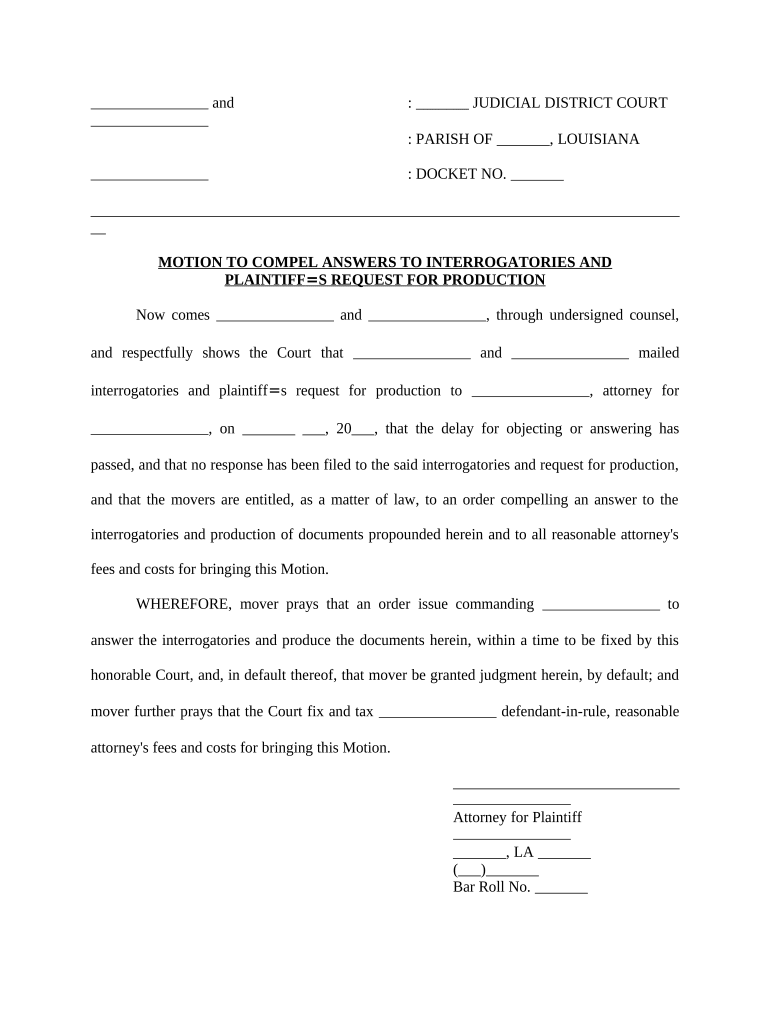
Motion to Compel Answers to Interrogatories and Plaintiff's Request for Production

This template is fully customizable. Edit the text, fill out the fields, and send it for signature. Give it a try!
Motion to Compel Answers to Interrogatories and Plaintiff's Request for Production

What this Motion and Request for Production are

A Motion to Compel Answers to Interrogatories and Plaintiff's Request for Production is a civil litigation filing that asks the court to order an opposing party to answer discovery (interrogatories) and produce requested documents. Typically used when responses are incomplete, evasive, or overdue, the motion documents the outstanding discovery, summarizes efforts to resolve the dispute, and asks for specific relief such as compelled responses, document production, evidentiary sanctions, or fee-shifting. Federal practice is governed by the Federal Rules of Civil Procedure (see Rules 33, 34, and 37) and many states have parallel rules and local meet-and-confer requirements.

Why filing a clear, focused motion matters

A precise motion narrows disputed issues, preserves record for appeal, enforces discovery obligations, and can recover reasonable expenses under Rule 37. A well-documented motion reduces the chance of denial and supports targeted remedies such as ordered production, compelled interrogatory answers, or monetary sanctions.

Why filing a clear, focused motion matters

Who prepares and who uses this motion

Typical users include litigation counsel, paralegals, and self-represented plaintiffs who need to enforce discovery obligations in civil cases.

  • Plaintiff counsel and litigants who need court enforcement of discovery obligations
  • Paralegals and litigation teams preparing supporting exhibits and meet-and-confer proof
  • Self-represented parties who must document efforts and present legal grounds clearly

The motion is filed in the court where the case is pending; local rules and court procedures determine the precise filing steps and timing.

Core parts of a professional motion and request package

A complete filing bundles a short, neutral statement of issues, concrete references to interrogatory numbers and production requests, evidence of meet-and-confer attempts, legal authority, and a proposed order. Each component should be concise, factual, and supported by exhibits or correspondence.

Case Caption

Court name, parties, docket number, and title of the motion; must match the main complaint caption exactly and be placed on a separate caption page.
Background Facts

Brief chronology of discovery requests and responses identifying dates, the exact interrogatory or request numbers, and materiality to the claims or defenses.

Meet-and-Confer Summary

Concise record of efforts to resolve the dispute (emails, letters, calls) with dates and outcomes; required by many jurisdictions and FRCP 37 certification practices.

Legal Argument

Cite controlling rules and case law; explain why responses are deficient and why court relief is warranted under FRCP 37 or state equivalents.

Requested Relief

Specify the precise order sought (complete answers by date, production of specified documents, cost shifting, or limited sanctions).

Proposed Order

Attach a short, fillable proposed order the judge can sign that sets deadlines and any consequences for noncompliance.

Step-by-step: preparing and filing the motion

Follow a clear sequence to preserve rights and improve chances of relief: verify deadlines, document efforts, prepare exhibits, and serve the motion per court rules.

  • 01
    Gather Records: Collect original requests, responses, and correspondence; label exhibits clearly.
  • 02
    Draft Motion: State deficiencies, cite authority, and propose specific relief and deadlines.
  • 03
    Certify Meet-and-Confer: Include a concise certification describing in-person or written efforts to resolve the dispute.
  • 04
    File and Serve: File with the clerk and serve all parties following court and local rules.

Configure an online workflow for drafting and signatures

Set up a repeatable digital workflow for drafting, internal review, signing, and court e-filing to reduce errors and track deadlines.

Field Configuration
Document Template Pre-fill case caption and standard language to ensure consistency.
Exhibit Attachments Bind exhibits as separate PDF attachments and label them Exhibit A, B, etc.
Signing Order Set signer roles (drafting attorney, supervising counsel) and single-click signature fields.
E-file Package Package motion, exhibits, and proposed order into court-ready PDF for upload.

How filing and service typically proceed

A predictable filing flow reduces procedural mistakes: prepare the motion, attach exhibits, obtain signatures, file with the clerk, and serve opposing counsel.

  • Prepare: Draft motion and collect exhibits.
  • Sign: Attorney signs; include verification if required.
  • File: E-file or hand-file per court requirement.
  • Serve: Serve all parties and file proof of service.

Digital filing and e-signature considerations

Courts and opposing counsel increasingly accept electronic documents and e-signatures, but confirm local e-filing rules and signature formats before submission.

  • File Formats: PDF/A preferred for court filings.
  • Integrations: Connectors to e-filing or document management systems reduce manual errors.
  • Authentication: Use email or multi-factor authentication for signer attribution.

Confirm the court's e-filing clerk and local rules about electronic signatures, embedded metadata, and any required proposed order formatting before submission.

Essential information to include in filings

Case Caption: Court and docket number
Party Names: Plaintiff and defendant exact names
Discovery IDs: Interrogatory and request numbers
Meet-and-Confer: Dates and participants
Requested Relief: Specific production or deadline
Proposed Order: Signed, fillable order

Potential consequences of errors or omissions

Motion Denied: Court may refuse relief
Sanctions: Monetary or evidentiary penalties possible
Costs Shifted: Court may award opposing fees
Waiver: Late objections may be waived
Record Gaps: Insufficient proof can harm appeal
Delay: Case schedule may be impacted

Common preparation mistakes to avoid

  • Failing to attach the original discovery requests and responses, leaving the court unable to verify the dispute and increasing the chance of denial.
  • Submitting vague or overly broad descriptions of requested documents rather than citing specific request numbers and categories that the court can enforce.
  • Skipping or under-documenting meet-and-confer efforts; many courts require a clear certification of good-faith efforts before accepting a motion.
  • Asking for overly broad relief without proposing narrow, time-limited production deadlines, which can make the motion seem punitive rather than corrective.

Key deadlines and procedural timeframes to track

Deadlines depend on federal or state rules; confirm local rules and FRCP provisions that set response and motion procedures.

Interrogatory Response Time:

30 days under FRCP 33(b)(2) unless court orders otherwise

Production Response Time:

30 days under FRCP 34(b)(2)(A) for production or written objection

Meet-and-Confer Requirement:

FRCP 37(a) requires good-faith effort before filing a motion to compel

Motion Opposition Time:

Typically set by local rule; often 14 days to respond to a motion

Judge's Ruling:

Timing varies; courts may set expedited deadlines for discovery disputes

Milestone timeline for a discovery dispute

Sequence the dispute from request to court order so each milestone is documented and sequenced for the record.

01

Discovery Served

Requests and interrogatories served; response clock begins.

02

Responses Due

Opposing party must answer or object within the rule period.

03

Meet-and-Confer

Parties attempt good-faith resolution before motion filing.

04

Motion Filed

File motion with exhibits and proposed order if meet-and-confer fails.

Practical tips to improve the motion's clarity and effectiveness

Adopt disciplined drafting, precise exhibits, and documented meet-and-confer proof to increase the chance the court will grant targeted relief and fee awards.

Document Every Contact
Keep a dated log of emails, calls, and letters showing who participated and what was discussed; attach this log as an exhibit to prove good-faith efforts.
Be Specific and Narrow
Cite exact interrogatory numbers and request categories; request narrow deadlines for production to avoid appearing overbroad or punitive.
Propose Practical Orders
Offer a proposed order with concrete dates, search parameters, and custodial lists to make judicial approval simpler and more likely.
Preserve Confidentiality
When documents contain sensitive data, propose a protective order and redaction procedure to address privacy and regulatory concerns.

eSignature vendor comparison for motion preparation and signing

Compare baseline pricing and core features relevant to signing legal filings; signNow appears first per vendor ordering rules and supports common compliance requirements.

signNow DocuSign Adobe Sign PandaDoc HelloSign
Starting Price $8/user/mo $15/user/mo $14/user/mo $19/user/mo $15/user/mo
Free Trial 7-day free trial Varies by vendor Varies by vendor Varies by vendor Varies by vendor
Bulk Send Yes Yes Yes Yes No
Audit Trail Yes Yes Yes Yes Yes
HIPAA Compliant Yes Yes Yes No No

Frequently asked questions and practical answers

Answers to common questions cover e-signature validity, meet-and-confer proof, timeline concerns, and handling privileged material in discovery.


Need help? Contact support

be ready to get more
Join over 28 million airSlate SignNow users