Establishing secure connection…Loading editor…Preparing document…

Negotiable Instrument

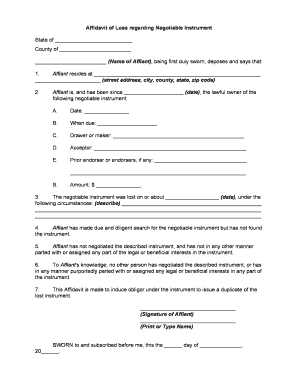
This template is fully customizable. Edit the text, fill out the fields, and send it for signature. Give it a try!
Negotiable Instrument

What a Negotiable Instrument Is and how it functions

A negotiable instrument is a written, transferable promise or order to pay a fixed sum of money to a named person or to bearer. Common U.S. examples include promissory notes, checks, and drafts. Negotiability means the instrument can be transferred by endorsement or delivery, allowing a subsequent holder to enforce payment. In the United States these instruments are governed by the Uniform Commercial Code's negotiable instruments principles and interact with electronic-record laws when executed digitally. Properly completed instruments create clear payment obligations and support commercial transfer and financing.

Why using a proper Negotiable Instrument matters

A correctly drafted and signed negotiable instrument clarifies payment obligations, facilitates transferability, and preserves enforcement rights for holders in due course. It supports commercial liquidity and predictable remedies under uniform commercial rules.

Why using a proper Negotiable Instrument matters

Who typically creates, endorses, or accepts negotiable instruments

Negotiable instruments are used across commercial, financial, and legal workflows where written payment obligations are required.

  • Lenders and finance teams: Banks, credit providers, and private lenders use promissory notes and drafts to document loan terms and repayment obligations.
  • Business payors and vendors: Companies issue checks or commercial drafts to settle invoices, payroll, or supplier payments in routine operations.
  • Legal and escrow professionals: Attorneys, escrow agents, and title companies handle endorsement, custody, and dispute resolution for instruments in transactions.

Key elements that make a Negotiable Instrument enforceable

A complete negotiable instrument contains several standard elements. Each element affects negotiability, transfer, and enforcement, so accuracy and clarity are essential.

Payor / Drawer

Identifies the party who owes payment. Use full legal name and business entity designation to avoid identity disputes and support bank processing.
Payee

Names who is entitled to receive payment. Specify 'payable to order' or 'payable to bearer' to control transferability and endorsement rules.

Unambiguous Amount

State the numeric amount and the amount written in words. Discrepancies create grounds for alteration claims and may delay payment.

Maturity / Due Date

Include issue date and due date where applicable. Date fields determine presentment, dishonor windows, and applicable statute of limitations.

Endorsement / Transfer

Specify endorsement lines or transfer instructions. Endorsement standards affect holder-in-due-course status and protection against defenses.

Signature

Signature of the obligor or authorized signer is required for enforceability. Signer identity and authority are central in forgery or agency disputes.

Step-by-step: drafting, signing, and transferring a Negotiable Instrument

Follow these sequential steps to create a complete instrument that preserves negotiability and minimizes processing friction.

  • 01
    Draft the instrument: Complete payor, payee, amount, and date fields accurately.
  • 02
    Verify signer authority: Confirm signatory can bind the paying party or entity.
  • 03
    Sign and date: Sign in the designated block and date the instrument.
  • 04
    Deliver or endorse: Deliver to payee or endorse for transfer according to instructions.

Where a Negotiable Instrument goes after execution

Understanding routing helps ensure timely payment and proper recordkeeping for holders and intermediaries.

  • Recipient delivery: Instrument delivered to payee or their agent for deposit or collection.
  • Bank presentment: Payee presents instrument to a bank for payment or collection.
  • Clearing and settlement: Banking networks process and settle funds between financial institutions.
  • Record retention: Banks and parties retain copies according to regulatory retention rules.

Digital signing and format considerations for negotiable instruments

When converting a negotiable instrument to an electronic record, confirm format, authentication, and retention meet legal and banking requirements.

  • Supported Formats: PDF, DOCX, or renderable HTML are recommended.
  • Integrations: Connect to systems like Salesforce, NetSuite, Box.
  • Authentication Options: Email, SMS code, or advanced multi-factor methods.

How negotiable instruments compare to similar payment documents

Compare key functional differences so you choose the correct instrument type for payment, credit, or transfer needs.

Criteria Promissory Note Check
Transferability negotiable by endorsement payable to order or bearer
Typical Parties maker, payee, holder drawer, payee, drawee (bank)
Primary Purpose loan or credit evidence immediate or scheduled payment
Enforcement context contractual enforcement bank presentment and clearing

Common risks and penalties from errors or misuse

Dishonor risk: Presentment refusal may cause fees and time-sensitive remedies.
Forgery risk: Unauthorized signatures can void enforceability and trigger fraud claims.
Alteration exposure: Changed amounts or dates may be contested and delay payment.
Endorsement errors: Improper endorsement can block transfer or lead to lost recovery rights.
Missing signature: Unsigned instruments lack enforceability against obligor.
Statute of limitations: Delay in presentment or suit may bar remedies under state law.

Key timing expectations and deadlines to observe

Timely presentment, notice of dishonor, and prompt endorsement protect holder rights and preserve remedies under commercial practice.

Presentment for payment:

Present within a reasonable time after issuance to avoid delay.

Notice of dishonor:

Notify endorsers promptly if payment is refused to preserve recourse.

Endorsement timing:

Endorse before or upon delivery to transfer holder status.

Bank processing windows:

Clearing and settlement follow banking cutoffs and network rules.

Legal action timing:

File suit within state statute of limitations to avoid forfeiture.

Representative eSignature vendor comparison for negotiating and signing instruments

Vendor pricing and basic feature availability vary; confirm plan details with each provider before selecting a solution for negotiable instruments.

signNow DocuSign Adobe Sign PandaDoc HelloSign
Starting Price $8/user/mo $15/user/mo $14/user/mo $19/user/mo $15/user/mo
Free Trial 7-day free trial Varies by vendor Varies by vendor Varies by vendor Varies by vendor
Bulk Send Yes Yes Yes Yes No
Audit Trail Yes Yes Yes Yes Yes
HIPAA Compliant Yes Yes Yes No No
Envelope Cap No cap 100 envelopes/user/year Varies Varies Varies

Frequently asked questions about Negotiable Instruments

Answers to common questions on electronic signing, endorsement, lost instruments, authority, and notarization to help avoid processing problems.


Need help? Contact support

be ready to get more
Join over 28 million airSlate SignNow users