Establishing secure connection…Loading editor…Preparing document…

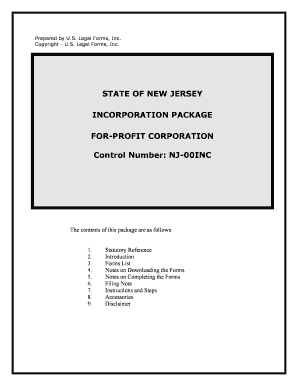
New Jersey Corporation

This template is fully customizable. Edit the text, fill out the fields, and send it for signature. Give it a try!
New Jersey Corporation

What a New Jersey Corporation is and what it does

A New Jersey Corporation is a business entity formed under the New Jersey Business Corporation Act to operate as a separate legal person. Formation begins when the Articles of Incorporation are filed with the New Jersey Division of Revenue and Enterprise Services and the state issues a filing receipt. The corporate form creates limited liability for shareholders, allows the issuance of stock, and supports structured governance through a board of directors and corporate bylaws. Corporations must comply with corporate formalities, file any required state reports, and meet tax obligations at federal and state levels.

Why choose the corporate form for a New Jersey business

Forming a New Jersey Corporation provides limited liability for owners, a clear governance framework for directors and officers, and flexibility to raise capital through stock issuance. It supports continuity beyond individual owners and may offer tax planning options and preferred standing for investors or lenders.

Why choose the corporate form for a New Jersey business

Who typically forms a New Jersey Corporation

Common users include founders pursuing outside investment, professional service firms, and owners seeking limited liability and a formal governance structure.

  • Startup founders seeking venture funding and stock-based equity
  • Small to mid-size businesses needing a formal board and stock structure
  • Professional firms and service providers requiring corporate liability protection

Roles involved in incorporation and early governance

Founder / CEO

A founder or CEO typically prepares incorporation information, selects the registered agent, and leads the initial organizational meeting where bylaws are adopted and the first directors are named.

Registered Agent

The registered agent accepts official service of process in New Jersey. This role can be an individual or business entity authorized to receive legal notices during normal business hours.

Essential information required in the filing

Entity name: Exact legal name as filed
Registered agent: Name and New Jersey address
Incorporator: Name of person filing articles
Authorized shares: Number and classes
Business purpose: General or specific purpose
Principal office: Street, city, state, ZIP

Common penalties and legal risks to avoid

Administrative dissolution: Failure to file state reports
Loss of limited liability: Ignoring corporate formalities
Tax assessments: Unfiled federal or state returns
Late fees: Missed state deadlines
Civil exposure: Improper contracts or disclosures
Regulatory fines: Noncompliance with industry rules

Frequent mistakes when preparing New Jersey corporate filings

  • Using an informal or unreserved company name that conflicts with another registered entity and causes rejection or delay.
  • Failing to appoint a compliant registered agent with a New Jersey street address, which can result in missed service and default judgments.
  • Omitting authorized share details or leaving par value ambiguous, creating uncertainty for investors and downstream filings.
  • Neglecting to adopt bylaws and hold the organizational meeting, which undermines governance and can risk veil protection.

Step-by-step: forming a New Jersey Corporation

Follow these core steps to prepare and file articles, adopt governance documents, and begin compliant operations in New Jersey.

  • 01
    Choose a name: Confirm availability with the NJ Division of Revenue
  • 02
    Designate agent: Appoint a registered agent with a NJ street address
  • 03
    File articles: Submit Articles of Incorporation and pay required fee
  • 04
    Adopt bylaws: Hold organizational meeting to elect directors

Filing flow and initial processing

The basic filing flow shows where to submit formation documents, what to expect from state processing, and immediate post-filing steps.

  • Prepare documents: Complete Articles and supporting details
  • File with state: Use Division of Revenue online portal or paper
  • Receive certificate: State issues filing receipt or Certificate
  • Organize entity: Adopt bylaws and issue stock certificates

Core components of a complete New Jersey corporate package

A professional formation package includes the state filing, governance documents, stock records, and operational items needed to prove corporate status and support early growth.

Articles of Incorporation

Legal filing that creates the corporation; contains name, registered agent, authorized shares, and incorporator details; filed with the New Jersey Division of Revenue and Enterprise Services.
Bylaws

Internal rules governing director meetings, officer duties, voting procedures, and other governance matters; adopted at the organizational meeting to demonstrate compliance with formalities.

Organizational minutes

Record of the inaugural board meeting where directors are named, bylaws adopted, and officers appointed; maintains proof of corporate action and decision-making.

Share ledger

Record of stock issuance and transfers that documents shareholder ownership, stock classes, and any restrictions or vesting arrangements.

Registered agent filing

Designation and contact information for the statutory agent who accepts service of process in New Jersey; must be maintained and updated when changed.

State filing receipt

Official confirmation from New Jersey that the Articles were accepted; used for bank accounts, tax registrations, and contracting.

Digital filing and document workflow configuration

Key settings for e-filing and electronic document workflows help ensure accurate submissions and reliable audit records for compliance.

Field Configuration
File format PDF/A or DOCX preferred for preservation
Signer authentication Email with optional SMS or KBA
Retention policy Define storage period and export rules
Delivery receipt Enable audit trail and timestamping

Digital submission and eSignature considerations

Use an e-filing workflow that preserves an audit trail, supports common document formats, and secures signer authentication.

  • Supported formats: PDF, DOCX, and flattened PDF
  • Authentication options: Email link, SMS, or multi-factor
  • Integration points: CRM, cloud storage, or API

Ensure the chosen platform documents intent, consent, attribution, and retention to satisfy ESIGN and state law requirements.

Key timing and filing expectations for a New Jersey Corporation

Be aware of formation steps, ongoing reporting, and federal filing deadlines that affect corporate compliance.

Initial filing:

File Articles to create the corporation; processing times vary by state

Annual report:

State-specific requirement; confirm due date with New Jersey Division of Revenue

Federal tax return:

Corporate returns generally due April 15 unless fiscal year applies

Payroll filings:

Deposit and report payroll taxes per IRS schedules and state timing

Franchise taxes:

State franchise or privilege tax payment timing varies by jurisdiction

Practical examples from real organizations

These concise customer examples show how organizations used digital signing and document workflows during formation and operations.

Tim Martin — Martin Properties

The team completed incorporation and property closing documents online to accelerate deals.

  • They relied on secure digital signatures for counterparty consent.
  • As a result, document turnaround shortened and compliance records were consistently available for audits and lender review, reducing time spent on paper filing and in-person signings.

Brian Fitzgibbons — Optica Ventures LLC

Optica used online filing and signatures to onboard investors and execute stock issuances quickly.

  • The process reduced paperwork bottlenecks during funding rounds.
  • That streamlining allowed them to finalize investment agreements faster and maintain an auditable trail for board approvals and subsequent regulatory filings.

Practical tips to ensure accurate and efficient incorporation

Follow these best practices to reduce rework, avoid rejection, and preserve corporate protections from the start.

Reserve and confirm the name
Search the New Jersey business name database before filing. Register a name reservation if you need time to prepare documents to avoid conflicts and rejection.
Use precise share language
Specify authorized share counts and classes clearly, including par values or designation of no-par shares, so investor documents and certificates are consistent.
Adopt bylaws promptly
Hold the organizational meeting to adopt bylaws and record minutes to establish governance and maintain the corporate veil.
Keep digital audit trails
Retain signed copies with timestamps, IP logs, and signer authentication details to demonstrate intent, consent, attribution, and retention under ESIGN.

Pricing and feature snapshot for eSignature options used during incorporation

Comparison focuses on starter pricing and core capabilities relevant to incorporation workflows; signNow is listed first per provider ordering rules.

signNow DocuSign Adobe Sign PandaDoc HelloSign
Starting Price $8/user/mo $15/user/mo $14/user/mo $19/user/mo $15/user/mo
Free Trial Yes, 7-day trial Varies Varies Varies Varies
Bulk Send Yes Varies Varies Varies Varies
Audit Trail Yes Yes Yes Yes Yes
HIPAA Compliant Yes Varies Varies Varies Varies

Frequently asked questions about New Jersey corporate filings and electronic signing

Answers to common questions about formation, e-signatures, notarization, amendments, and recordkeeping for New Jersey Corporations.


Need help? Contact support

be ready to get more
Join over 28 million airSlate SignNow users