Establishing secure connection…Loading editor…Preparing document…

New Mexico Personal Representative’s Deed

This template is fully customizable. Edit the text, fill out the fields, and send it for signature. Give it a try!
New Mexico Personal Representative’s Deed

What the New Mexico Personal Representative’s Deed Is and When it’s Used

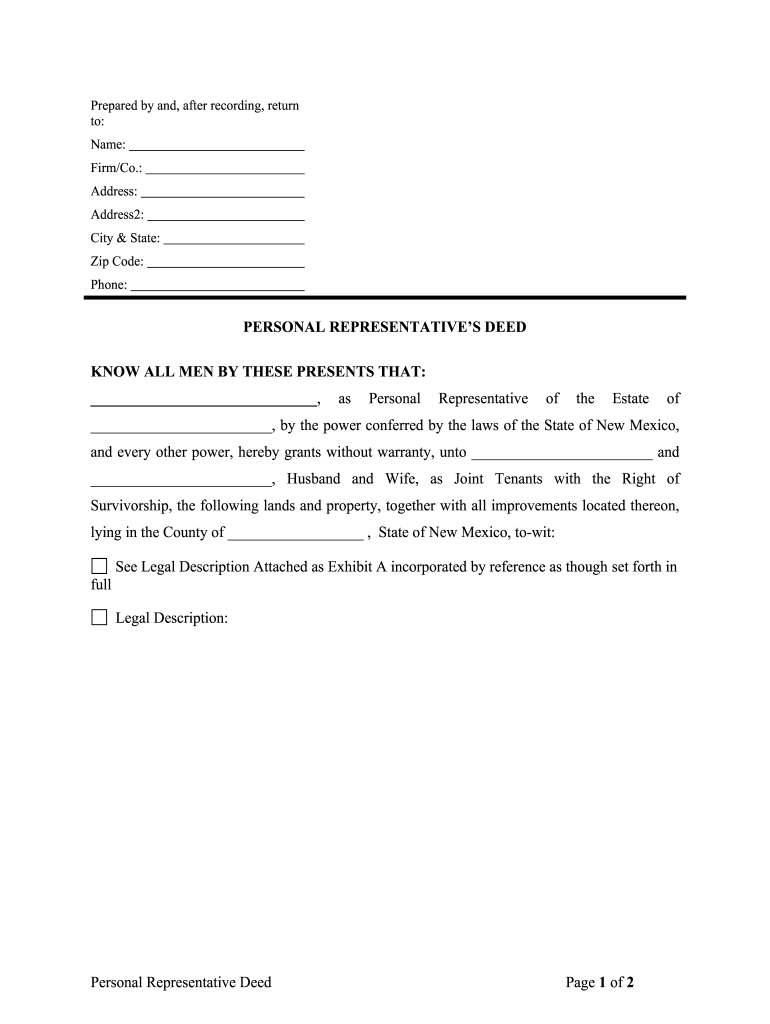
A New Mexico Personal Representative’s Deed is a conveyance document executed by the estate’s personal representative (executor or administrator) to transfer real property that belonged to a decedent. It identifies the decedent, names the personal representative, describes the property by legal description, and conveys whatever interest the estate holds. The deed is typically prepared after issuance of letters testamentary or administration by the probate court and is recorded with the county clerk to update the public land records and enable sale, transfer, or clear title for the grantee.

Why this deed matters for settling estate real property

A Personal Representative’s Deed provides clear legal transfer of estate property after probate, creates a public record of title change, and enables marketable title for sale or distribution to heirs.

Why this deed matters for settling estate real property

Who typically prepares, signs, and handles this deed

Typical participants and professionals involved in preparing and recording the deed.

  • Personal representatives and executors — Prepare or approve the deed, sign in official capacity, and provide probate authorizing documents.
  • Probate attorneys and paralegals — Draft deed language, verify legal description, and ensure compliance with probate order and state formalities.
  • Title companies and closing agents — Review chain of title, clear encumbrances, and record the deed at county clerk.

Core parts of a professional New Mexico Personal Representative’s Deed

A complete deed includes formal grant language, identification of grantor and grantee, precise property description, authority statement for the personal representative, acknowledgment for notarization, and a block for recording information.

Grant Clause

Clear operative phrase transferring property (for example: 'The Personal Representative hereby grants, conveys, and quitclaims to...'). This language sets the transfer’s legal effect.
Parties

Full legal names for the decedent (as predecessor in interest), the personal representative (with capacity stated), and the grantee to avoid later identity disputes.

Legal Description

Complete metes-and-bounds or lot/block description recorded in county records; omissions or shorthand descriptions can cause title defects.

Authority Statement

Reference to probate case number and letters testamentary/administration that show the signer's authority to convey the estate property.

Notary Acknowledgment

A state-approved notarial block showing the personal representative acknowledged signing under oath before a notary public.

Recording Block

Space reserved for county clerk entry (recording date, document number, recording fees) so the public record reflects the new title holder.

Essential information and fields to include

Decedent Name: Full legal name
Personal Representative: Name and capacity
Property Description: Complete legal description
County of Record: County where property is located
Consideration: Monetary amount or statement
Probate Case: Court name and case number

Step-by-step: preparing and recording the deed

Follow a clear sequence to prepare, execute, and record the deed so the transfer is effective and searchable in public records.

  • 01
    Gather probate documents: Obtain letters testamentary/administration and certified death certificate.
  • 02
    Draft deed: Include grant language, authority clause, and full legal description.
  • 03
    Sign and notarize: Personal representative signs before a notary; follow RON rules if used.
  • 04
    Record deed: File with county clerk in the county where the property is located.

How to set up an online workflow for this deed

Configure digital fields and authentication to mirror paper requirements and capture audit trails when eSigning the deed.

Field Configuration
Signature Block Require printed name, signature, date, and capacity fields for the representative
Notary Block Reserve a notary acknowledgement area and enable image upload for journal entry
Document Format Use PDF/A or PDF format compatible with county recording systems
Authentication Enable SMS or ID verification for signer identity where allowed

Digital signing and technical requirements to support validity

Electronic workflows must preserve signer intent, capture an audit trail, and meet any state notary or RON requirements before recording.

  • Audit Trail: Capture signer IP, timestamps, and actions
  • Authentication: Use multi-factor or ID analysis for strong attribution
  • File Types: Support PDF and PDF/A for recorder acceptance

Integrations with title systems and county eRecording providers reduce rejections; ensure the platform supports document export and notarization workflows.

Where the completed Personal Representative’s Deed goes after signing

Understand the routing steps after execution so recording, title transfer, and beneficiary notification occur without gaps.

  • County Clerk Recording: Primary filing location for public record and indexation.
  • Title Company: Provides title clearance and may handle recording on your behalf.
  • Probate Court File: Attach a copy to the probate file if court requires confirmation of conveyance.
  • Grantee Delivery: Provide recorded copy to the grantee for their records and mortgage purposes.

Timing considerations and practical deadlines

While no fixed federal deadline requires immediate recording, prompt action reduces title risk and clarifies ownership for tax and sale purposes.

Record Promptly:

Record as soon as possible after execution to protect grantee rights.

Probate Authority:

Do not convey until letters testamentary/administration are issued by the probate court.

Title Clearance:

Allow title company time to clear liens before closing; timelines vary by case.

Notary Retention:

If RON used, audio-video and journal records typically retained per state RON rules.

Tax Reporting:

Coordinate with county tax assessor for change-of-ownership reporting and reassessment timelines.

Common mistakes to avoid when preparing the deed

  • Using an incomplete legal description or 'street address only' causes recording rejection or ambiguous conveyance and complicates title searches.
  • Failing to reference the probate case and letters testamentary can lead recorders or title companies to challenge the representative’s authority.
  • Signing before letters are issued or using the wrong capacity (personal instead of representative) may render the deed voidable.
  • Omitting a proper notary acknowledgement or using an incorrect notarial form triggers rejection by the county clerk.

Consequences and legal risks of incorrect deeds

Title Defect: May create clouded title or require corrective deed
Recording Rejection: County clerk may refuse to record the instrument
Probate Challenge: Heirs may contest transfer or representative authority
Tax Impact: Change-of-ownership may trigger reassessment
Liability Exposure: Representative may face personal liability for improper conveyance
Fraud Risk: Improper signatures can lead to rescission or criminal charges

Sample eSignature vendor comparison for executing and managing deeds

When choosing an eSignature provider for deed workflows, compare pricing, HIPAA/enterprise compliance, bulk send, and audit trail capabilities; signNow is shown first as a pricing reference.

signNow DocuSign Adobe Sign PandaDoc HelloSign
Starting Price $8/user/mo $15/user/mo $14/user/mo $19/user/mo $15/user/mo
Free Trial 7-day trial Plan varies Plan varies Plan varies Plan varies
Bulk Send Yes Yes Yes Yes Varies
Audit Trail Yes Yes Yes Yes Yes
HIPAA Compliant Yes Yes Yes No No

Practical tips for accurate and efficient completion

Follow these best practices to reduce rework and ensure the deed records cleanly and conveys the estate interest intended.

Match court documents
Use the exact names and case number shown on letters testamentary or administration when drafting the deed.
Use recorded descriptions
Copy the legal description from the deed under which the decedent held title to ensure consistency.
Confirm authority
Verify the personal representative’s appointment and confirm no restrictions in the probate order before signing.
Record without delay
Record the signed and notarized deed promptly to reduce title disputes and protect the grantee.

Frequently asked questions about the New Mexico Personal Representative’s Deed

Answers to common questions about authority, notarization, eSigning, recording, and remedies for defective deeds.


Need help? Contact support

be ready to get more
Join over 28 million airSlate SignNow users