Establishing secure connection…Loading editor…Preparing document…

North Carolina Tort Claim Form

This template is fully customizable. Edit the text, fill out the fields, and send it for signature. Give it a try!
North Carolina Tort Claim Form

What the North Carolina Tort Claim Form Is

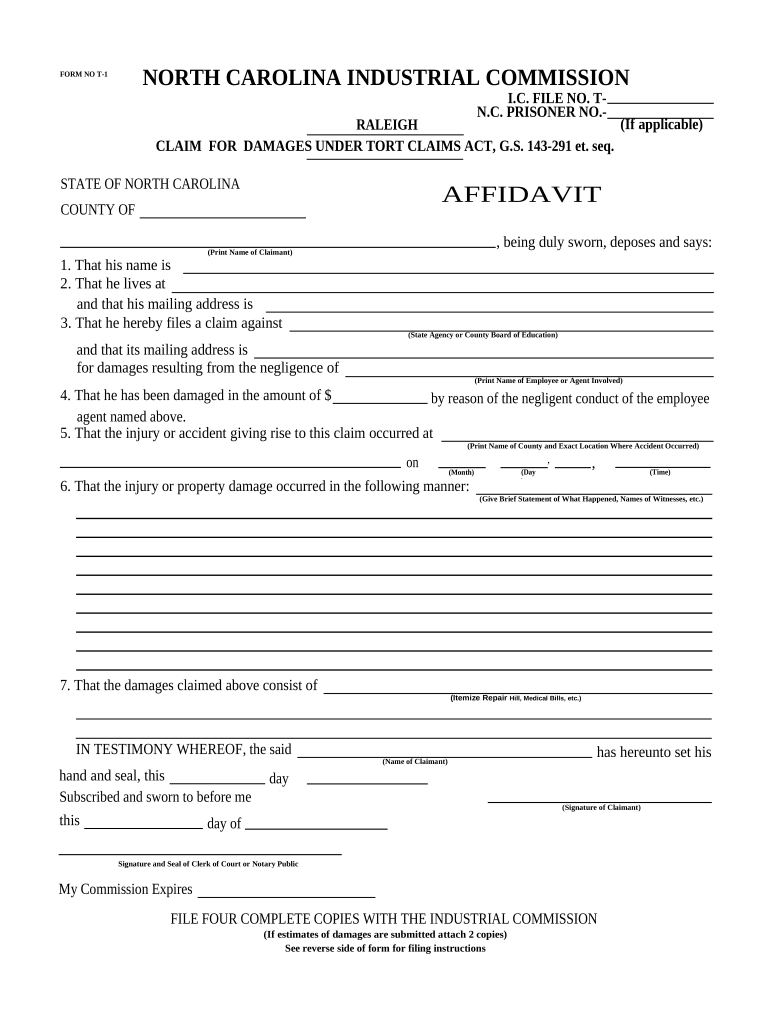
The North Carolina Tort Claim Form is a standardized notice document used when an individual or entity asserts a tort-based claim against a state agency, county, or municipality in North Carolina. It records claimant identity, incident facts, estimated damages, and the date and location of the event. Completing and delivering the form is often a prerequisite under state procedures before initiating litigation against a governmental entity; agencies use it to evaluate potential liability and to trigger internal review and claims handling.

Why this form matters for potential claimants

Filing the Tort Claim Form preserves the claimant’s opportunity to have the matter considered administratively and can be a procedural prerequisite to any later lawsuit. It provides the agency with notice and basic facts so the claim can be investigated, potentially resolving the dispute without litigation.

Why this form matters for potential claimants

Who typically completes the North Carolina Tort Claim Form

This form is completed by persons or businesses asserting injury or property damage allegedly caused by a governmental entity or employee.

  • Individual claimants submitting notice after personal injury or property damage incidents.
  • Business owners seeking recovery for commercial losses caused by government action or negligence.
  • Claims administrators or attorneys filing on behalf of clients to preserve legal rights.

If you represent someone else, include an authorization or power of attorney as required by the receiving agency.

Representative signatories and users

Claimant — Individual

A private person who suffered injury or property loss files the form to put the governmental entity on formal notice. The narrative should be factual and concise; attach supporting documents such as police reports, repair estimates, or medical records when available to strengthen the claim.

Representative — Attorney

An attorney or authorized agent may complete and submit the form for a client. Include proof of representation and client authorization. Attorneys typically follow submission with a more detailed demand letter and coordinate with the agency’s claims office during investigation.

Key data and security points to include

Claimant Name: Full legal name
Incident Date: MM/DD/YYYY format
Location: Street, city, county
Damage Amount: Specific dollar request
Supporting Records: Attach PDFs or photos
Authentication: Signed and dated

Step-by-step: completing the North Carolina Tort Claim Form

Follow these steps in order to prepare a clear, complete, and compliant submission.

  • 01
    Gather evidence: Collect reports, photos, invoices.
  • 02
    Complete form: Enter all required fields accurately.
  • 03
    Attach documents: Include PDFs for support.
  • 04
    Submit timely: Send to the designated agency recipient.

How the claim routing and review typically proceeds

Understand the usual flow so you can track status and respond to agency requests quickly.

  • Receipt: Agency logs receipt and assigns claim number.
  • Acknowledgment: Agency may acknowledge and request more details.
  • Investigation: Claims unit reviews records and interviews relevant staff.
  • Resolution: Agency accepts, denies, or offers settlement.

Configuring an online submission workflow

Set up a digital workflow to collect completed forms, attachments, and signatures consistently.

Upload document Add the fillable PDF or Word form to the platform
Place fields Insert name, date, text, and attachment fields
Signer authentication Choose email or SMS verification for signers
Attachment workflow Require supporting files for key fields
Routing rules Send completed packet to agency email or clerk

Digital delivery options and integration considerations

Many claimants and law firms submit forms electronically; platform choice affects authentication and storage.

  • Integrations: Salesforce, NetSuite, Google Workspace
  • File Formats: PDF, DOCX, TIFF
  • Authentication: Email, SMS, KBA options

Select a platform that supports required authentication, captures an audit trail, and retains signed records in a retrievable format aligned with legal retention obligations.

Essential components of a professional claim submission

A complete packet combines clear narrative, factual support, and verifiable contact and signature data to reduce processing friction.

Claimant Details

Full legal name, address, contact info, and any representative or counsel information so the agency can communicate directly and verify authority.
Incident Narrative

Concise chronological description of what happened, who was involved, and how the claimant was harmed; include dates, times, and locations for clarity.

Damages and Basis

Itemized damages, valuation method, and supporting invoices or estimates to substantiate the requested amount and speed review.

Supporting Evidence

Attach police reports, medical records, photographs, repair estimates, and witness statements to corroborate material facts and timing.

Signature and Authority

Signed claimant signature or authorized representative signature with title and proof of authority where applicable to validate submission.

Routing Information

Clear designation of the specific agency office, mailing address, and any required internal claim number to avoid misrouting.

Timing considerations and statutory limits

Timing affects both admissibility and legal options; start with prompt filing and verify any agency-specific notice periods.

Statute of Limitations:

North Carolina personal injury claims generally use a three-year limit (N.C. Gen. Stat. §1-52)

Administrative Notice:

Some agencies require a claim notice before suit; verify agency-specific deadlines

Prompt Submission:

Submit as soon as possible after incident to preserve evidence and witness availability

Extensions or Tolling:

Certain circumstances may toll filing deadlines; consult counsel for exceptions

Agency Response Time:

Response windows vary; track acknowledgment and follow up if no confirmation

Key milestone timeline for a typical claim process

A simplified sequential view of major processing stages helps claimants know what to expect.

01

Prepare Claim Packet

Assemble form, evidence, and representative authorization as applicable

02

File with Agency

Deliver by permitted channel and obtain confirmation or claim number

03

Agency Investigation

Agency reviews records and may request additional information

04

Decision or Offer

Agency issues denial, settlement offer, or authorizes further action

Common preparation mistakes to avoid

  • Incomplete incident description that omits critical dates, locations, or responsible parties and forces requests for more information.
  • Missing supporting documentation such as invoices, photos, or reports that undermines damage estimates and slows review.
  • Incorrect claimant identity or mismatched names between attachments and the form, which can trigger identity verification delays.
  • Failing to file through the agency’s prescribed channel or missing a required acknowledgment, which may affect rights to sue.

Potential consequences of errors or late filing

Forfeited Rights: May lose right to pursue suit
Rejection: Agency may administratively dismiss claim
Delay in Recovery: Processing delays reduce evidence quality
Increased Costs: More legal fees and document requests
Privacy Risks: Poor handling can expose sensitive data
Misrouted Claims: Wrong recipient slows adjudication

Practical tips for accurate, efficient submissions

Adopt a checklist approach and preserve originals to reduce rework and accelerate resolution.

Use a consistent file naming system
Name attachments clearly (e.g., ClaimantName_Invoice_2024-06-01.pdf) so reviewers can locate documents quickly and reduce processing time.
Include concise, factual narratives
Keep the incident description chronological and fact-based, avoid argument or speculation, and cite supporting evidence by attachment label for clarity.
Retain originals and make copies
Keep original bills, receipts, and reports; provide legible copies with your submission and be prepared to produce originals on request.
Confirm agency filing procedures
Verify the agency’s preferred delivery method (email, portal, mail) and any notarization or signature requirements before submitting to avoid rejection.

Real-world examples of form handling and digital signing

These examples show how organizations standardize form capture and compliance for administrative claims.

Tim Martin — Property Operations

Tim Martin’s team moved claim packets online to avoid paper delays and improve compliance.

  • They used mobile signing for on-site capture.
  • As a result, they reported faster return of completed packets and consistent retention of audit trails to support follow-up and potential litigation needs.

Dan Rotelli — Corporate Compliance

Dan Rotelli emphasized platform certifications when migrating claims processing.

  • He prioritized SOC 2 and ESIGN compliance.
  • That approach increased internal confidence during audits and ensured that signed claim documents met legal admissibility standards while simplifying integration with case management systems.

How a Tort Claim Form differs from a civil complaint

These high-level distinctions help decide whether to file notice or initiate litigation.

Document Type Tort Claim Form Civil Complaint
Purpose notice to agency commences lawsuit
Filing Timing pre-litigation notice after notice or concurrently
Notary Required varies by agency typically no
Effect triggers review starts court case

eSignature vendor pricing and capability snapshot

Basic pricing and feature availability to consider when selecting an eSignature provider for claim forms and attachments.

signNow DocuSign Adobe Sign PandaDoc HelloSign
Starting Price $8/user/mo $15/user/mo $14/user/mo $19/user/mo $15/user/mo
Free Trial 7-day free trial Varies Varies Varies Varies
Bulk Send Yes (Business Premium) Yes Yes Yes Varies
Audit Trail Yes Yes Yes Yes Yes
HIPAA Compliant Yes Yes Yes Varies Varies

Frequently asked questions and troubleshooting

Answers to common questions about completing, signing, and submitting the North Carolina Tort Claim Form.


Need help? Contact support

be ready to get more
Join over 28 million airSlate SignNow users