Georgia Notice to Owner and Contractor
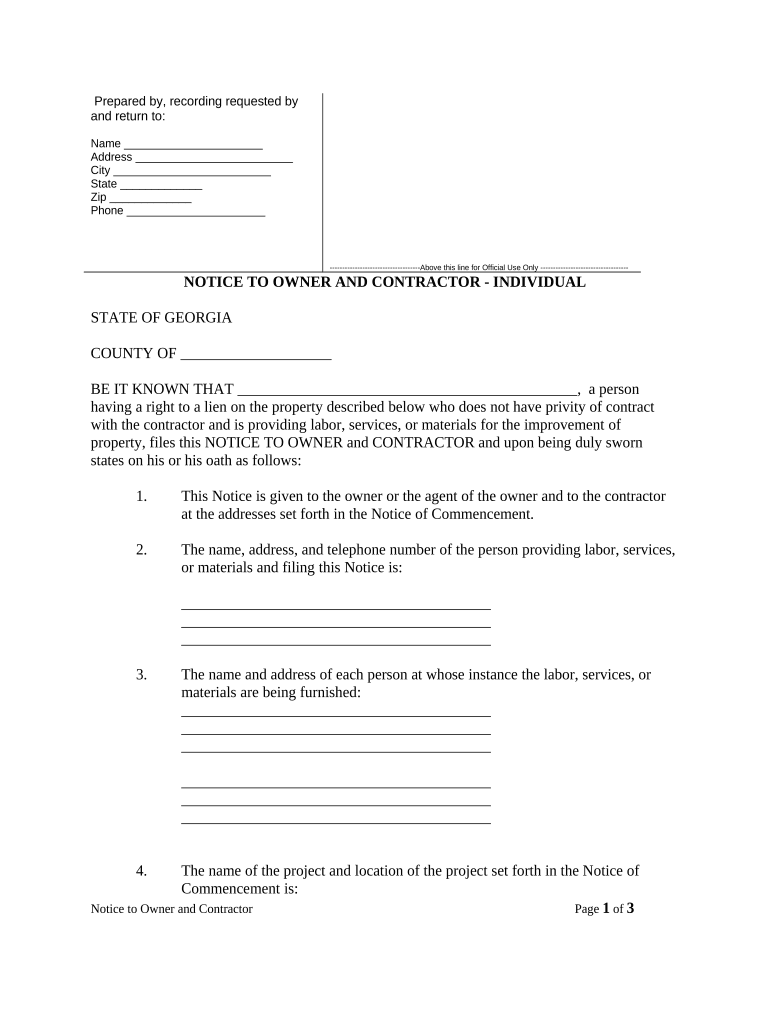
What the Georgia Notice to Owner and Contractor Is
Why This Notice Matters for Contractors and Suppliers
A timely Georgia Notice to Owner and Contractor preserves lien rights, clarifies who supplied work or materials, and reduces payment disputes by creating an early written record accessible to owners and lenders.

Who Typically Prepares and Receives This Notice
Common parties involved include subcontractors, suppliers, general contractors, and property owners; each has distinct reasons to send or receive the notice.
- Subcontractors and suppliers who have not been paid and want to protect potential lien rights and improve leverage for collection.
- General contractors who need an accurate supplier roster and documented notice of delivered materials or performed work on a project.
- Property owners and lenders who must know of potential lien claimants to address payment or escrow issues before project closing.
Use the notice early in the project lifecycle; delivering it promptly improves enforceability and keeps project records transparent for all parties.
Step-by-Step: Complete and Deliver the Notice
-
01Prepare: Fill every required field and confirm legal names.
-
02Date: Add the effective date in MM/DD/YYYY format.
-
03Serve: Deliver by certified mail, hand, or e-delivery per local rules.
-
04Record: Retain proof of delivery and the signed notice for records.
How to Configure an Online Notice Workflow
| Field | Configuration |
|---|---|
| Template | Create reusable template with locked required fields. |
| Signer Order | Set sender signs first, then optional owner acknowledgment. |
| Authentication | Use email plus SMS code for recipient verification. |
| Storage | Automatically save signed PDF to project folder. |
Where the Notice Goes and What Happens Next
-
Owner: Informs the owner of suppliers and potential lien claimants.
-
General Contractor: Alerts the prime contractor to outstanding materials or labor.
-
Project File: Retained in the contract folder for later proof or filing.
-
Accounting: Triggers invoice tracking and payment follow-up.
Digital Delivery and Signing Considerations
Choose delivery and signing methods that meet legal and project requirements, balancing convenience with authentication strength.
- Accepted Formats: PDF and DOCX are standard for retention and filing.
- Authentication: Email+SMS or knowledge-based methods support signer attribution.
- Retention: Store signed copies with audit trail metadata.
Use platforms that produce a tamper-evident signed PDF, preserve audit trails, and support the storage and retrieval requirements of construction records.
Timing: When to Send and Track the Notice
Initial Dispatch:
Send as soon as materials are delivered or work begins to document presence on site.
Follow-up:
Re-send or confirm delivery if project contacts change or if mail is returned.
Pre-lien Preparation:
Retain the notice as part of pre-lien analysis before any lien filing.
Record Keeping:
Keep signed notice in the project file until payment issues are resolved.
Contract Timelines:
Align notice delivery with contractual notice and cure periods when possible.
Key Project Milestones for Notice and Enforcement
Work Commencement
Send initial notice documenting start of furnishing.
Invoice Delivery
Confirm invoice dates coincide with notice records.
Payment Default
Document missed payments and escalate per contract terms.
Pre-Lien Review
Assess whether notice and evidence support a lien filing.
Common Preparation Pitfalls to Avoid
- Using abbreviated or trade names instead of the legal entity can prevent correct identification in lien searches and filings.
- Delivering notices late or without proof of service undermines the notice’s role in preserving lien rights or settlement leverage.
- Leaving out county or parcel identifiers makes it difficult to match the notice to the correct property in recorder searches.
- Failing to keep signed copies and audit trails complicates enforcement and weakens the evidentiary record.
Consequences of Inaccurate or Missing Notices
Comparing eSignature Options for Notice Delivery and Signing
| signNow | DocuSign | Adobe Sign | PandaDoc | HelloSign | |
|---|---|---|---|---|---|
| Starting Price | $8/user/mo | $15/user/mo | $14/user/mo | $19/user/mo | $15/user/mo |
| Free Trial | 7-day free trial | Varies | Varies | Varies | Varies |
| Bulk Send | Yes | Yes | Yes | Yes | No |
| Audit Trail | Yes | Yes | Yes | Yes | Yes |
| HIPAA Compliant | Yes | Yes | Yes | No | No |
Practical Examples of When Notices Matter
Subcontractor Preserves Claim
A roofing supplier delivered materials and sent the notice within days of delivery
- The owner was notified immediately
- The supplier later relied on the notice to establish standing during a lien foreclosure and settlement negotiation, simplifying recovery.
Owner Prevents Escrow Surprise
A property owner received timely notices from several suppliers
- The lender added reserves for potential claims
- Early disclosure avoided closing delays and reduced post-closing disputes.
Practical Tips for Accurate and Efficient Completion
Frequently Asked Questions About the Georgia Notice to Owner and Contractor
-
Is the notice required to preserve a lien?
Not always. Requirements vary by state and by the type of claimant; a notice often helps preserve rights, but confirm Georgia recording rules and lien deadlines before assuming it alone suffices.
-
Can the notice be sent electronically?
Yes, electronic delivery is generally acceptable if the method meets attribution and consent standards under the ESIGN Act (15 U.S.C. §7001) and relevant state rules; retain an audit trail.
-
What if the owner’s name is unknown?
Use the best available identifying information (parcel number, legal description, lender name) and document the search steps; update the notice if accurate owner details become available.
-
Does a signed notice need notarization?
Notarization rules vary by jurisdiction and document type; recording a lien affidavit typically requires a notary in many counties, so keep notarization capabilities available if a lien may follow.
-
How should I store completed notices?
Keep signed PDF copies, proof of delivery, and related invoices for at least three to seven years depending on tax and dispute considerations; include metadata for easy retrieval.
-
When should I consult an attorney?
Seek counsel before filing a lien, in complex multi-party projects, or when notice defects could jeopardize statutory deadlines or create exposure to counterclaims.