Establishing secure connection…Loading editor…Preparing document…

Notice of Deposition

This template is fully customizable. Edit the text, fill out the fields, and send it for signature. Give it a try!
Notice of Deposition

What a Notice of Deposition Is and when it’s used

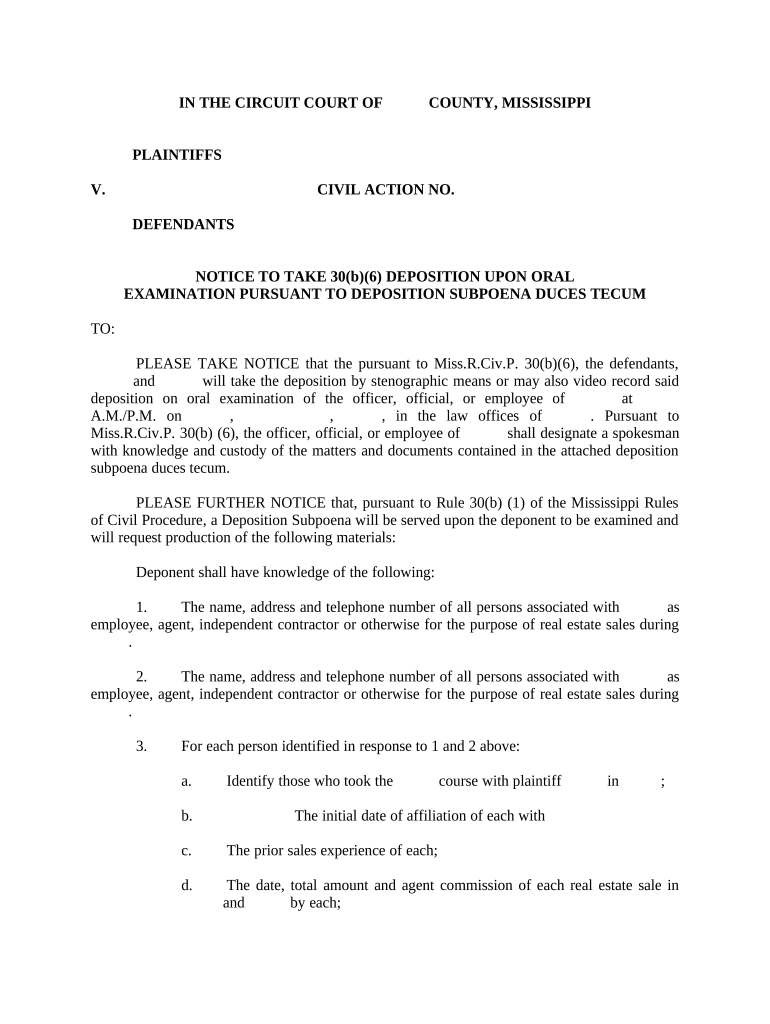
A Notice of Deposition is a formal written notice used in U.S. civil litigation to inform a party or nonparty that they are required to appear for sworn oral testimony. It identifies the case caption, deponent name, date, time, location or remote method, the topics or scope of questioning, and any exhibits to be used. Notices of deposition follow federal or state rules of civil procedure for service and timing; some jurisdictions permit remote depositions and electronic service subject to local rules and statutes.

Why a clear Notice of Deposition matters

A precise notice ensures proper service, preserves the deponent’s testimony under oath, sets expectations about topics and exhibits, and reduces disputes over scope or timing during discovery.

Why a clear Notice of Deposition matters

Who prepares and receives a Notice of Deposition

Notices are typically prepared by litigators or their staff and served on opposing counsel, represented parties, and nonparty witnesses.

  • Plaintiff counsel serving witnesses and opposing parties to secure testimony for discovery or trial preparation.
  • Defense counsel responding to or serving notices to test factual claims and develop cross-examination themes.
  • Corporate representatives or third-party witnesses who must prepare documents or witnesses under Rule 30(b)(6).

Typical signer and preparer profiles

Plaintiff Attorney

A litigation attorney or paralegal who drafts the notice, confirms availability, coordinates exhibits, and effects service. They must follow local service rules and include sufficient detail to avoid objections.

Deposition Clerk

A court or law-firm staff member who manages scheduling, delivers copies to counsel, arranges court reporters or remote platforms, and retains proof of service and exhibit records.

Core parts to include in a professional Notice of Deposition

Including these elements makes the notice complete, minimizes objections, and helps ensure enforceability under applicable discovery rules.

Case Caption

Full court name, docket number, and parties. Use the exact caption to ensure the notice is associated with the correct file and to avoid misrouting or administrative rejection.
Deponent Details

Full legal name, title or role, and whether the deponent is a party, corporate representative, or third party. Provide identifying information to avoid confusion and to support proper service.

Date and Time

Specific date and start time in MM/DD/YYYY and specific time zone. If the deposition is remote, include connection instructions, platform, and login procedures.

Location or Platform

Physical address, room, or remote platform name. For remote depositions, include instructions for audio/video, and reference any required authentication or security steps for the session.

Scope and Topics

Concise description of topics or notice under Rule 30(b)(6). Identify documents and subject matter to give the deponent adequate time to prepare and avoid scope objections.

Exhibits and Attachments

List exhibits to be used and provide copies or produce them in advance where required by local rules. Note whether documents will be marked and the form for production.

Essential information and document safeguards

Encryption: TLS 1.2/1.3; AES-256 at rest
Audit Trail: Timestamps and IP logs
HIPAA BAA: BAA required for PHI
Authentication: Email, SMS, or MFA
Access Controls: Role-based permissions
Retention: Immutable audit records

Consequences of errors in a Notice of Deposition

Late Service: Motion to quash
Improper Venue: Enforceability issues
Missing Details: Scope objections
Bad Service: Sanctions risk
Unauthorized Access: Privacy breach
Noncompliance: Court sanctions

Common drafting and service mistakes to avoid

  • Failing to specify time zone for remote depositions, which causes missed appearances or disputes about timeliness.
  • Not attaching or delivering exhibits in advance when local rules require production before the deposition starts.
  • Using vague topic descriptions for Rule 30(b)(6) notices, leading to disputes over the scope of corporate preparation.
  • Serving the notice on the wrong party or counsel, producing defective service or a motion to quash.

Step-by-step: preparing and serving a Notice of Deposition

Follow these steps to draft, serve, and document a compliant notice under typical U.S. civil procedure rules.

  • 01
    Draft: Complete caption, deponent, date, place, topics
  • 02
    Attach: Include exhibits or produce in advance
  • 03
    Serve: Use permitted service methods and proof
  • 04
    File: File certificate of service if required

Where to send or file the Notice of Deposition

Delivery and filing practices vary by jurisdiction; use the route required by local rules and preserve proof of service.

  • Opposing Counsel: Deliver via permitted service (email if allowed)
  • Nonparty Witness: Serve directly or by process server
  • Court Clerk: File certificate or notice if required
  • Court Reporter: Confirm attendance and exhibit handling

Export, sharing, and supporting file options

Make copies and preserve a defensible record by exporting in standard formats and attaching proof of service and exhibits.

Export Formats

Save final notice and exhibits as PDF/A or PDF to preserve layout and metadata. Include produced native files when required by agreement or court order for document-intensive depositions.

Delivery Receipts

Preserve email delivery receipts, certificate of service, or process-server affidavit. These records are essential if the opposing party disputes valid service or timing of the notice.

Remote Sessions

For virtual depositions, record platform logs, audio/video files, and participant authentication records to document who attended and when.

Exhibit Management

Number exhibits consistently, provide Bates ranges if used, and confirm whether paper originals will be required at trial or for authentication.

Practical tips for accurate and efficient completion

Adopt consistent templates and confirmation steps to reduce errors and speed coordination.

Confirm availability early
Contact opposing counsel and the deponent before serving to find acceptable dates. Early coordination reduces the chance of motions and rescheduling delays, saving time and litigation cost.
Be specific on topics
List topics with sufficient detail for a 30(b)(6) notice to allow corporate designees to prepare. Vague language often produces objections and extra motion practice.
Preserve proof of service
Obtain and retain delivery receipts, server affidavits, or platform logs. Courts require proof when service timing or method is contested.
Coordinate exhibits
Deliver exhibits in the form the receiving party can use, and mark exhibits consistently to avoid confusion during the deposition and at trial.

Timing considerations and common scheduling requirements

Check applicable federal or local rules for required notice periods, and factor in mail or electronic delivery time.

Notice Period:

No universal federal wait; follow local rule or agreement

Rule 30(b)(6):

Allow reasonable preparation time for corporate reps

Remote Notice:

Specify connection time zone and access details

Document Production:

Produce requested documents by agreed deadline

Scheduling Conflicts:

Offer alternative dates promptly to avoid motions

Key milestones from notice to testimony

Typical milestone sequence to track and document when preparing for a deposition.

01

Prepare Notice

Draft notice with topics, exhibits, and logistics.

02

Serve Notice

Effect service using permitted methods and preserve proof.

03

Confirm Logistics

Coordinate report, platform, and exhibit delivery.

04

Conduct Deposition

Record proceedings, mark exhibits, and obtain transcript.

Configuring a digital workflow for Notices of Deposition

A simple workflow ensures consistent notices, timely service, and preserved evidence for remote or in-person depositions.

Step Configuration
Document Template Pre-fill case caption, signature blocks, exhibit placeholders
Authentication Email with SMS code or multi-factor on remote sessions
Delivery Email, registered mail, or process server depending on rules
Recordkeeping Store certificate of service, logs, and exhibit versions

Technical and platform considerations for e-notices and remote depositions

Confirm platform capabilities and integrations before scheduling to ensure secure delivery and auditability.

  • File Types: PDF, DOCX, and native exhibits
  • Integrations: Works with Google Workspace and Microsoft 365
  • Audit Logs: Timestamped records retained

Comparing paper service versus electronic delivery for deposition notices

Compare practical differences so you choose an enforceable, auditable service method permitted by your jurisdiction.

Criteria Paper Notice Electronic Notice
Service Proof affidavit of service delivery receipt
Speed slower faster
Authentication server affidavit audit trail
Court Acceptance generally accepted accepted where allowed

eSignature vendor pricing and capability snapshot for deposition workflows

Compare basic pricing and common feature support across vendors to evaluate e-delivery, audit trails, and bulk distribution for deposition materials.

signNow DocuSign Adobe Sign PandaDoc HelloSign
Starting Price $8/user/mo $15/user/mo $14/user/mo $19/user/mo $15/user/mo
Free Trial 7-day trial Varies Varies Varies Varies
Bulk Send Yes Yes Yes Yes No
Audit Trail Yes Yes Yes Yes Yes
HIPAA Compliant Yes Yes Yes No No

Frequently asked questions about Notices of Deposition

Answers to common questions about service, electronic delivery, authentication, and correcting errors in a notice.


Need help? Contact support

be ready to get more
Join over 28 million airSlate SignNow users