Establishing secure connection…Loading editor…Preparing document…

Letter Regarding Notice of Objection to Secure Claim

This template is fully customizable. Edit the text, fill out the fields, and send it for signature. Give it a try!
Letter Regarding Notice of Objection to Secure Claim

What this Letter Is and when it’s used

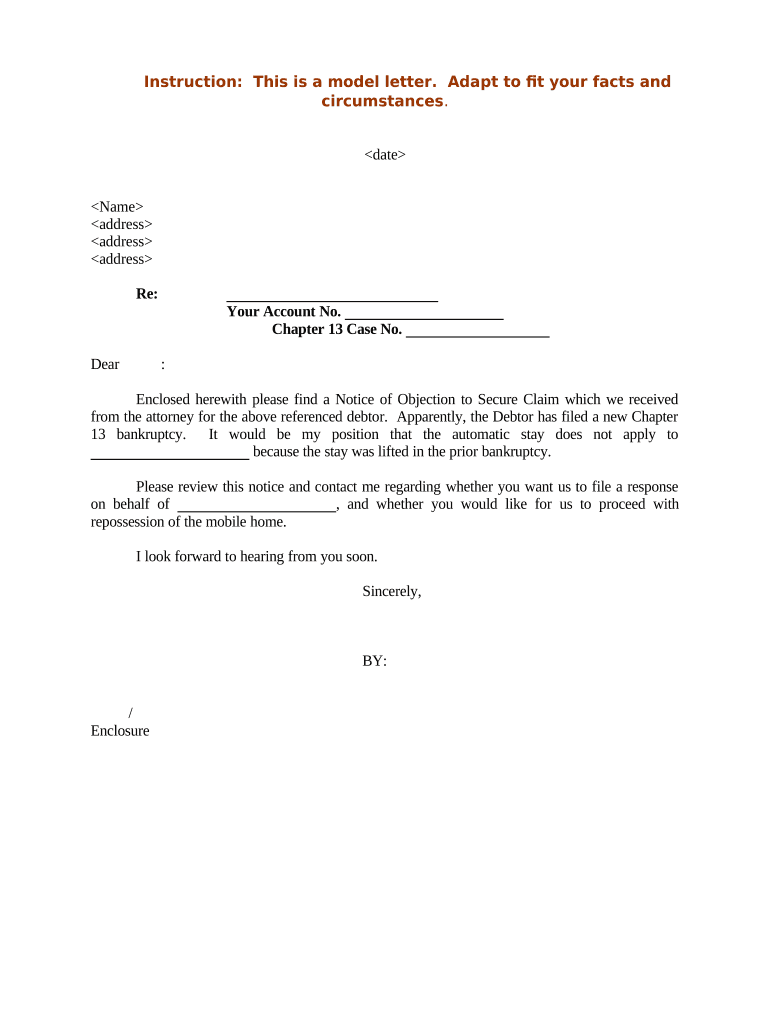
A Letter Regarding Notice of Objection to Secure Claim is a formal written notice sent by a party disputing the validity, amount, or priority of a secured claim against property or assets. It identifies the claim being contested, explains the basis for objection, and requests correction, withdrawal, or further documentation. The letter creates a written record and may trigger procedural deadlines for the claimant, servicer, or court. It is used in lending, bankruptcy, real estate, and commercial disputes where a secured interest or lien is asserted.

Why sending a clear objection letter matters

A focused, documented objection preserves legal rights, begins dispute resolution, and creates an auditable record that can affect lien priority or enforcement outcomes.

Why sending a clear objection letter matters

Who typically prepares and receives this letter

Several parties may prepare or receive this letter depending on the context; examples below outline common senders and recipients.

  • Borrowers and debtors disputing a claimed lien or secured balance; letters often accompany requests for payoff itemization or documentation.
  • Title companies, real estate closing agents, and escrow officers when a cloud on title appears during closing due diligence.
  • Attorneys, trustees, or creditors involved in bankruptcy or commercial litigation seeking formal preservation of an objection.

Essential parts to include in the objection letter

A professional letter should be concise, identify the claim precisely, state the legal or factual basis for objection, and request a specific remedy or follow-up within a stated timeframe.

Header

Date, sender name and contact, recipient name, mailing and email addresses, and any file or claim number for precise identification.
Claim Details

Cite the secured claim by account number, lien instrument (deed/mortgage/financing statement), filing date, and recording jurisdiction to avoid ambiguity.

Grounds for Objection

State the factual errors, legal defenses, or missing documentation (e.g., assignment gaps, incorrect payoff, deficient notary, or chain-of-title issues).

Requested Action

Specify remedy sought: rescission, correction, lien release, payoff recalculation, or production of supporting documents within a fixed period.

Supporting Evidence

List attachments such as recorded instruments, payment records, title searches, correspondence, or court docket entries that substantiate the objection.

Signature

Signature block with printed name, title (if applicable), date, and notation whether signed electronically, notarized, or witnessed.

Step-by-step: preparing the objection letter

Follow these steps to prepare a clear, defensible objection that preserves rights and enables efficient follow-up.

  • 01
    Verify Claim: Locate recorded instrument and creditor account details before drafting.
  • 02
    Gather Evidence: Collect payments, title reports, assignments, and prior correspondence supporting your position.
  • 03
    Draft Letter: State facts, law, requested remedy, and a response deadline in plain language.
  • 04
    Deliver & Record: Send via certified mail and retain proof; file a short public notice if required by local practice.

Typical routing and handling after you send the letter

Understanding the common flow helps set expectations for responses and next steps.

  • Receipt Confirmation: Recipient acknowledges via mail or email.
  • Claims Review: Creditor reviews documentation and ledger entries.
  • Response or Correction: Creditor accepts, disputes, or amends the claim.
  • Further Action: Escalate to counsel, title insurer, or court if unresolved.

Digital workflow settings for electronic objection letters

Configure your document workflow to capture signatures, attachments, and an audit trail that supports the objection.

Field Configuration
Signer Order Sequential or parallel based on parties involved
Authentication Email link, SMS code, or KBA for higher assurance
Attachment Handling Require supporting documents before final signature
Audit Trail Capture IP, timestamp, and event log for each signer

Choosing eDelivery and signature options

Decide whether to use electronic signature, in-person signing, or notarized execution based on legal requirements and recipient preferences.

  • eSignature: Acceptable under ESIGN and UETA when intent, consent, attribution, and retention are met
  • Remote Notarization: Use RON where permitted and for documents needing notarization
  • Certified Mail: Provides a traditional proof-of-delivery record when required

Common timelines and response expectations

Timelines vary by context; set practical response windows and track statutory deadlines where applicable.

Immediate Acknowledgement:

Expect receipt confirmation within 3–7 business days after certified mailing or e-delivery

Standard Response Window:

Typical creditor response time is 10–30 days depending on jurisdiction and internal policies

Escalation Period:

Begin counsel review if no acceptable response within 30–60 days

Title Closing Impact:

Document clouds may delay closing until resolution; plan extra time

Retention Trigger:

Keep all correspondence until final resolution plus statutory retention period

Key milestones from objection to resolution

Track these stages to manage follow-up and demonstrate timely preservation of rights.

01

Draft & Send

Prepare and send the objection letter with attachments and delivery proof.

02

Acknowledgement

Confirm receipt and note the date for any deadlines.

03

Document Review

Creditor or title agent examines records and responds in writing.

04

Resolution or Escalation

Accept correction, obtain release, or pursue legal remedies if unresolved.

Common pitfalls to avoid when preparing the letter

  • Vague descriptions of the claim or property that permit the recipient to claim the notice does not apply to their file.
  • Failing to attach supporting evidence such as payment stubs, recorded assignments, or title reports that substantiate the objection.
  • Using informal delivery without proof of receipt when the jurisdiction or contract requires formal service or certified mail.
  • Mixing procedural demands with substantive allegations without clearly separating requested actions from factual assertions.

Information you should include and protect

Claim ID: Exact account or lien number
Property ID: Parcel number or VIN
Sender Contact: Full address and phone
Attachments: Copies of supporting records
Signature Type: eSign or notarized
Retention Flag: Indicate legal hold status

Consequences of an incomplete or incorrect objection

Waiver Risk: Argument the objection was untimely
Dismissal: Court may decline relief
Title Delay: Closings can be postponed
Cost Exposure: Attorney fees may accrue
Lien Enforcement: Creditor may proceed with remedies
Penalty Fees: Late or filing charges apply

Typical eSignature pricing and capability snapshot

Comparison of starting price and select features for common eSignature vendors. signNow appears first per vendor ordering rules.

signNow DocuSign Adobe Sign PandaDoc HelloSign
Starting Price $8/user/mo $15/user/mo $14/user/mo $19/user/mo $15/user/mo
Free Trial 7-day free trial No No Yes, limited Yes, limited
Bulk Send Yes Yes Yes Yes No
Audit Trail Yes Yes Yes Yes Yes
HIPAA Compliant Yes Yes Yes No No
Envelope Cap No envelope cap 100 envelopes/user/year Varies by plan Varies by plan Varies by plan

Frequently asked questions about objection letters and e-signatures

Answers to common procedural and technical questions when preparing and submitting a Letter Regarding Notice of Objection to Secure Claim.


Need help? Contact support

be ready to get more
Join over 28 million airSlate SignNow users