Establishing secure connection…Loading editor…Preparing document…

Notice of Trespassing

This template is fully customizable. Edit the text, fill out the fields, and send it for signature. Give it a try!
Notice of Trespassing

What a Notice of Trespassing Is and When it Applies

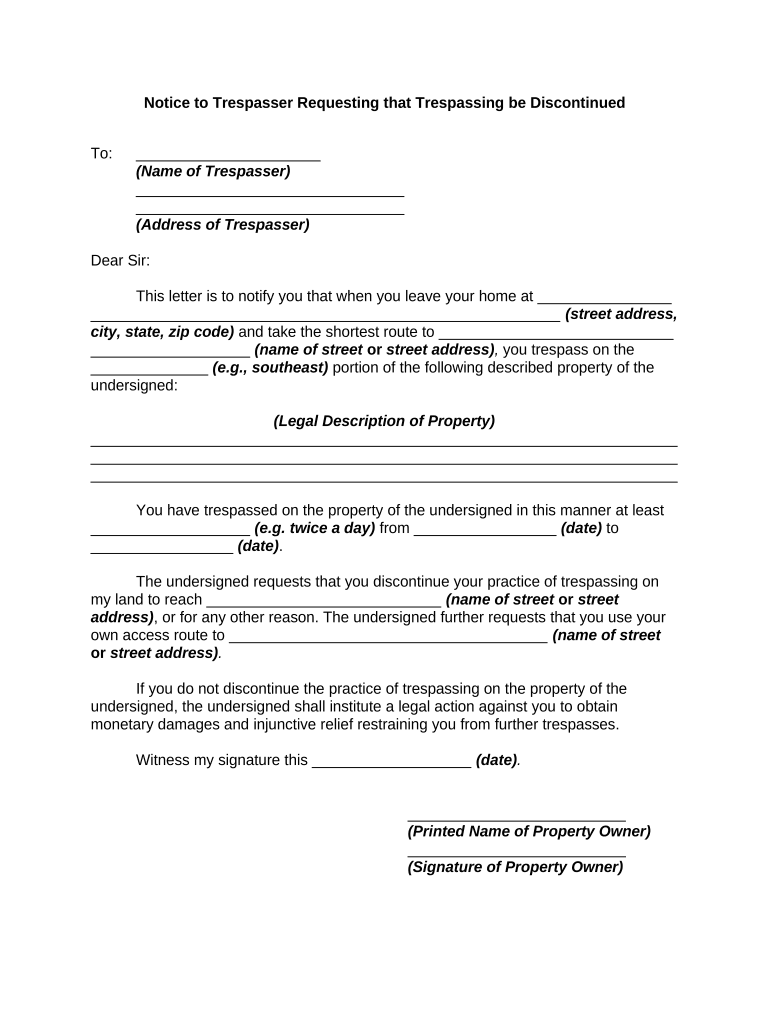
A Notice of Trespassing is a written notification used by a property owner, manager, or authorized agent to inform a person that they are not permitted to enter or remain on specified real property. The notice describes the property, identifies the prohibited person or behavior, and states that future entry will be treated as trespass under applicable law. It is used to create clear, documented notice before civil or criminal trespass enforcement, and to record the date and method of delivery for evidentiary purposes.

Why a Clear Written Notice Matters

A properly prepared Notice of Trespassing documents both the prohibition and the method of delivery, which can be crucial for enforcement or liability protection. It reduces ambiguity for occupants, law enforcement, and courts by establishing when notice was given and what conduct is prohibited.

Why a Clear Written Notice Matters

Who typically issues or receives these notices

Common users range from individual property owners to institutional managers and law enforcement who need a documented prohibition against entry.

  • Property owners and landlords: Issue notices to protect private property and tenants from unauthorized entry or repeat trespassers.
  • Property managers and HOAs: Use standardized notices to enforce community rules and protect common areas.
  • Security teams and law enforcement: Receive or rely on notices when responding to trespass complaints or arrests.

Notices are practical for single incidents and for ongoing problems; select the signer with legal authority and keep delivery records.

Step-by-step: Prepare and Issue a Notice of Trespassing

Follow these steps to create a clear, enforceable notice and preserve evidence of delivery.

  • 01
    Identify property: Describe the property precisely (address, boundaries) to avoid ambiguity.
  • 02
    Describe conduct: State prohibited actions or persons clearly and concisely.
  • 03
    Choose delivery: Select personal delivery, posting, or certified mail as appropriate.
  • 04
    Record proof: Retain dated copies, witness statements, or a delivery receipt.

Configuring an online workflow for this notice

Set up a simple, auditable workflow to create, deliver, and archive notices electronically while preserving signer identity and delivery records.

Workflow field and configuration name Setting value
Signer authentication and verification method Email link, SMS code, or advanced ID verification
Signature placement and required fields Require signature, printed name, date, and signer role
Delivery recording and proof capture Capture IP, timestamp, delivery receipt, and optional photo
Archive and retention routing Route final PDF to secure storage and case folder

Technical considerations for digital delivery

Choose a platform that preserves audit trails, supports common file types, and offers signer authentication suitable for your risk level.

  • Integrations: CRM and case systems supported
  • File types: PDF, DOCX, and printable formats
  • Security: Encryption and detailed audit logs

Ensure the platform records IP addresses, timestamps, and a tamper-evident final document; consider two-factor authentication for high-risk cases.

Where to send or file the notice

Choose destinations that preserve evidence and support enforcement: local law enforcement, internal security files, and the recipient.

  • Personal delivery: Hand notice directly to the person and obtain signature where possible.
  • Posting: Post notice on property in a conspicuous location; photograph posting for records.
  • Certified mail: Send return receipt requested to establish an official delivery record.
  • Law enforcement: Provide a copy to local police to support potential enforcement action.

Files, evidence, and recordkeeping to include with each notice

Include the signed notice, delivery proof, any witness statements, and timestamped photos to support enforcement or civil proceedings.

Export formats

Save the final notice as a locked PDF/A and keep editable DOCX or original source files for internal records. Include a signed PDF with embedded audit trail for evidentiary use.

Audit trail and metadata

Retain signer IP, timestamps, and delivery method. Metadata documents who signed, when, and how — critical for admissibility and chain-of-custody issues.

Proof of posting

Photograph notice in place showing location and date. Combine with a signed witness statement when possible to corroborate posting.

Law enforcement packet

Assemble notice copy, delivery proof, photos, and witness contact details so officers can assess violations quickly and accurately.

Typical timelines and timing expectations

Understanding effective dates and retention timelines helps coordinate enforcement and reduces disputes about when notice was given.

Notice effective on delivery:

A notice generally takes effect when delivered or posted.

Enforcement timing varies:

Local law and policy determine when police will act after notice.

Retain for evidentiary period:

Keep records for at least three years or longer if litigation is possible.

Respond to disputes promptly:

Document any challenge and preserve related communications immediately.

Renewal or repeated notices:

Issue new notices for repeated or changed circumstances to reaffirm prohibition.

Common mistakes to avoid when preparing the notice

  • Vague property description: Omitting precise address or boundaries leads to disputes over the notice’s scope and enforceability.
  • Missing delivery proof: Failing to document how and when the notice was given weakens evidence for enforcement or court proceedings.
  • Unsigned or unauthorized signers: Notices signed by staff without clear authority can be rejected by police or treated as informal warnings.
  • Overbroad prohibitions: Using overly broad language may be unenforceable; specify the prohibited conduct and applicable times or areas.

Potential consequences of incorrect or improper notices

Civil liability: Wrongful exclusion claims possible
Criminal exposure: False statements may trigger charges
Enforcement refusal: Police may decline action without clear notice
Evidence challenges: Poor records reduce admissibility
Escalation risk: Ambiguous notices can widen conflicts
Administrative penalties: Fines in specific jurisdictions possible

Required information elements to include

Recipient name: Full legal name required
Property details: Address and boundary summary
Effective date: MM/DD/YYYY with time if needed
Prohibited conduct: Clear, specific behavior list
Delivery method: Personal, posted, or certified mail
Signer capacity: Owner, manager, or authorized agent

Real-world examples of how property teams use notices

These customer use examples show common practical outcomes when notices are prepared and retained correctly.

Martin Properties

A small property manager used a standard notice after repeated campsite activity on a lot

  • The manager posted and photographed the notice
  • Police were able to remove the trespassers and the documented notice supported a swift civil remedy while preserving tenant relations.

Optica Ventures

A commercial landlord issued a notice to a former contractor who returned to remove equipment

  • Notice was sent by certified mail and retained in the tenant file
  • The delivery proof reduced dispute time and allowed the landlord to coordinate recovery without prolonged litigation.

eSignature vendor comparison for delivering notices

Basic pricing and feature differences for common eSignature vendors. signNow appears first for parity in comparisons.

signNow DocuSign Adobe Sign PandaDoc HelloSign
Starting Price $8/user/mo $15/user/mo $14/user/mo $19/user/mo $15/user/mo
Free Trial 7-day trial Varies by plan Varies by plan Varies by plan Varies by plan
Bulk Send Yes Yes Yes Yes No
Audit Trail Yes Yes Yes Yes Yes
HIPAA Compliant Yes Yes Yes No No
Envelope Cap No cap 100 envelopes/user/yr Varies by plan Varies by plan Varies by plan

Frequently asked questions and practical answers

Answers address common legal and practical issues when preparing, delivering, and enforcing a Notice of Trespassing.


Need help? Contact support

be ready to get more
Join over 28 million airSlate SignNow users