Establishing secure connection…Loading editor…Preparing document…

Novation Agreement

This template is fully customizable. Edit the text, fill out the fields, and send it for signature. Give it a try!
Novation Agreement

What a Novation Agreement Is and when it applies

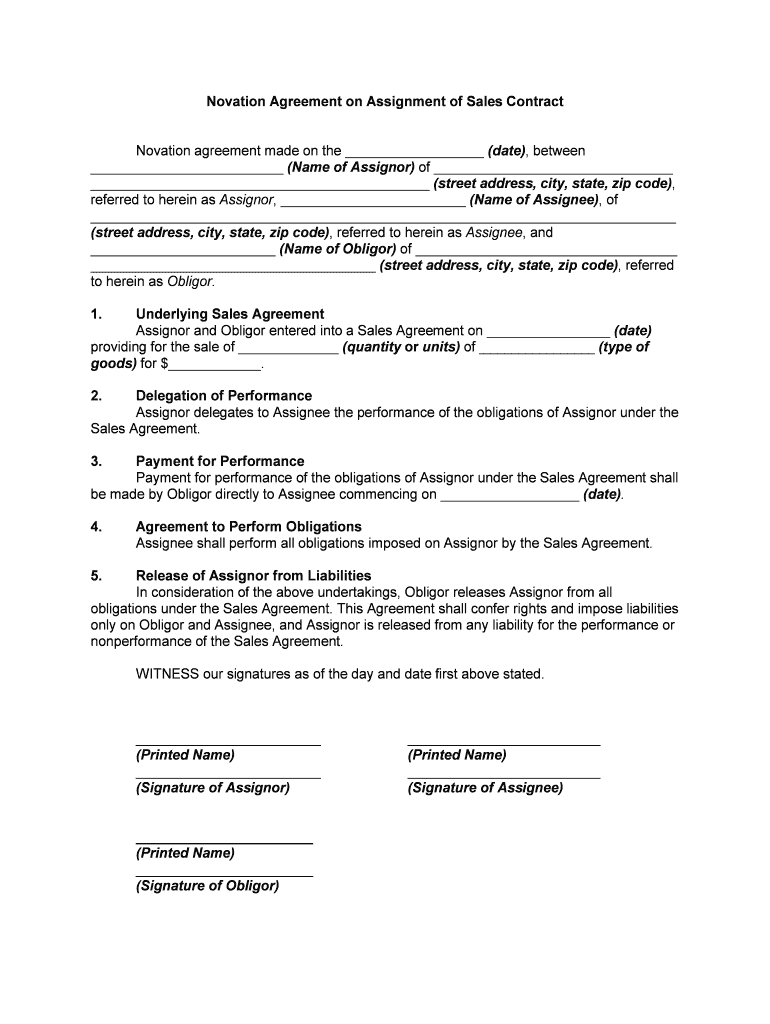
A Novation Agreement is a written contract that replaces one party in an existing agreement with another party, transferring both rights and obligations to the incoming party. Unlike a simple assignment, novation requires the mutual consent of the original parties and the new party so the original contracting party is released from future liabilities. Novations are common when businesses are sold, when contracts are restructured, or when a supplier or contractor is substituted. The document usually states the effective date, identifies the replaced party and transferee, and confirms consideration and consent.

Why use a Novation Agreement

A Novation Agreement clears legal title to contractual obligations, removes a departing party’s ongoing liability, and preserves continuity of rights for the counterparty without drafting a new primary contract.

Why use a Novation Agreement

Who typically prepares or signs a Novation Agreement

Novation Agreements are used by parties that need a clean transfer of contractual duties and rights rather than a partial assignment.

  • Real estate landlords and tenants when a leasehold interest is transferred to another entity.
  • Corporate sellers and buyers during asset or business sales affecting existing service contracts.
  • Contract managers and general contractors replacing subcontractors or suppliers on ongoing projects.

Each signer should confirm authority to bind their organization and preserve documentation proving consent and consideration.

Typical signatories and their roles

General Counsel

General counsel or outside counsel usually advises on novation terms, confirms release language, and ensures the new party assumes liabilities without creating gaps in the original contract coverage.

Contract Manager

Contract managers or procurement leads coordinate execution logistics, collect signatures, confirm deliverables and notice requirements, and update contract registers and AM systems.

Essential clauses to include in a professional Novation Agreement

A clear, professionally drafted novation includes identification, consent, assumption, release, effective date, and dispute resolution clauses to avoid ambiguity and preserve enforceability.

Parties

Full legal names and entity types for the original parties and the incoming party, including state of incorporation and principal address to avoid identity confusion.
Consent Clause

A statement that all original contracting parties consent to the substitution, expressly acknowledging that the incoming party assumes both rights and obligations under the original agreement.

Assumption of Obligations

Specific language by which the transferee accepts liabilities, performance duties, and any pending or prospective obligations under the primary contract.

Release of Transferor

An explicit release stating the original party is discharged from future liability once novation is effective, subject to any carve-outs or retained obligations.

Consideration

Description of consideration or mutual promises that support the novation, which can be monetary, a credit, or mutual contractual concessions.

Effective Date and Notices

A clear effective date and updated notice addresses plus any required consent or notice procedures specified in the original contract for substitutions.

Information commonly required in the agreement

Effective Date: MM/DD/YYYY
Original Party: Full legal name
Incoming Party: Full legal name
Original Contract: Title and date
Consideration: Amount or description
Signatures: Printed name and date

Key legal risks if a Novation Agreement is incorrect

Incomplete Consent: Liabilities may remain with transferor
Poorly Drafted Release: Counterparty may sue transferor
Ambiguous Effective Date: Performance gaps can occur
Missing Consideration: Enforceability challenges
Failure to Record: Third-party priority issues
Authentication Errors: E-signature admissibility risk

Common drafting and execution mistakes to avoid

  • Using generic assignment language instead of explicit novation language that releases the transferor.
  • Failing to update notice addresses or contact points, which can invalidate contractual notice requirements.
  • Omitting the original agreement’s title and date, making it unclear which contract is being novated.
  • Allowing unsigned or partially executed novations to stand in high-volume portfolio transfers without documented ratification.

Step-by-step: how to execute a Novation Agreement

Follow these sequential steps to prepare, approve, and finalize a novation with certainty and traceability.

  • 01
    Identify Contract: Confirm the exact agreement to be novated.
  • 02
    Obtain Consent: Secure written consent from all original parties.
  • 03
    Draft Novation: Include release, assumption, effective date.
  • 04
    Execute and Record: Sign, notarize if required, update records.

How to set up an online novation signing workflow

Configure your eSigning workflow to authenticate signers, capture clear intent, and preserve an audit trail for enforceability.

Field Configuration
Authentication Email link or SMS code; use MFA for higher assurance
Signature Type Electronic signature with timestamp; consider certificate-based signature if required
Notary Enable remote online notarization or schedule in-person notarization as needed
Retention Store signed PDF and audit trail with access controls

Where to file, send, and who to notify after signing

After execution, route copies to all parties, update contract repositories, and file with third parties if required by the primary contract.

  • Send to Parties: Email final signed copy to all signatories.
  • Update Registers: Record novation in contract and vendor systems.
  • Third Parties: Notify lenders or licensors if required.
  • Recordation: File with recorder for real property interests.

Typical timing and processing expectations

Timing depends on contract notice periods and any required third-party consents; plan for internal approvals and external acknowledgements.

Internal Review Time:

Allow 3–10 business days for legal and procurement review.

Counterparty Consent:

Obtain written consent within contract-specified notice periods.

Notarization Scheduling:

Book notary or RON session at least 2–7 business days ahead.

Recording Delay:

Recording with county may take 7–30 days depending on backlog.

Post-Execution Updates:

Update systems and send notices within 5 business days.

Common eSignature pricing and capability comparison for novation workflows

eSignature vendors vary by price model, bulk-send capability, audit trail features, and HIPAA availability — select a plan that supports required authentication and retention.

signNow DocuSign Adobe Sign PandaDoc HelloSign
Starting Price $8/user/mo $15/user/mo $14/user/mo $19/user/mo $15/user/mo
Free Trial 7-day free trial Varies Varies Varies Varies
Bulk Send Yes Yes Yes Yes No
Audit Trail Yes Yes Yes Yes Yes
HIPAA Compliant Yes Yes Yes No No
Envelope Cap No cap 100 envelopes/user/year Varies Varies Varies

Frequently asked questions about Novation Agreements

Answers address frequent points of confusion including enforceability, electronic execution, notarization, revocation, and the difference from assignment.


Need help? Contact support

be ready to get more
Join over 28 million airSlate SignNow users