Identification
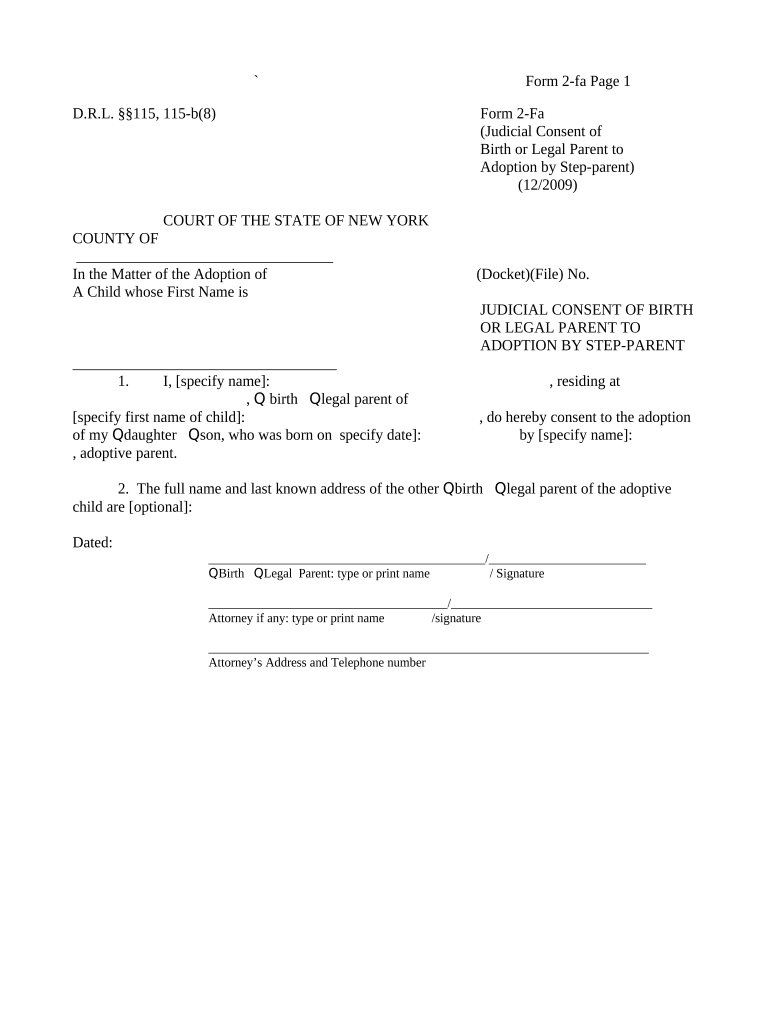
Full legal names and contact information for the consenting parent, the child, and the adopting step-parent to establish parties clearly for the court record.
A properly executed judicial consent clarifies parental rights, supports the court record, and reduces delays in the adoption process. It establishes the consenting parent’s voluntary relinquishment or approval and helps judges determine whether statutory requirements and best-interests standards are satisfied.

Typical users include the consenting birth or legal parent, the adopting step-parent, family law attorneys, and court clerks processing adoption petitions.
The form’s audience also includes child welfare agencies and, when required, guardians ad litem; accurate completion streamlines judicial review.
The birth or legal parent who is giving consent. This person must provide full legal name, date of birth, relationship to the child, and sign under oath or before an authorized official; courts verify voluntariness and mental capacity.
The step-parent seeking to adopt. The adopting parent is identified in the petition and frequently required to appear or be listed in court paperwork; their details help the court assess home environment and eligibility.
Full legal names and contact information for the consenting parent, the child, and the adopting step-parent to establish parties clearly for the court record.
A concise statement that the parent consents to adoption, specifying whether the consent is unconditional, limited, or subject to conditions and describing any legal restrictions.
A sworn affirmation or notary block confirming the signer understands rights and signs voluntarily, which courts routinely require to confirm authenticity.
Space for case number, county, and judge name so clerks can attach the consent to the correct petition and docket entry.
Fields documenting that required notices were provided to the other parent, guardian ad litem, or child welfare agency as applicable under state law.
Signature block for the consenting parent, dated and witnessed or notarized per state rules to ensure evidentiary weight in court proceedings.
| Field | Configuration |
|---|---|
| Signature Block | Require signature and date field; lock after signing |
| Notary Block | Include visible notary block for in-person or RON notarization |
| Signer Authentication | Use email + SMS or stronger ID verification depending on court preference |
| Attach Petition | Route consent as attachment to petition PDF for filing |
Confirm the court accepts PDF filings and whether a scanned original or electronic original is required before using an eSignature platform.
When courts permit electronic submissions, ensure the platform preserves an audit trail and supports notarization workflows (in-person or RON) to meet statutory and local court rules.
Varies by state; often 30–90 days before final decree
Date consent is signed and notarized
Scheduled by family court after petition filing
Some states allow limited revocation within days
File concurrently with adoption petition
Consenting parent signs and notarizes the form
Adopting parent files the adoption petition with attachments
Required parties are served and notified
Judge reviews records and holds hearing
| signNow | DocuSign | Adobe Sign | PandaDoc | HelloSign | |
|---|---|---|---|---|---|
| Starting Price | $8/user/mo | $15/user/mo | $14/user/mo | $19/user/mo | $15/user/mo |
| Free Trial | 7-day free trial | Varies by plan | Varies by plan | Varies by plan | Varies by plan |
| Bulk Send | Yes | Yes | Yes | Yes | No |
| Audit Trail | Yes | Yes | Yes | Yes | Yes |
| HIPAA Compliant | Yes | Yes | Yes | No | No |
A consenting parent signs a notarized consent to allow their spouse to adopt the child
A parent provides conditional consent limited to supervised visitation provisions