Establishing secure connection…Loading editor…Preparing document…

Minutes of Meeting of Directors

This template is fully customizable. Edit the text, fill out the fields, and send it for signature. Give it a try!
Minutes of Meeting of Directors

What Minutes of Meeting of Directors Are and why they matter

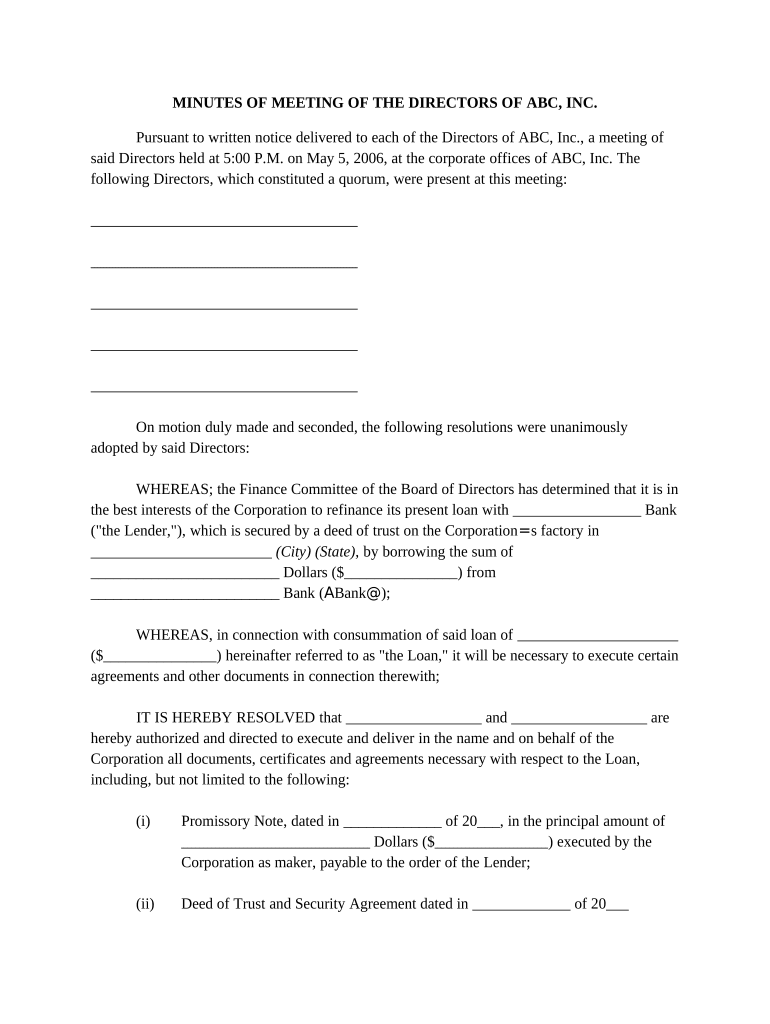
Minutes of Meeting of Directors are the official corporate record summarizing the actions, decisions, and material discussions of a board meeting. They document attendance, motions, votes, resolutions, and any director authorizations, and they support corporate governance, regulatory compliance, and internal audit trails. Properly drafted minutes form evidence of board deliberations and protect the corporation and its officers by showing that decisions were made according to bylaws and fiduciary duties.

Purpose and legal standing of accurate board minutes

Minutes create a contemporaneous record that supports corporate decisions, demonstrates compliance with bylaws, and reduces personal liability for directors. They are evidence for auditors, regulators, lenders, and in litigation.

Purpose and legal standing of accurate board minutes

Who prepares and relies on board meeting minutes

Proper role assignments speed approval, reduce errors, and make minutes defensible in audits or litigation.

  • Corporate Secretary or Clerk — prepares the draft, records attendance, and maintains the corporate minute book for future reference.
  • General Counsel — reviews minutes for legal precision and to ensure resolutions match corporate authority and regulatory obligations.
  • Board Chair and Directors — review and approve minutes to confirm an accurate record of board action and votes.

Essential elements to include in professional board minutes

A complete Minutes of Meeting of Directors should be clear, concise, and structured to reflect formal corporate decision-making.

Meeting ID

Date, start time, end time, and meeting type (regular, special, reconvened) so the record clearly identifies the session.
Attendance

Names of directors present, absent, invited guests, and whether quorum was established to validate any corporate action taken.

Agenda Items

Succinct descriptions of each agenda item discussed, including any reports presented and documents referenced during deliberations.

Motions and Votes

Exact wording of motions, who moved and seconded, vote tally (for/against/abstain), and any director recusals.

Resolutions

Text of adopted resolutions or delegated authorities, including delegated signatory powers and effective dates where applicable.

Signatures

Signature block for the board secretary and board chair or authorized officer confirming accuracy and approval of the minutes.

Required fields and quick-reference checklist

Meeting Date: MM/DD/YYYY
Meeting Type: Regular or special
Quorum Statement: Yes or No
Motion Text: Exact wording
Vote Record: For/Against/Abstain
Approval Signature: Secretary / Chair

Step-by-step: preparing and approving minutes

Follow a consistent sequence from draft to approved minute to maintain record integrity and avoid disputes.

  • 01
    Draft the Minutes: Prepare a factual draft within a few days after the meeting.
  • 02
    Circulate for Review: Share the draft with directors and counsel for factual corrections only.
  • 03
    Approve at Next Meeting: Place minutes on the subsequent board agenda for formal approval.
  • 04
    Finalize and Store: Date and sign the approved minutes and add to the minute book or digital repository.

Configuring an online minutes workflow

Set up a repeatable digital workflow to draft, review, sign, and store minutes with role-based access and an audit trail.

Field Configuration
Draft Template Create a reusable minutes template with standard headings and placeholders.
Review Permissions Limit edit access to corporate secretary and counsel; allow comments for directors.
Approval Flow Route to chair or board for formal approval; record approval timestamp.
Retention Policy Automatically archive to secure repository after approval.

Digital signing and storage considerations

Maintain access controls and an exportable audit record to meet corporate governance and regulatory review needs without compromising confidentiality.

  • Authentication: Multi-factor or strong ID verification for signers.
  • Audit Trail: Complete timestamps, IP, and action log retained.
  • Secure Storage: AES-256 at rest and TLS 1.2/1.3 in transit.

Where to file, distribute, and retain approved minutes

After approval, follow a standard routing to preserve the official record and make it available to authorized stakeholders.

  • Corporate Minute Book: Add the signed minutes to the company minute book (physical or digital master copy).
  • Board Distribution: Send the approved minutes to all directors and key executives for their records.
  • Legal and Finance: Provide copies to legal counsel and finance for compliance and audit purposes.
  • Secure Archive: Store long-term in an encrypted document repository with versioning and access logs.

Timing expectations and common internal deadlines

Set consistent internal deadlines to ensure minutes are timely, accurate, and approved according to corporate governance practices.

Draft Within Days:

Prepare an initial draft within 3–7 business days after the meeting.

Review Period:

Allow 7–14 days for director review and factual corrections before formal approval.

Approval at Next Meeting:

Place minutes on the next scheduled board meeting agenda for formal approval.

Sign-off Timeline:

Obtain signatures within 30 days of approval where possible to finalize the record.

Retention Start Date:

Retention begins from the meeting date or the approval date per company policy.

Common mistakes to avoid when preparing minutes

  • Including hearsay or editorial comments rather than neutral, factual descriptions of discussion and action.
  • Omitting quorum statements, vote tallies, or recusals that later impair proof of valid corporate action.
  • Failing to link minutes to supporting documents or resolutions referenced during the meeting.
  • Delaying drafting and approval so long that recollections differ and factual corrections proliferate.

Risks and potential consequences of inaccurate minutes

Corporate Liability: Undermined defense in derivative suits
Regulatory Scrutiny: Heightened review by regulators or auditors
Contract Risk: Unclear authority may void transactions
Tax Exposure: Missing approvals can complicate tax positions
Investor Relations: Erosion of investor trust and governance scores
Operational Confusion: Impaired execution of delegated authorities

Practical examples of board minutes in common scenarios

These condensed examples show how minutes record different types of board actions and outcomes.

M&A Approval Example

Draft records the negotiated acquisition terms and board consent

  • Motion records the approval and delegated signatory authority
  • The final paragraph notes compliance with bylaws, ratifies prior acts, and directs officers to execute closing documents, creating a clear audit trail for counsel and regulators.

Executive Compensation Example

Minutes summarize compensation committee recommendations and rationale

  • Motion documents the vote to adopt a new package
  • The outro confirms conflict disclosures were reviewed and that approvals comply with corporate policy and SEC disclosure expectations.

Practical tips for accurate, efficient minutes preparation

Adopt consistent formats and controls to reduce review time and improve reliability across successive meetings.

Use a standard template
A template enforces consistent headings, quorum language, motion structure, and signature blocks so minutes are uniform and easier to approve.
Record motions verbatim
Capture exact motion language and vote counts; precise wording prevents later disputes about scope or authority of board actions.
Separate confidential materials
Keep minutes that record privileged legal advice or sensitive negotiation details in a secure, access-restricted file to preserve privilege and confidentiality.
Leverage secure e-signing
Use an e-signature solution that provides an audit trail and secure storage to speed approvals while maintaining evidentiary records.

eSignature vendor comparison for signing and storing minutes

Common vendor attributes for signing and archiving board minutes vary by price and compliance features; signNow is listed first for parity in comparison.

signNow DocuSign Adobe Sign PandaDoc HelloSign
Starting Price $8/user/mo $15/user/mo $14/user/mo $19/user/mo $15/user/mo
Free Trial 7-day free trial Varies by vendor Varies by vendor Varies by vendor Varies by vendor
Bulk Send Available on select plans Varies by plan Varies by plan Varies by plan Varies by plan
Audit Trail Yes Yes Yes Yes Yes
HIPAA Compliant Yes Yes Yes No No

Frequently asked questions about board minutes

Answers to common questions about validity, e-signatures, corrections, notarization, and retention of Minutes of Meeting of Directors.


Need help? Contact support

be ready to get more
Join over 28 million airSlate SignNow users