Establishing secure connection…Loading editor…Preparing document…

Grant of Conservation Easement

This template is fully customizable. Edit the text, fill out the fields, and send it for signature. Give it a try!
Grant of Conservation Easement

What a Grant of Conservation Easement Is and when it’s used

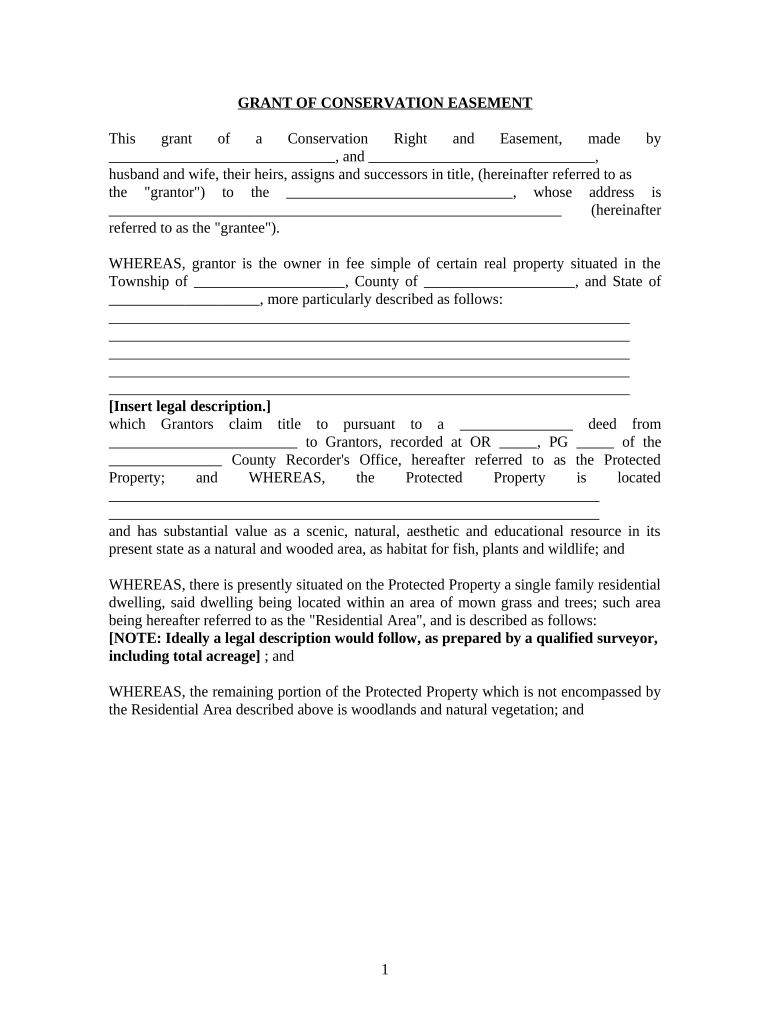
A Grant of Conservation Easement is a legally binding deed by which a landowner (the grantor) conveys specific development rights and use restrictions over real property to a qualified holder (charitable organization, government entity, or land trust). The instrument defines permitted and prohibited uses, the conservation purposes served, monitoring and enforcement rights, and whether the easement is perpetual or time-limited. It is recorded in the county land records to provide notice to future owners, and it often supports federal or state tax benefits when properly documented and appraised.

Why properly drafted conservation easements matter

A clear Grant of Conservation Easement preserves conservation objectives, reduces future disputes, and establishes enforceable rights and remedies for the easement holder under state property law.

Why properly drafted conservation easements matter

Typical users and stakeholders

These documents involve multiple parties — landowners, conservation organizations, legal counsel, title companies, and government agencies.

  • Land trusts and government agencies — negotiate terms, hold, monitor, and enforce conservation values over time.
  • Private landowners and donors — grant rights, provide baseline documentation and appraisals, and comply with reporting requirements for tax benefits.
  • Real estate and tax attorneys — draft, review legal language, confirm tax compliance, and coordinate recording with title companies.

Core elements every professional Grant of Conservation Easement should include

A complete easement instrument combines precise legal descriptions with enforceable use restrictions, reserved rights, enforcement procedures, and recording instructions to ensure long-term protection and clarity for all parties.

Granting Clause

A clear conveyance statement identifying the grantor, the grantee (easement holder), and the specific property interests being conveyed.
Legal Description

A metes-and-bounds or recorded plat reference that unambiguously identifies the real property subject to the easement for recording and title purposes.

Conservation Purpose

Explicit statement of the conservation goals (e.g., habitat, open space, agricultural protection) that limit permitted uses and changes.

Reserved Rights

List of rights retained by the grantor (e.g., timber harvest, public access rules) with conditions and limitations to prevent ambiguity.

Enforcement & Monitoring

Procedures for inspections, notice, cure periods, remedies for violations, and the holder’s authority to enforce the terms.

Recording Instructions

Direction to record the easement in county land records with signature, notary, and any required attachments or exhibits.

Step-by-step completion and execution workflow

Follow these steps to prepare, sign, and record a Grant of Conservation Easement with minimal errors.

  • 01
    Drafting: Prepare full text, exhibits, and legal description for review.
  • 02
    Internal Review: Holder and grantor counsel confirm terms, reserved rights, and enforcement provisions.
  • 03
    Execution: Signatures obtained, notarized as required, and dated on the final signed document.
  • 04
    Recording: File with county recorder, attach exhibits, and obtain the recorded instrument number.

How the grant, signing, and recording process flows

A concise routing sequence clarifies who reviews, signs, notarizes, and records the easement and when each step must occur.

  • Prepare Package: Assemble deed, exhibits, baseline documentation, and appraisal.
  • Review & Approve: Legal and title review clear encumbrances and accuracy.
  • Sign & Notarize: Obtain signatures and notary or RON per state rules.
  • Record & Archive: Record in county; distribute copies to parties and holder.

Configuring a digital execution workflow for the easement

Set up the signing sequence, authentication, and recording attachments before sending documents for signature.

Field Configuration
Authentication Method Email link with optional SMS code or KBA per state requirements
Signing Order Specify grantor then holder; notary step last
Notary / RON Enabled Enable remote online notarization where state permits
Recording Attachments Include exhibits, baseline report, and appraisal as PDF attachments

Digital delivery and format considerations

Ensure the platform supports the file formats and signer authentication your jurisdiction and title company require.

  • Formats Supported: PDF, DOCX, and flattened PDF/A for recording
  • Integrations: Salesforce, NetSuite, Google Workspace available
  • Audit Trail: Timestamp, IP, and signer attribution

Key timing and filing considerations

Timely recording and tax filings protect priority and support potential charitable contribution treatment.

Execution Date:

Sign and notarize according to the effective date stated in the easement

Recording Deadline:

Record promptly after execution to ensure priority against subsequent interests

Tax Filings:

File charitable deduction claims with your annual Form 1040 by April 15 or extension

Appraisal Timing:

Obtain qualified appraisal contemporaneously with the donation for IRS review

Monitoring Schedule:

Establish inspection intervals (annual or multi-year) as required in the easement

Common mistakes and pitfalls to avoid

  • Using vague language for reserved rights that leaves room for disputes about permitted activities and future development.
  • Failing to attach baseline documentation and maps, which weakens enforcement and complicates appraisals for tax purposes.
  • Neglecting to confirm county recorder technical requirements for electronic submission or exhibit formatting before e‑filing.
  • Omitting a clear enforcement remedy or cure period, increasing the cost and difficulty of resolving violations.

Risks and consequences of improper execution or recording

Invalid Recording: Loss of priority
Tax Disallowance: Denial of deduction
Enforcement Costs: Litigation and remediation expenses
Title Issues: Clouded title or insurance denial
Boundary Disputes: Increased survey and legal costs
Loss of Rights: Grantor or holder uncertainty

Comparison of eSignature vendor pricing and key features

Pricing and feature availability vary by plan; the table below shows starting price and common feature availability for five vendors.

signNow DocuSign Adobe Sign PandaDoc HelloSign
Starting Price $8/user/mo $15/user/mo $14/user/mo $19/user/mo $15/user/mo
Free Trial Yes, 7-day free trial No No Yes, limited Yes, limited
Bulk Send Yes (Premium tier) Yes Yes Yes No
Audit Trail Yes Yes Yes Yes Yes
HIPAA Compliant Yes (BAA available) Yes Yes No No

Frequently asked questions about Grants of Conservation Easement

Answers to common execution, recording, tax, and digital signing questions to reduce risk and improve compliance.


Need help? Contact support

be ready to get more
Join over 28 million airSlate SignNow users