Establishing secure connection…Loading editor…Preparing document…

Oklahoma Calculation Garnishment

This template is fully customizable. Edit the text, fill out the fields, and send it for signature. Give it a try!
Oklahoma Calculation Garnishment

What the Oklahoma Calculation Garnishment Is

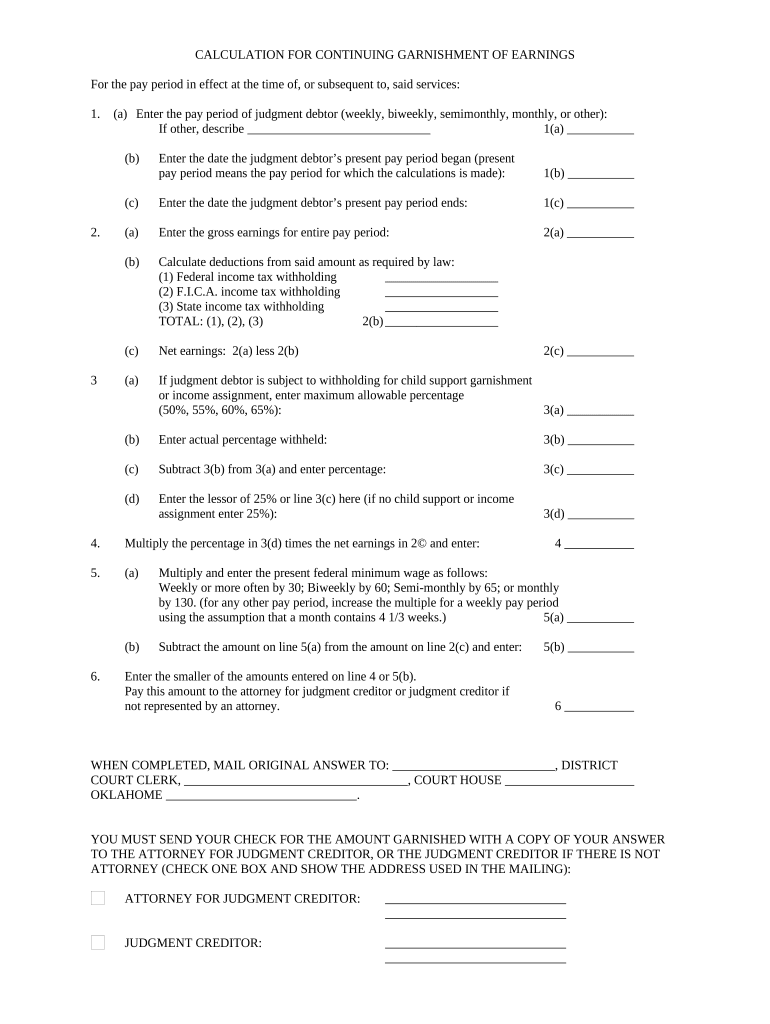
The Oklahoma Calculation Garnishment is a formal worksheet or court-directed form used to compute the amount of wages or other income to be withheld from a debtor in Oklahoma pursuant to a judgment, support order, or statutory lien. It documents the debtor's disposable earnings, allowable exemptions, priority deductions, and the final garnishment amount for each pay period. Employers, payroll administrators, attorneys, and court clerks use the calculation to ensure withholding complies with federal limits and the issuing order. Accurate calculations protect employers from liability and ensure proper distribution to creditors or obligees.

Why a Proper Calculation Matters

A correct Oklahoma Calculation Garnishment ensures withholdings comply with the court order, federal wage-garnishment limits, and state rules, reducing employer risk and protecting debtor rights.

Why a Proper Calculation Matters

Who Completes and Relies on the Calculation

Parties involved include employers, payroll teams, creditor attorneys, and court clerks who must prepare or verify garnishment computations.

  • Payroll administrators responsible for implementing withholding and remitting funds to the court or creditor.
  • Creditor or obligee representatives requesting accurate withholding amounts and proving entitlement to funds.
  • Judicial officers or clerks reviewing computations to confirm compliance with the order and statutory caps.

Accurate preparation reduces disputes, accelerates remittance, and supports compliance with federal and state statutes.

Stepwise Process to Complete the Garnishment Calculation

Follow these steps in order to produce an accurate garnishment amount aligned with the court order and applicable law.

  • 01
    Gather order: Obtain the court order or support notice and read withholding instructions.
  • 02
    Collect payroll data: Pull the debtor's gross pay, pay period, and mandatory deductions.
  • 03
    Compute disposable: Subtract required taxes and deductions to find disposable earnings.
  • 04
    Apply cap: Apply federal/state garnishment limits and compute final withholding.

How Garnishment Moves From Order to Payroll

This sequence explains the operational flow from receiving a garnishment to remitting withheld funds.

  • Court issues order: Judicial clerk sends the garnishment or withholding order to the creditor or employer.
  • Serve employer: Employer receives the order by certified mail or authorized electronic service.
  • Employer computes: Payroll computes disposable earnings and withholding amount each pay period.
  • Remit funds: Employer sends withheld amounts to the creditor or court per instructions.

Digital Workflow Settings for Completing Calculations Online

Configure your e-sign and form workflow to capture data, authenticate signers, and retain a tamper-evident audit trail.

Field Configuration
Authentication Use email plus SMS or ID verification for payroll signers
Calculation field Use numeric formula fields to auto-calculate disposable earnings
Notifications Enable email alerts for served orders and completed calculations
Retention Store signed PDF with audit trail for required retention period

Platform Capabilities for eSubmission and Signatures

Select a platform that supports secure signing, audit trails, and integrations with payroll or document systems.

  • Document formats: PDF, DOCX, and fillable forms supported
  • Integrations: Connects with HR and storage systems
  • Security: TLS and AES encryption in place

For high-volume or recurring garnishments, choose a solution with templates, formula fields, bulk send, and audit logs to reduce manual work.

Timing Expectations and Common Deadlines

Garnishment processing follows sequence-based timings that depend on service method, payroll cycles, and the court's remittance schedule.

Start withholding:

Begin at the next payroll cycle after lawful service of the order

Remittance schedule:

Remit withheld amounts per the court or creditor's instructions

Employer accounting:

File payroll accounting if the order or court calendar requires it

Debtor notice:

Provide any statutorily required notices to the debtor promptly

Appeals window:

Debtor may seek relief per the issuing court's procedural rules

Common Preparation Errors to Avoid

  • Misclassifying deductions leads to incorrect disposable earnings and over- or under-withholding.
  • Failing to check priority of multiple garnishments can result in improper distributions or creditor disputes.
  • Not documenting the calculation steps and sources makes it difficult to defend employer actions in court.
  • Delivering the order incorrectly or missing service requirements can delay withholding and create liability.

Consequences of Incorrect Garnishment Calculations

Employer liability: Civil damages or restitution
Court sanctions: Contempt or fines possible
Tax issues: Backup withholding risks apply
Administrative penalties: State fines or compliance notices
Debtor hardship: Excessive withholding may trigger claims
Data breach: Privacy violations can incur penalties

Essential Sections of a Professional Garnishment Calculation

A complete worksheet includes case identifiers, income details, legal deductions, computation steps, certification, and distribution instructions so third parties can verify results.

Case Header

Court name, case number, and issuing judge to clearly associate the calculation with the order and jurisdiction.
Debtor Details

Debtor name, address, SSN last four, and employer details for accurate identification and recordkeeping.

Income Table

Gross pay, pay period, frequency, and required deductions used to compute disposable earnings.

Computation Steps

Line-by-line math showing excluded deductions, exemptions, and final garnishment amount for transparency.

Payment Schedule

When amounts are withheld and when remittances are due to the creditor or court per order terms.

Certification

Signature block for the payroll officer, date, and contact information to certify accuracy and responsibility.

Supporting Documents Commonly Attached

Attach documents that substantiate earnings, deductions, and legal authority to make the garnishment calculation clear and defensible.

Court Order

Certified copy of the judgment or withholding order indicating amount, priority, and remittance instructions.

Payroll Records

Pay stubs, timesheets, and payroll register entries for the pay periods used in the computation.

Tax Withholding

Evidence of mandatory tax, FICA, and other deductions applied before computing disposable earnings.

Service Proof

Return receipt, certified mail, or other proof that the employer was lawfully served.

Best Practices for Accurate and Efficient Completion

Adopt repeatable controls, templates, and audit trails to minimize errors and streamline garnishment processing.

Verify identities and orders
Confirm the debtor and case number match court documents; verify the order's effective date and any priority language before withholding.
Automate calculations
Use formula fields or payroll integrations to reduce manual math errors and ensure consistent application across pay periods.
Document every step
Keep signed worksheets, remittance receipts, and communications to the debtor for defense against disputes or audits.
Seek counsel for ambiguity
If the order conflicts with federal caps or other liens, consult legal counsel before adjusting payroll withholdings.

eSignature Vendor Comparison — Pricing and Core Capabilities

Compare baseline pricing and core capabilities relevant to processing and signing garnishment calculations; signNow appears first as the reference platform.

signNow DocuSign Adobe Sign PandaDoc HelloSign
Starting Price $8/user/mo $15/user/mo $14/user/mo $19/user/mo $15/user/mo
Free Trial 7-day free trial Varies by vendor Varies by vendor Varies by vendor Varies by vendor
Bulk Send Yes (Business Premium+) Varies by plan Varies by plan Varies by plan Varies by plan
Audit Trail Yes Yes Yes Yes Yes
HIPAA Compliant Yes (BAA required) Varies by plan Varies by plan Varies by plan Varies by plan
Envelope Cap No cap 100 envelopes/user/year Varies Varies Varies

How Organizations Use eSign and Templates for Legal Forms

These cases show how document automation and signing platforms have improved throughput for legal and payroll paperwork across organizations.

Optica Ventures (COO)

The team centralized legal paperwork and templates to reduce turnaround time.

  • They deployed templates and shared links across teams.
  • "The interface is simple and easy-to-use for our team; more importantly, it is just as easy for our customers."

Tech Data (CEO)

Legal and finance teams standardized external notices and remittances.

  • Integration with backend systems automated delivery.
  • "Tech Data uses airSlate SignNow to improve our internal and external customer service while increasing our speed to revenue."

Frequently Asked Questions About Oklahoma Garnishment Calculations

Answers to common questions on when to start withholding, how to compute disposable earnings, e-sign validity, recordkeeping, and employer obligations.


Need help? Contact support

be ready to get more
Join over 28 million airSlate SignNow users