Establishing secure connection…Loading editor…Preparing document…

Oklahoma Guardianship Report

This template is fully customizable. Edit the text, fill out the fields, and send it for signature. Give it a try!
Oklahoma Guardianship Report

What the Oklahoma Guardianship Report Is

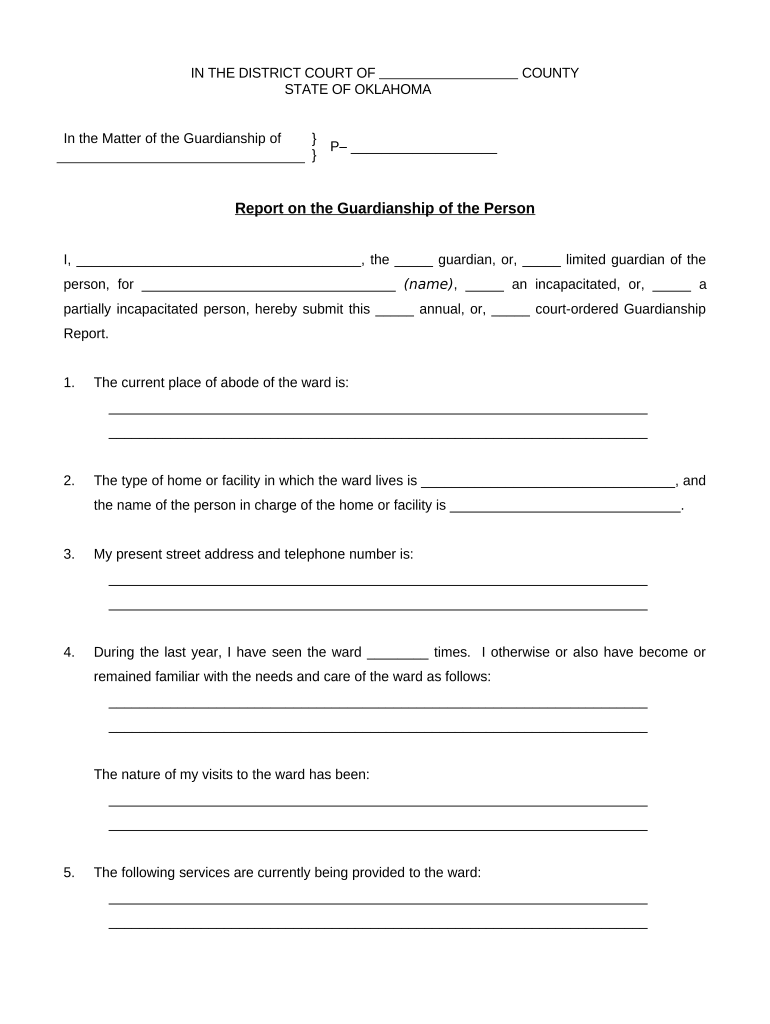
The Oklahoma Guardianship Report is a court-filed document used to update the probate or district court on the status of a ward and the guardian's administration of the ward's person or estate. It typically includes identifying case details, the guardian's inventory of assets, financial accountings, health and living arrangements, and recommendations for continued oversight. Courts use these reports to evaluate compliance with court orders, consider petitions for modification or termination, and protect the ward's welfare. Timing, required sections, and supporting exhibits are governed by local court rules and the supervising judge's orders.

Why a Clear Guardianship Report Matters

A complete, accurate report documents decisions and finances for court review, maintains legal compliance, and protects the guardian and ward by creating a transparent record for the judge, family members, and other stakeholders.

Why a Clear Guardianship Report Matters

Step-by-Step: Completing the Report

Follow these sequential steps to prepare, validate, and submit the guardianship report to the court and interested parties.

  • 01
    Gather Documents: Collect inventories, bank statements, medical summaries, and prior court orders.
  • 02
    Complete Report: Populate all fields, attach exhibits, and verify names and dates.
  • 03
    Sign and Notarize: Obtain guardian signature(s) and notarization when required by local rule.
  • 04
    File and Serve: File with the clerk and serve statutorily required parties per court rules.

Frequently Asked Questions and Practical Answers

Answers to the most common procedural and filing questions about the Oklahoma Guardianship Report, focusing on filing, timing, signatures, and amendments.


Need help? Contact support

Who Prepares and Reviews These Reports

Several distinct roles interact with the Oklahoma Guardianship Report during preparation and review.

  • Appointed guardians or conservators who manage the ward's person or estate and complete the substantive reporting.
  • Attorneys for guardians, ward, or interested parties who prepare filings and ensure legal compliance.
  • Court clerks and judges who receive, review, and act on the filed reports.

Clear role definition reduces delays and ensures required service and court review happen on schedule.

Typical Users of the Oklahoma Guardianship Report

Public Guardian — Program Director

A county or state public guardian office often files reports for wards under public guardianship. Their filings must reconcile multiple client accounts and follow uniform internal procedures for inventories, payments, and medical oversight.

Private Guardian — Individual

A family member or private professional guardian files periodic reports for a single ward, focusing on personal care decisions, asset management, and prompt submission of required accountings to the court.

Security and Compliance Considerations

Encryption: TLS 1.2/1.3 in transit; AES-256 at rest
Access Controls: Role-based access and authentication
Audit Trail: Timestamps, IP addresses, action history
HIPAA: BAA required for protected health data
ESIGN / UETA: Electronic signature legal frameworks
Retention: Secure archival and export controls

Consequences and Legal Risks of Errors

Court Sanctions: Monetary fines possible
Contempt: Civil contempt for willful noncompliance
Loss of Authority: Guardianship may be modified or removed
Liability Exposure: Personal liability for mismanaged funds
Accountability Hearings: Court-ordered audits or accountings
Criminal Risk: Fraud charges for intentional misconduct

Common Preparation Mistakes to Avoid

  • Incomplete asset descriptions or missing account numbers that prevent accurate account reconciliation and prompt court questions.
  • Incorrect names or case numbers that cause misfiling or require corrected filings and additional clerk work.
  • Unsigned or improperly notarized signature blocks that lead to clerk rejection or motion to validate.
  • Failure to serve required parties or to include required service certificates, triggering continuances or additional hearings.

Filing Flow: From Preparation to Court Review

A clear routing workflow reduces processing time and ensures required parties receive the report.

  • Prepare Packet: Compile report, exhibits, and service copies.
  • Authenticate Signatures: Obtain notarization or required electronic verification.
  • File With Clerk: Submit paper or e-file as permitted locally.
  • Serve Interested Parties: Deliver copies per statutory or court-ordered service rules.

Configuring an Online Workflow for the Report

Set up a repeatable online template and signer flow to reduce errors and speed submission.

Field Mapping Create template fields matching the court form
Authentication Use email or SMS code signer verification
Template Reuse Save a pre-filled template for recurring reports
Notary Support Enable remote or in-person notarization options
Delivery Options Choose e-file, PDF download, or certified mail

Technical Requirements for eSubmission and Storage

Use a platform that produces court-ready PDFs, preserves audit trails, and supports required signer authentication and notary workflows.

  • File Formats: PDF and DOCX support
  • Integrations: Connectors for cloud storage and case management
  • RON and Notary: Audio-video recording and credentialing

For secure eSubmission and long-term retention, choose a solution that provides tamper-evident signed PDFs, detailed audit trails, and integrations with case management or cloud storage systems to meet court and agency needs.

Typical Deadlines and Reporting Expectations

Deadlines for submission and accounting frequently vary by county and by the supervising judge; these are common timing expectations to confirm with the clerk.

Initial Inventory Deadline:

Often within 30–60 days of appointment; county rules vary.

Annual Report:

Many courts require annual reporting; some require more frequent updates.

Interim Accountings:

Accountings may be ordered at set intervals or when requested.

Notice Periods:

Service deadlines for interested parties follow local procedural rules.

Hearing Schedules:

Allow extra time for scheduling if the court requires review.

Key Case Milestones from Appointment to Review

A concise milestone timeline helps guardians track required deliverables and court events.

01

Appointment

Court issues letters of guardianship and sets initial deadlines.

02

Inventory Filing

Guardian files asset inventory for court review and bond calculation.

03

Annual Reporting

Recurring report to update status, finances, and care arrangements.

04

Accountings & Hearings

Full financial accountings and any required hearings or audits.

How the Guardianship Report Differs from Related Documents

Compare core attributes to distinguish the guardianship report from other legal documents used in incapacity and estate planning contexts.

Criteria Guardianship Report Durable Power of Attorney
Primary Purpose court oversight agent authority
Filing Requirement yes, with court no, typically private
Court Supervision ongoing not court-supervised
Typical Signers guardian principal or agent

eSignature Pricing Snapshot for Completing the Report

Select an eSignature vendor that supports PDF output, audit trails, and notarization where required; signNow is listed first for parity in feature comparison with other major vendors.

signNow DocuSign Adobe Sign PandaDoc HelloSign
Starting Price $8/user/mo $15/user/mo $14/user/mo $19/user/mo $15/user/mo
Free Trial 7-day free trial Verify Verify Verify Verify
Bulk Send Yes Verify Verify Verify Verify
Audit Trail Yes Yes Yes Yes Yes
Envelope Cap No cap 100 envelopes/user/year Verify Verify Verify

Practical Examples of Report Use

Two representative scenarios show how the Oklahoma Guardianship Report functions in practice and what courts typically expect.

County Guardian Filing

A public guardian files an initial inventory and first-year report documenting assets and care arrangements

  • The court reviews bond and approves conservatorship accounting
  • The submitted exhibits, including bank statements and medical summaries, supported the guardian's plan and avoided contested hearings by providing clear, contemporaneous records.

Private Guardian Update

A family guardian submits an annual report after a hospitalization and change in care setting

  • The report lists updated medical providers, care costs, and a proposed budget
  • The judge accepted the supplemental disclosures and scheduled no further oversight beyond routine annual review.

Practical Tips for Accurate, Efficient Reports

Adopt consistent document practices to minimize errors, reduce clerk rejections, and streamline court review.

Use Court-Provided Forms
Start with the court's official form or template to match required fields exactly and minimize the risk of omission or formatting-related rejection.
Keep Source Documents Organized
Attach bank statements, bills, receipts, and medical notes in chronological order with clear labels so the court can verify each line item quickly.
Verify Names and Numbers
Double-check case numbers, legal names, and account numbers before filing; small typos are a frequent cause of misrouting and delay.
Record Signature and Notary Details
Maintain copies of notarized signature pages and notary journals or RON session logs to prove authentication if later questioned.
be ready to get more
Join over 28 million airSlate SignNow users