Grantor/Settlor
Clear identification of the grantor, including capacity (individual, trustee, corporate officer), and contact information to confirm authority.
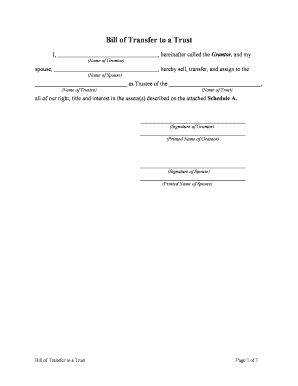
A clear, complete Bill of Transfer preserves property rights, updates legal ownership, and reduces the risk of later title disputes or probate intervention. It creates an auditable record of intent and timing for trustees, beneficiaries, title companies, and tax authorities.

Several parties commonly prepare, review, or sign a Bill of Transfer to a Trust depending on the asset type and transaction complexity.
In many transfers a title company or attorney will confirm form, attach required exhibits, and handle recording or tax filings as needed.
| Field | Configuration |
|---|---|
| Authentication | Email + SMS code or stronger KBA for high-value transfers |
| Signature Type | Use captured signature with audit trail; consider digital signature if required |
| Notary Integration | Enable RON or schedule in-person notarization per state rules |
| Recipient Routing | Define signing order: grantor → notary → trustee → title |
Choose platforms that permit PDF/DOCX uploads, produce audit trails, and support notarization workflows when required.
Confirm the chosen provider supports retention of the full audit trail, TLS/AES encryption, and optional BAA for healthcare contexts; also verify integrations with title or county e-recording services if used.
Determine on signing; governs transfer timing and priority
Notarize at signing; RON must follow state proofing rules
Record promptly with county recorder to assert priority; local timing varies
Reportable transfers may affect filings; consult tax advisor promptly
Keep executed originals per retention rules and recorder requirements
Prepare Bill, attach trust excerpt and legal description; attorney review if needed
Sign parties and complete notary acknowledgements or affidavits
Submit to county recorder and satisfy recording fees or transfer taxes
Update trust records, notify beneficiaries, and update insurance/lender records
Clear identification of the grantor, including capacity (individual, trustee, corporate officer), and contact information to confirm authority.
Full trust name and date, plus designation of trustee and successor trustee for administrative clarity and beneficiary notice.
Precise real property legal description or account identifiers for personal property; include parcel ID or exhibit as necessary.
Statement of intent to transfer, any consideration paid or nominal recital if none, and reference to the trust instrument.
Proper notarial acknowledgement formatted to state law; for RON include required identity-proofing statement and recording details.
County recorder information, fee payer, and any request for return address or recording reference numbers.
A homeowner transfers a single-family parcel into a living trust to avoid probate and centralize estate management.
A grantor assigns ownership of a brokerage account into a revocable trust for continuity and beneficiary designation alignment.
| signNow | DocuSign | Adobe Sign | PandaDoc | HelloSign | |
|---|---|---|---|---|---|
| Starting Price | $8/user/mo | $15/user/mo | $14/user/mo | $19/user/mo | $15/user/mo |
| Free Trial | 7-day free trial | Trial available | Trial available | Limited free plan | Limited free plan |
| Bulk Send | Yes | Yes | Yes | Yes | No |
| Audit Trail | Yes | Yes | Yes | Yes | Yes |
| HIPAA Compliant | Yes | Yes | Yes | No | No |
| Envelope Cap | No envelope cap | 100 envelopes/user/year | Varies by plan | Varies by plan | Varies by plan |