Establishing secure connection…Loading editor…Preparing document…

Oregon Lien

This template is fully customizable. Edit the text, fill out the fields, and send it for signature. Give it a try!
Oregon Lien

What the Oregon Lien Is and when it applies

An Oregon Lien is a statutory claim recorded against real property to secure payment for labor, materials, services, or a judgment related to that property. In practice it notifies interested parties that the claimant asserts a monetary right tied to the property and can affect title transfer and financing until satisfied or released. Mechanic's liens, materialmen's liens, and judgment liens are common forms; procedures and remedies depend on the underlying statute and county recording practices, so accuracy and timeliness matter for enforceability.

Why filing an Oregon Lien matters

Filing a lien preserves a claimant's ability to collect unpaid sums and improves priority against later creditors. It creates a public record that can prompt negotiation or payment without immediate litigation.

Why filing an Oregon Lien matters

Who typically files or responds to an Oregon Lien

Common participants include contractors, suppliers, subcontractors, property owners, and lenders.

  • Contractors and subcontractors asserting unpaid labor or services on a construction project.
  • Material suppliers claiming unpaid materials furnished to a project site.
  • Property owners or lenders responding to, clearing, or defending lien claims.

Each party has distinct obligations and timelines; consult the applicable county recording office or counsel for procedural specifics.

Key components you should include in a professional Oregon Lien

A complete lien claim combines identifying details, contract and payment facts, and an accurate property description to maximize enforceability and reduce dispute risk.

Claimant

Full legal name, business entity type, and a contact address for notices; mismatch risks rejection or enforcement complications when not exact.
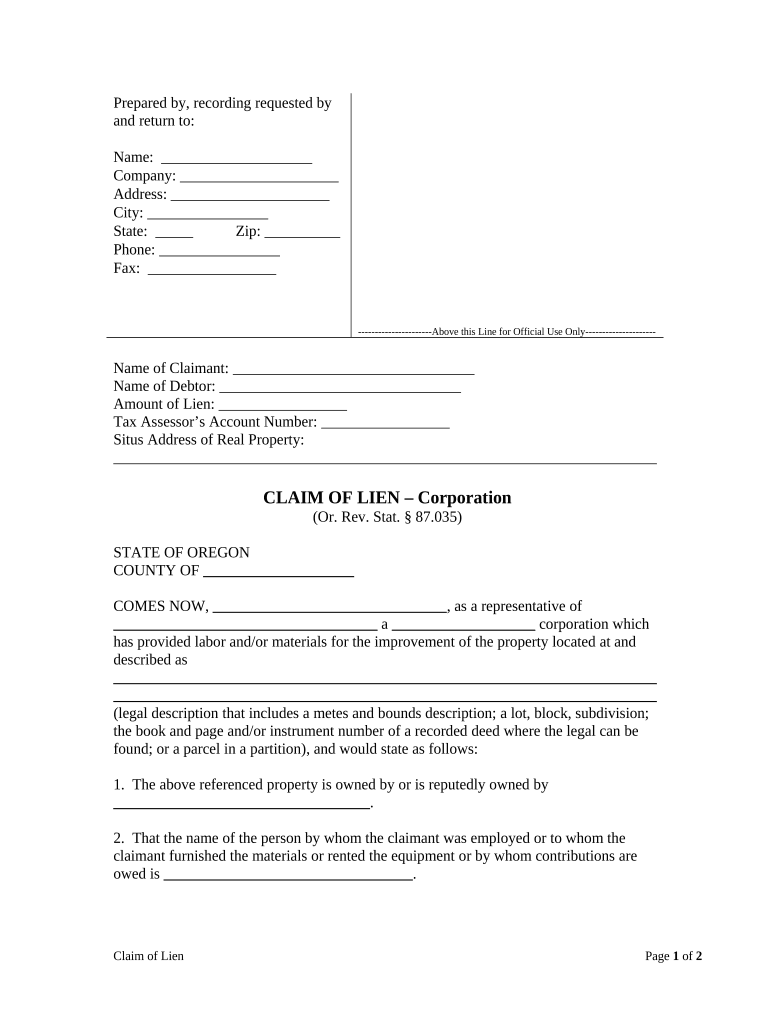
Property

Precise legal description or assessor parcel number and street address. Incomplete property descriptions often result in recording delays or defects in priority.

Contract Details

Type of work performed, contract dates, purchase orders, and job location information that tie the claim to a discrete project and scope.

Amount Owed

Itemized unpaid amounts, retainage, and any interest or agreed penalties with dates for each unpaid invoice to support the claimed sum.

Basis of Claim

Statement of labor, materials, or judgment giving rise to the lien, including contract or invoice references and performance dates.

Signature

Signed and dated by the claimant or authorized agent; include notarization or acknowledgement if required by the recording jurisdiction.

Required fields commonly found on an Oregon Lien form

Claimant Name: Exact legal name
Claimant Address: Street, city, state, ZIP
Property Description: Legal description or APN
Amount Claimed: Total unpaid amount
Basis Stated: Labor, materials, judgment
Signed Date: MM/DD/YYYY

Step-by-step: completing an Oregon Lien

Follow each step carefully; errors or omissions commonly delay recording or weaken enforcement.

  • 01
    Gather documents: Collect contracts, invoices, and delivery records supporting the claim.
  • 02
    Describe property: Use the legal description or assessor parcel number for accuracy.
  • 03
    Calculate amount: Itemize unpaid invoices, retainage, and permitted interest.
  • 04
    Sign and notarize: Sign as claimant or authorized agent; notarize if required by county rules.

Customizing an electronic Oregon Lien workflow

Set up a clear digital workflow for review, signature, and secure submission to reduce mistakes and speed recording readiness.

Field | Setting Configuration
Document Upload PDF, DOCX accepted; include attachments
Signer Order Claimant signs before notary or reviewer
Authentication Email or SMS code for signer identity
Notifications Automated emails for executed documents

Where to file or submit an Oregon Lien

Filing options depend on local practice; confirm the correct recording office and preferred submission method before sending.

  • County Recorder: Primary office for lien recording in most counties.
  • Clerk/County Website: Some counties accept digital uploads or eRecording through vendors.
  • Mail or In-Person: Paper filings typically accepted by mail or at the recorder's counter.
  • E-Recording Services: Third-party eRecording may speed acceptance where available.

Typical timing and deadline considerations for lien claims

Time limits vary by jurisdiction and by the type of lien; file promptly and confirm local deadlines with the county recorder or counsel.

Filing window:

Often 60–180 days after project completion; verify locally.

Commencement of action:

Many states require lawsuit to enforce within 6–12 months of filing.

Notice requirements:

Some jurisdictions require preliminary notices before filing.

Expiration:

Unenforced liens may lapse; renewal procedures differ by state.

Recording response:

Allow processing time—recording may take days to weeks.

Penalties and risks of an incorrect or late Oregon Lien

Loss of Priority: May lose lien priority
Claim Rejection: Recorder may refuse defective filings
Statute Bar: Missed deadlines can bar enforcement
Cost Exposure: Possible liability for attorney fees
Civil Penalties: Sanctions for false claims
Recording Errors: Title problems for owner and lender

Common mistakes to avoid when preparing an Oregon Lien

  • Using an informal property address instead of the legal description or assessor parcel number.
  • Failing to confirm local filing deadlines or required preliminary notices for construction projects.
  • Listing an incorrect claimant name or entity form that does not match tax or corporate records.
  • Signing without required notarization or failing to follow the county's submission format for recorded documents.

Practical tips for accurate and efficient completion

Adopt consistent processes and maintain supporting documentation to reduce disputes and recording issues.

Document everything
Keep organized records of contracts, change orders, delivery tickets, invoices, and communications to substantiate amounts claimed and the timeline of performance. Precise documentation reduces disputes and supports enforcement if litigation is required.
Verify property data
Obtain the exact legal description and assessor parcel number from deed records or the county recorder. Accurate property identifiers are essential for indexing and establishing lien priority; automated title searches can help catch discrepancies.
Confirm procedural steps
Check whether preliminary notices, specific affidavits, or sworn statements are required by the applicable statute or county practice, and follow filing formatting, page margins, and origination rules to avoid rejection.
Coordinate signatures and notarization
Schedule any required notarization or remote online notarization session after finalizing the claim text and before submission to ensure the document is executed in the presence of an authorized notary if the county requires notarized acknowledgment.

Digital signing and eSubmission considerations

When using electronic tools, confirm authentication, audit trail, and storage meet recording and evidentiary needs.

  • Authentication: Email, SMS, or KBA
  • File formats: PDF and DOCX supported
  • Integrations: Connect with cloud storage

Choose tools that provide tamper-evident PDFs, a complete audit log, and secure storage; integrate with county eRecording services where available for electronic submission.

Comparing signNow and other eSignature vendors for lien workflows

Basic pricing and compliance features for commonly considered eSignature vendors. Verify plan details with each vendor before purchase.

signNow DocuSign Adobe Sign PandaDoc HelloSign
Starting Price $8/user/mo $15/user/mo $14/user/mo $19/user/mo $15/user/mo
Free Trial 7-day free trial Varies by plan Varies by plan Varies by plan Varies by plan
Bulk Send Yes Varies by plan Varies by plan Varies by plan Varies by plan
Audit Trail Yes Yes Yes Yes Yes
HIPAA Compliant Yes Yes Yes No No
Envelope Cap No cap 100 envelopes/user/year Varies Varies Varies

Frequently asked questions about Oregon Lien filing and e-signing

Answers to common procedural and technical questions when preparing, signing, and recording an Oregon Lien.


Need help? Contact support

be ready to get more
Join over 28 million airSlate SignNow users