Establishing secure connection…Loading editor…Preparing document…

Party Wall Agreement

This template is fully customizable. Edit the text, fill out the fields, and send it for signature. Give it a try!
Party Wall Agreement

What a Party Wall Agreement Covers

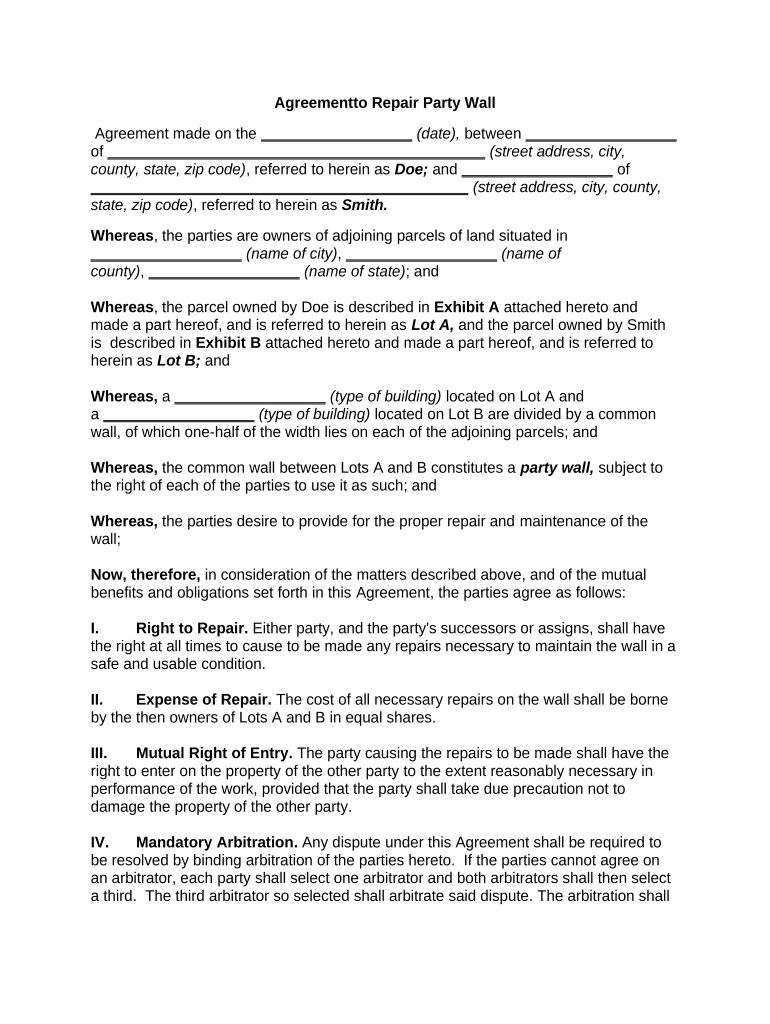
A Party Wall Agreement is a written contract between adjoining property owners that governs construction, repair, or alterations affecting a shared wall, boundary structure, or excavation close to a neighbor's property. It specifies who may carry out work, the scope and timing of work, responsibilities for damage, indemnities, and access arrangements. In the United States, these agreements are typically private contracts tailored to state and local laws; they may be negotiated directly by owners or prepared by attorneys and often include plans, schedules, and signatures from all parties to reduce dispute risk.

Why a Party Wall Agreement Matters

A Party Wall Agreement clarifies legal responsibilities, timelines, and financial liability for work affecting shared structures, reducing litigation risk and enabling coordinated access. Clear terms protect property values and establish remedies for damage, making projects more predictable for owners, contractors, and lenders.

Why a Party Wall Agreement Matters

Who Typically Uses a Party Wall Agreement

Property owners, developers, and contractors commonly execute Party Wall Agreements when work affects shared walls or boundaries.

  • Adjoining homeowners scheduling renovations that involve load-bearing walls or new openings.
  • General contractors coordinating access, scaffolding, and liability allocation for shared structures.
  • Architects and engineers preparing drawings and scopes tied to party wall obligations.

Core Elements to Include in a Party Wall Agreement

A professional Party Wall Agreement organizes rights, responsibilities, schedules, access, compensation, and dispute resolution into a clear, signed contract to guide construction near shared boundaries.

Scope of Work

Describe work types, locations on the party wall or adjacent land, methods to be used, hours, duration, and any protective measures to prevent damage to adjoining property.
Access & Timing

Specify when contractors may enter neighboring property, notice periods required, permissible work hours, temporary occupancy conditions, and coordination procedures for shared site access and equipment placement.

Liability & Repairs

Allocate responsibility for damage, define inspection processes, outline repair timelines, standards of workmanship, and procedures for cost recovery and insurance claims between parties.

Financial Terms

State consideration, cost-sharing formulas, security deposits, payment schedules, mechanisms for approving change orders, and how unforeseen expenses or variations will be estimated, billed, and allocated between parties.

Insurance & Indemnity

Require proof of liability and, where applicable, builder's risk insurance; specify indemnity obligations, limits, and the process for bringing claims and resolving subrogation disputes in a timely manner.

Dispute Resolution

Identify governing law, mandatory negotiation steps, mediation or arbitration clauses, venue selection, and remedies including cost-shifting and injunctive relief for breach or damage.

Required Information and Fields at a Glance

Parties' Names: Full legal names as on ID
Property Description: Legal description and street address
Scope of Work: Detailed description and plans
Effective Date: MM/DD/YYYY format required
Signatures: All parties sign and date
Notary / Witness: Notary and witness details if required

Penalties and Risks from an Incorrect Agreement

Property Damage: Costly repairs and litigation
Delay Claims: Project schedule overruns
Invalid Agreement: Unenforceable terms risk
Insurance Gaps: Claims denied for missing coverage
Costs Shift: Unexpected expense allocation
Regulatory Fines: Local code violations possible

Common Mistakes to Avoid

  • Failing to define the scope precisely, such as not specifying wall sections or methods, leads to disputes over responsibility for damage and differing contractor interpretations.
  • Using vague financial language like 'reasonable cost' without formulae or caps causes disagreements; include formulas, payment milestones, and dispute mechanisms for unexpected variations.
  • Skipping required notarization or witness steps in jurisdictions that require them can render provisions unenforceable and expose parties to evidentiary challenges in court.
  • Failing to attach accurate plans, schedules, and access protocols results in operational confusion, increased delays, and higher cost disputes during construction.

Step-by-Step: Preparing and Executing a Party Wall Agreement

Follow these steps to prepare, execute, and record a Party Wall Agreement to minimize disputes and ensure compliance with applicable law.

  • 01
    Assess Work: Document impact area and structural implications
  • 02
    Notify Neighbor: Provide written notice with plans and schedule
  • 03
    Negotiate Terms: Agree on access, repairs, and compensation
  • 04
    Execute & Record: Sign, notarize if required, and keep originals

Where to Send and File the Executed Agreement

Routinely route the executed Party Wall Agreement to involved owners, contractors, lenders, and your attorney; record or file if local practice recommends recording with property records.

  • Owners: Provide originals to all signatories and retain copies
  • Contractors: Share signed plans and access protocols with contractors
  • Lenders: Send copies to mortgage holders when required
  • Recording: Record with county recorder where local practice requires

Digital Signing and Platform Considerations

Use e-signature platforms that support PDF, DOCX, and audit trails to capture clear consent and history of signatures.

  • Formats: PDF and Word supported
  • Integrations: Salesforce, NetSuite, Microsoft 365
  • Authentication: Email, SMS code, or 2FA

How to Configure an Online Workflow for This Agreement

Configure an electronic workflow that places fields, routes signers in order, and collects a comprehensive audit trail for the Party Wall Agreement.

Field or Setting (name and purpose) How to configure this field in the workflow
Signature field placement and signer role Assign to property owner; require date field alongside signature
Initials and confirmation fields for milestones Place initials at each stage to confirm access and inspections
Upload plans and attachments with version control Require PDF attachments and restrict replacements to approver role
Authentication methods and access codes Enable email, SMS, or KBA and log IP addresses

Key Deadlines and Timing Considerations

Key deadlines for Party Wall Agreements, including notice periods, signature dates, and recording or inspection timelines, vary by jurisdiction and project complexity.

Written notice to adjoining property owner:

Provide notice with plans at least 30 days before work begins, or per local law.

Response and consent period from neighbor:

Neighbor must respond within the statutory period or consent is deemed per jurisdictional rules.

Signing, notarization, and witness completion deadline:

Complete execution and notarial acts before work commencement where required by local ordinance.

Recording with County Records Office:

Record the agreement if advised; recording preserves notice for title and lender review in many states.

Post-work inspection and repair timing requirements:

Set timelines for inspections, defect notices, and repair completion to avoid prolonged disputes and cost escalation.

Milestone Timeline for a Typical Party Wall Project

Sequential milestones show the Party Wall Agreement lifecycle from planning through final inspection and recordkeeping to support project governance.

01

Planning & Assessment

Survey, structural review, and scope defined with drawings

02

Notice & Negotiation

Deliver notices, meet with neighbor, and negotiate terms

03

Execution & Authentication

Signatures obtained, notarization completed, and copies distributed

04

Work, Inspection & Closeout

Construction monitored, inspections performed, repairs documented, and final release issued

eSignature Vendor Comparison for Executing Party Wall Agreements

Compare common eSignature vendors and key feature differences relevant to executing Party Wall Agreements and retaining compliant audit trails for property records.

signNow DocuSign Adobe Sign PandaDoc HelloSign
Starting Price $8/user/mo $15/user/mo $14/user/mo $19/user/mo $15/user/mo
Free Trial 7-day free trial, no credit card Varies by plan Varies by plan Varies by plan Varies by plan
Bulk Send Yes Yes Yes Yes No
Audit Trail Yes Yes Yes Yes Yes
HIPAA Compliant Yes Yes Yes No No
Envelope Cap No cap 100 envelopes/user/year Varies by plan Varies by plan Varies by plan

Real-World Examples of Party Wall Agreements in Practice

Real-world examples show how clear Party Wall Agreements prevent disputes, allocate costs, and streamline construction near shared property lines.

Urban Renovation

A multi-unit building owner planned new window openings that would affect a shared masonry wall and required neighbor access.

  • Neighbor concerns delayed the schedule
  • The parties executed a detailed Party Wall Agreement with drawings, inspection protocols, compensation for repair, and a staged access plan; the agreement avoided litigation, allowed timely inspections, and clarified financial responsibility for restoration.

Historic Renovation

An owner renovating a historic townhouse needed to stabilize a party wall shared with an adjacent landmark property under tight municipal review.

  • Permits required engineer-approved shoring and neighbor consent
  • A tailored Party Wall Agreement defined monitoring instruments, emergency access procedures, and a cost-sharing matrix; notarization and recorded exhibits satisfied lenders and reduced insurance premiums, preserving clear title transferability at closing.

Practical Tips for Accurate and Efficient Agreements

Adopt practices that make Party Wall Agreements clear, enforceable, and easy to apply during construction to limit disputes and satisfy lenders or regulators.

Use clear and specific technical descriptions
Include drawings, marked-up plans with dimensions, materials, and construction methods. Reference numbered exhibits so inspectors and contractors can unambiguously identify work locations and restore standards if damage occurs during closeout.
Define payment milestones and cost-sharing formulas
Tie payments to completed milestones with retainage for verified repairs. Specify calculation methods for shared tasks, include caps for contingencies, and require invoices with supporting receipts to simplify reconciliation and auditing.
Document inspection and repair procedures
Set inspection intervals, required inspectors' qualifications, photographic records, and timelines for defect notice and remediation. Define acceptable standards for workmanship and dispute escalation paths with neutral third-party options.
Keep copies and record where appropriate
Supply fully executed originals to all parties, store digital copies in secure cloud storage, and consider recording instruments with county records when title notice is needed for lenders or future buyers.

Frequently Asked Questions About Party Wall Agreements

Answers to common Party Wall Agreement questions about enforceability, notarization, e-signatures, and how to correct errors during execution and filing.


Need help? Contact support

be ready to get more
Join over 28 million airSlate SignNow users