Certificate
Formal filing with the Department of State that names the corporation, registered office, and incorporator(s) and establishes authorized shares and corporate existence.
Forming a corporation in Pennsylvania separates personal and business liability, supports investment and stock issuance, and creates a formal governance structure. Corporations may enhance credibility with lenders and partners and enable clearer succession planning while requiring ongoing compliance such as filings, taxes, and corporate records.

Founders, advisors, and capital providers use corporate organization to formalize ownership and governance in Pennsylvania.
Formal filing with the Department of State that names the corporation, registered office, and incorporator(s) and establishes authorized shares and corporate existence.
Internal rules adopted by the board to govern meetings, officer powers, shareholder rights, and procedural matters; not filed publicly but essential for governance.
Named agent and physical address for service of process within Pennsylvania; required for receiving legal notices and corporate correspondence.
Ledgers documenting issuance, transfers, and ownership of shares; essential for investor rights, tax filings, and due diligence.
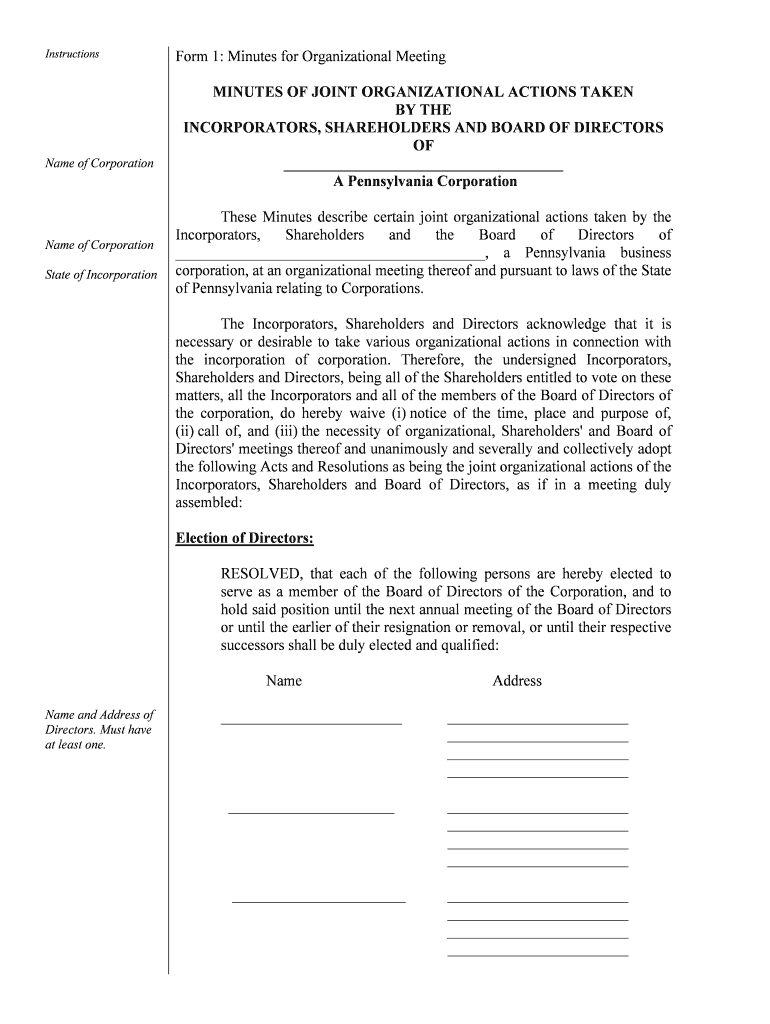
Board resolutions, officer appointments, and adoption of bylaws taken at the organization meeting to operationalize the corporation.
Periodic compliance tasks such as report filings, tax registrations, payroll setup, and maintenance of corporate minutes and records.
Electronic filing and eSignature streamline formation when state rules and the document permit electronic records and signatures.
Online: often same-day to a few business days
IRS issues EIN online immediately in most cases
Adopt bylaws and issue stock promptly after filing
Register for state withholding within 30 days of hiring
Calendar-year individual returns due April 15; corporate dates vary
Optica standardized formation packets and investor subscription documents to reduce turnaround times.
Tech Data integrated signature workflows into internal systems to speed approvals.
The incorporator (individual or authorized agent) signs and files the Certificate of Incorporation. This person or entity completes the initial filing, provides contact information, and may sign organizational resolutions if specified.
After formation, corporate officers or the board adopt bylaws and execute contracts. Officers sign ongoing corporate documents, bank forms, and filings consistent with board authority and bylaws.
Determine whether the specific document requires notarization or witnesses under state law.
Choose in-person notary or RON if state rules permit remote notarization.
Have government-issued ID and any required supporting documents ready.
Sign in the notary's physical or audio-video presence as required.
Retain audio-video and identity-proofing records for the retention period.
Ensure the notary completes the acknowledgment or jurat certificate correctly.
Include notarized documents with filings where the agency requires originals.
Keep notary journals and certificates in secure records for audits.
Save executed agreements as PDF/A or signed PDF with an embedded audit trail to preserve the signature, timestamps, and document integrity for compliance.
Maintain a clean DOCX or original source file for amendments and internal edits; never circulate edited source as a signed document.
Export shareholder ledgers and capitalization tables as CSV or Excel for accounting and investor reporting while retaining signed evidentiary copies.
Store certified copies of the filed Certificate of Incorporation alongside digital signed agreements for reference and onboarding.
| signNow | DocuSign | Adobe Sign | PandaDoc | HelloSign | |
|---|---|---|---|---|---|
| Starting Price | $8/user/mo | $15/user/mo | $14/user/mo | $19/user/mo | $15/user/mo |
| Free Trial | 7-day trial | Varies by plan | Varies by plan | Varies by plan | Varies by plan |
| Bulk Send | Yes | Yes | Yes | Yes | No |
| Audit Trail | Yes | Yes | Yes | Yes | Yes |
| HIPAA Compliant | Yes | Yes | Yes | No | No |