Establishing secure connection…Loading editor…Preparing document…

Petition for Release of Excess Proceeds and Notice of Hearing

This template is fully customizable. Edit the text, fill out the fields, and send it for signature. Give it a try!
Petition for Release of Excess Proceeds and Notice of Hearing

What this petition is and when it’s used

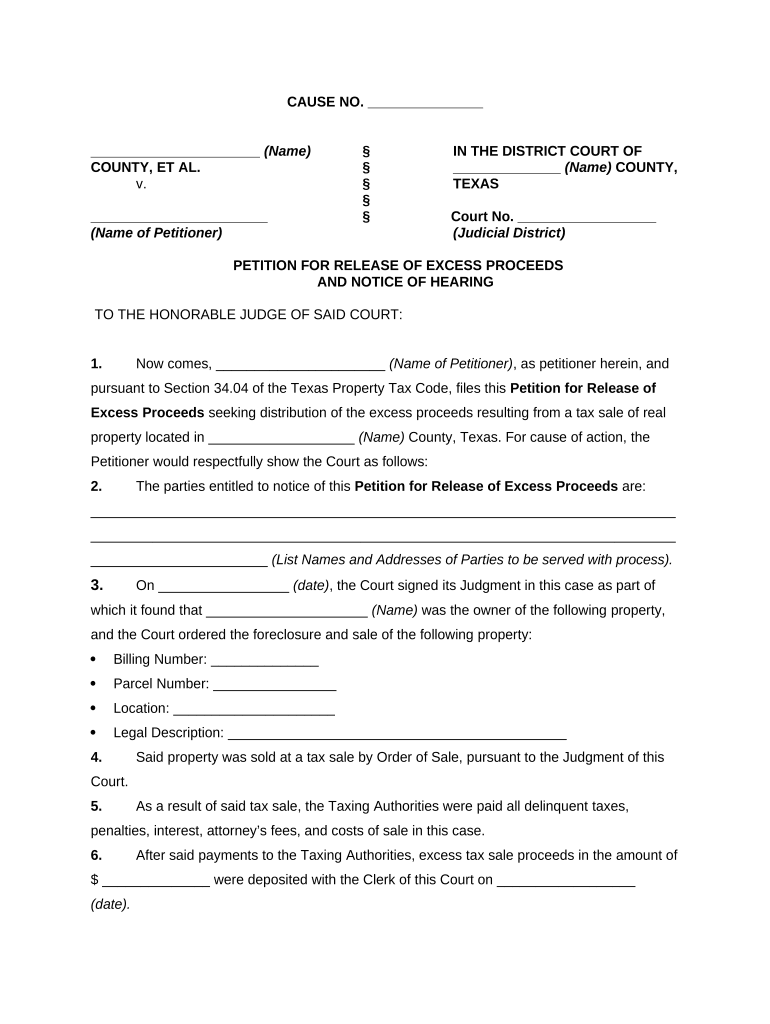
The Petition for Release of Excess Proceeds and Notice of Hearing is a court filing used after a tax sale, sheriff’s sale, or foreclosure where sale proceeds exceed amounts owed to lienholders. The petition identifies the claimant, the property, the sale date, the calculated surplus amount, and asks the court to order distribution of the excess funds. The accompanying Notice of Hearing schedules the court date, provides service instructions, and informs interested parties of their opportunity to appear. Filing and signature rules vary by jurisdiction and by court e-filing procedures.

Why filing a clear petition matters

A properly prepared petition preserves legal rights to surplus funds, alerts other claimants, and creates a court record that supports distribution. The Notice of Hearing ensures due process and gives the court the facts needed to decide release of funds under applicable state law and local court rules.

Why filing a clear petition matters

Who typically files or responds to this petition

The petition is used by parties with a legal or equitable claim to surplus sale proceeds who must present documentary proof to the court.

  • Claimants and former owners with title or equity interests and supporting documentation.
  • Secured creditors or junior lienholders asserting priority or partial entitlement to surplus funds.
  • Court clerks, trustees, or county treasurers who manage distribution after judicial order.

Core components to include in a professional petition

A complete petition combines factual case details, proof of entitlement, and clear service instructions so the court can schedule and decide the hearing efficiently.

Caption and Case Info

Full court caption, case number, county, and party names must appear exactly as in the original sale record to ensure the petition is linked to the correct case and docket.
Property Description

Provide legal description, parcel or tax ID, and physical address so the clerk and interested parties can unambiguously identify the property tied to the sale proceeds.

Sale and Proceeds Detail

State the sale date, purchaser name, total sale amount, amounts applied to liens and costs, and the remaining excess proceeds calculation with supporting accounting.

Claimant Statement

Identify the claimant, relationship to the property, basis for the claim (ownership, lien assignment), and attach affidavits, deeds, assignments, or judgments supporting entitlement.

Notice of Hearing

Specify hearing date, time, location or e-court link, and the method and timeline for service on interested parties consistent with local rules.

Proposed Order

Include a draft order for the judge that states the requested distribution, payment destinations, and any escrow or bond requirements to simplify judicial disposition.

Step-by-step: filing a petition and scheduling the hearing

Follow a logical sequence to prepare documentation, notify interested parties, and submit the petition to the court.

  • 01
    Prepare Documents: Assemble sale records, ledger, title documents, and affidavits.
  • 02
    Draft Petition: Complete the petition with clear figures and a proposed order.
  • 03
    Serve Parties: Serve the Notice of Hearing per local rules and file proof of service.
  • 04
    File with Court: E-file or deliver paper copies and pay required filing fees.

Configuring an online workflow for the petition

Set up a repeatable e-filing workflow to reduce manual steps and track completion.

Field Configuration
Document Template Create a template with reusable fields and placeholders.
Signer Roles Assign claimant and counsel signer roles with contact emails.
Authentication Enable email or SMS codes for signer attribution.
Proof of Service Attach signed service affidavits before final filing.

Where to file and how the notice reaches interested parties

Understand local court e-filing and service rules so the petition and notice are accepted and parties receive timely notice.

  • Court Clerk Filing: File with the clerk in the county where the property is located.
  • E-Filing Portals: Use the court’s e-filing system when available to upload documents.
  • Service Methods: Serve parties by certified mail, personal service, or electronic methods allowed by the court.
  • Proof of Service: File a signed affidavit or certificate of service with the court docket.

Distribution channels and technical considerations

Confirm with the local clerk which channels produce acceptable proof of service and whether electronic signatures meet filing requirements.

  • Email Service: Permitted if court rules allow electronic service.
  • Certified Mail: Widely accepted for notice and creates a USPS return receipt.
  • E-Filing Portals: Use the court’s portal for docketing and time-stamped filing confirmation.

Key stages from filing to fund disbursement

Typical milestone flow tracks filing, service, hearing, order entry, and distribution — each stage may have required waiting periods.

01

Filing Submitted

Court accepts petition and sets preliminary docket entry.

02

Service Completed

All interested parties receive notice and proof is filed.

03

Hearing Held

Judge reviews evidence and hears objections if any.

04

Order and Distribution

Court signs order directing funds to claimant or holders.

Typical timing expectations and common notice periods

Deadlines and minimum notice periods vary by court; the following are common timelines to anticipate.

Notice Lead Time:

Often 14–30 days before the scheduled hearing in many jurisdictions.

Service Proof Deadline:

File proof of service before the hearing to preserve the record.

Objection Window:

Interested parties may file objections by the court’s stated deadline.

Order Entry Time:

Judge may issue decision immediately or within weeks after hearing.

Distribution Processing:

Funds are disbursed after a signed order and any administrative processing.

Typical eSignature vendor pricing and feature comparison

Vendor pricing and feature sets affect total cost and compliance capabilities for signing and distributing petitions and notices.

signNow DocuSign Adobe Sign PandaDoc HelloSign
Starting Price $8/user/mo $15/user/mo $14/user/mo $19/user/mo $15/user/mo
Free Trial 7-day free trial Yes, trial available Yes, trial available Yes, trial available Yes, trial available
Bulk Send Yes Yes Yes Yes No
Audit Trail Yes Yes Yes Yes Yes
HIPAA Compliant Yes Yes Yes No No
Envelope Cap No envelope cap 100 envelopes/user/year Varies by plan Varies by plan Varies by plan

Security and compliance elements to verify for e-signed filings

Encryption: TLS 1.2/1.3; AES-256 at rest
Audit Trail: Detailed timestamps, IPs, and action logs
Certifications: SOC 2 Type II; ISO 27001
HIPAA: BAA available for protected health information
ESIGN / UETA: Meets ESIGN and UETA legal requirements
21 CFR Part 11: Features available for FDA-regulated records

Common mistakes that cause delays or rejection

  • Submitting incomplete supporting documents, such as missing deed, assignment, or sale ledger, which causes the court to request additional proof and reschedule the hearing.
  • Using an incorrect or inconsistent claimant name that does not match title documents or identification, leading to identity disputes and potential denial of the claim.
  • Failing to serve all interested parties per local rules, which can result in the hearing being continued or the order being challenged.
  • Providing an inaccurate calculation of excess proceeds or failing to attach the itemized accounting used to compute the surplus, prompting clerk or judicial inquiry.

Potential legal and financial consequences to avoid

Forfeiture Risk: Loss of claim
Court Sanctions: Monetary or procedural penalties
Delayed Payment: Extended processing time
Contested Claims: Increased litigation costs
Attorney Fees: Potential added legal expense
Invalid Service: Hearing may be vacated

Practical examples of how petitions are used

The following examples show two common scenarios and how a petition and notice resolve competing interests in surplus funds.

Case Study 1

A former owner filed a petition claiming surplus after a tax sale; they attached the deed and settlement ledger.

  • The county treasurer initially disputed entitlement.
  • After a single hearing the court ordered partial distribution to the owner and to a junior lienholder, with the clerk instructed to issue checks per the court order and file a closing entry.

Case Study 2

A secured creditor submitted a petition asserting priority over surplus proceeds based on an assignment.

  • The debtor did not appear.
  • The court entered the creditor’s proposed order after verifying assignment documents and proof of service, and directed the county to release funds to the creditor subject to a short accounting period for any late claims.

Frequently asked questions and quick solutions

Answers to common questions about preparing, filing, and correcting a Petition for Release of Excess Proceeds and its Notice of Hearing.


Need help? Contact support

be ready to get more
Join over 28 million airSlate SignNow users