Establishing secure connection…Loading editor…Preparing document…

Petition for Legitimation

This template is fully customizable. Edit the text, fill out the fields, and send it for signature. Give it a try!
Petition for Legitimation

What a Petition for Legitimation Is and When It’s Used

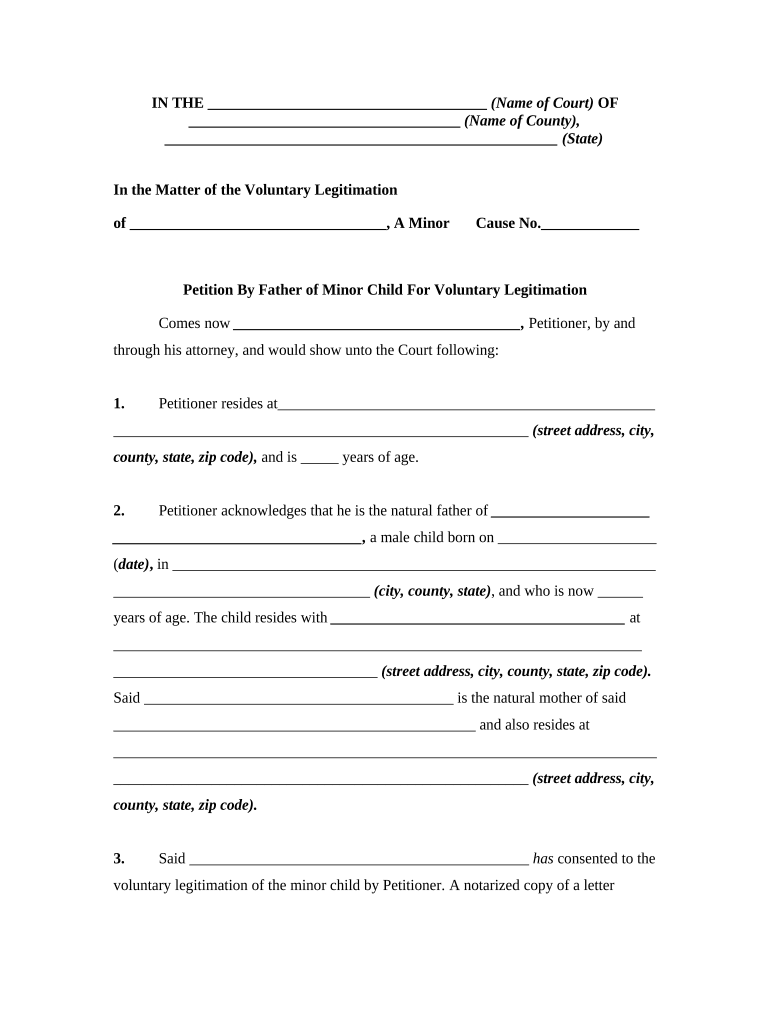
A Petition for Legitimation is a formal court filing used in family law to establish the legal parent-child relationship between a biological or presumed father and a child when the parents were not married at the time of birth. The petition asks a court to recognize the petitioner as the child's legal parent and can affect parental rights and responsibilities including custody, visitation, and child support. Procedures, required evidence, and terminology vary by state; courts generally require evidence of paternity, notice to interested parties, and compliance with local rules.

Why You Might File a Petition for Legitimation

Filing a Petition for Legitimation secures a legal parental status that enables custody, visitation, and child support enforcement. It clarifies rights for inheritance, benefits, and medical decision-making, and establishes a legal record that can be necessary for future family-law or government interactions.

Why You Might File a Petition for Legitimation

Who Typically Files and Who Is Involved

Parents, legal guardians, or putative fathers commonly file; attorneys, child welfare agencies, and court clerks are frequent participants in the process.

  • Unwed biological fathers seeking legal recognition and parental rights in court
  • Mothers requesting an adjudication that names the father for support and custody
  • State or county agencies establishing paternity for benefits, records, or support enforcement

Step-by-Step: Preparing and Filing the Petition

Follow these sequential steps to prepare, file, and serve a Petition for Legitimation in most U.S. jurisdictions.

  • 01
    Prepare Petition: Describe petitioner, child, legal basis, and requested relief.
  • 02
    Attach Evidence: Provide birth certificate, DNA results, and supporting affidavits.
  • 03
    File With Court: Submit to family or probate court clerk and pay filing fee.
  • 04
    Serve Parties: Deliver notice to alleged parent and other interested parties per rules.

Essential Data Elements to Include

Petitioner Name: Full legal name on ID
Child Name: Exact name on birth certificate
Child DOB: Date of birth in MM/DD/YYYY
Place of Birth: City, county, state
Proof of Paternity: DNA report or affidavit
Service Information: Addresses for all parties

Core Components of a Professional Petition for Legitimation

A professional petition contains organized headings, accurate party information, clear factual statements, attached evidence, proper signature blocks, and a concise statement of the relief the petitioner requests.

Caption

Include court name, case number (if available), county, and style of the case. A precise caption ensures clerk processing and correct docket assignment; avoid abbreviations that obscure identity.
Jurisdiction

State the legal basis for the court's jurisdiction and venue, citing statutes or residency facts. Jurisdictional errors can result in dismissal or transfer.

Parties

List full names, addresses, and relationships to the child for petitioner, respondent, and any alleged parent; include contact information for service of process.

Statement of Facts

Chronological factual narrative stating birth details, parental relationships, dates of key events, and any prior court proceedings relevant to paternity.

Evidence

Attach certified birth records, DNA tests, affidavits, or school/medical records that corroborate parentage; mark exhibits and reference them in the petition.

Signature Block

Provide dated signatures, printed names, and attorney contact information; include sworn verification if state rules require notarization or signature under penalty of perjury.

Where to File and the Basic Filing Flow

Typical filing and service flow for a Petition for Legitimation follows these four operational steps.

  • Draft: Complete petition, exhibits, and proposed orders.
  • File: File with county or family court clerk and pay fee.
  • Serve: Serve respondent per state rules; file proof of service.
  • Hearing: Attend hearing; present evidence and witness testimony.

Digital Submission and Authentication Considerations

Electronic submission and eSignature requirements vary; review authentication and recordkeeping standards before eFiling or e-signing.

  • Accepted Formats: PDF and DOCX preferred for court filings
  • Authentication: Email, SMS code, or MFA
  • Integrations: Works with court eFile portals

Key Timeframes and Deadlines to Track

Common timeframes and statutory deadlines to track when filing and responding to a Petition for Legitimation.

Filing Deadline:

State statutes vary; file promptly when paternity evidence exists.

Service Period:

Serve respondent per local rules, typically within 30–90 days.

Response Time:

Respondent usually has 20–30 days to answer after service.

Hearing Scheduling:

Court sets hearing date; timing depends on docket and notice.

Appeal Window:

Post-judgment appeals follow state rules; deadlines often 30 days.

Milestone Timeline from Filing to Final Judgment

Key milestones from filing through final judgment highlight timing and required documents at each stage.

01

Petition Filed

Clerk assigns case number; file-stamped copy returned.

02

Service Completed

Proof of service must be filed to proceed to hearing.

03

Pretrial/Discovery

Court may order discovery or genetic testing before hearing.

04

Final Judgment

Judge issues order on legitimation, custody, support determinations.

Common Preparation Errors to Avoid

  • Failing to name all legally interested parties can result in later challenges to the judgment and may require reopening the case.
  • Using inconsistent or abbreviated names between documents causes verification issues and can trigger subpoenas or additional proof of identity.
  • Relying solely on an unserved or informal affidavit rather than court-accepted evidence may leave paternity unresolved.
  • Not checking state-specific procedural rules, such as required witness counts or local filing forms, commonly delays processing and increases costs.

Consequences of Inaccurate or Incomplete Petitions

Filing Errors: Case dismissed or amended
Incorrect Names: Service failure or judgment void
Missing Evidence: Hearsay challenges; weaker case
Late Filing: Statute issues or denied relief
Perjury Risk: False statements carry criminal penalties
Support Liability: Retroactive obligations possible

eSignature Pricing and Feature Snapshot for Filing and Signing

Neutral comparison of baseline eSignature pricing and plan features relevant when filing a Petition for Legitimation.

signNow DocuSign Adobe Sign PandaDoc HelloSign
Starting Price $8/user/mo $15/user/mo $14/user/mo $19/user/mo $15/user/mo
Free Trial 7-day free trial No No Yes, limited Yes, limited
Bulk Send Yes Yes Yes Yes No
Audit Trail Yes Yes Yes Yes Yes
HIPAA Compliant Yes Yes Yes No No

Frequently Asked Questions About the Petition for Legitimation

Answers to frequently asked procedural, jurisdictional, and evidence questions about filing and completing a Petition for Legitimation.


Need help? Contact support

be ready to get more
Join over 28 million airSlate SignNow users