Establishing secure connection…Loading editor…Preparing document…

Washington Petition for At-Risk Youth

This template is fully customizable. Edit the text, fill out the fields, and send it for signature. Give it a try!
Washington Petition for At-Risk Youth

What the Washington Petition for At-Risk Youth Is

The Washington Petition for At-Risk Youth is a formal court filing used to ask juvenile court for protective orders, services, or temporary guardianship for a minor who may be endangered, neglected, exploited, or otherwise at risk. The petition sets out factual allegations, identifies parties, requests specific relief, and attaches supporting evidence so the court can evaluate immediate safety and long-term welfare. Filers typically include parents, guardians, social services, schools, or appointed attorneys and the petition proceeds under state juvenile or family court procedures.

Why this petition matters for urgent youth protection

A properly prepared petition helps the court identify risk factors, authorize immediate protective steps, and trigger services such as temporary placement, counseling, or oversight. Clear allegations and supporting documentation reduce delays and improve the court’s ability to order timely interventions designed to protect the minor’s safety and wellbeing.

Why this petition matters for urgent youth protection

Who commonly prepares and files this petition

A range of parties may prepare or request this petition depending on the situation and local court rules.

  • Parents or caregivers who observe immediate danger, neglect, or inability to provide care and who seek protective court orders or formal services.
  • Child welfare agencies and social workers initiating court intervention when investigations indicate risk to the minor’s safety or development.
  • Attorneys, guardians ad litem, or public defenders who represent the child’s interests and prepare legal filings for juvenile court review.

Local court clerks and juvenile court rules control filing requirements, so parties should confirm document format, service, and intake procedures with the relevant county court.

Core sections to include in a professional petition

A complete Washington Petition for At-Risk Youth follows a predictable structure so judges and clerks can quickly assess urgency, facts, and requested remedies.

Caption

Court name, case number area, and title identifying petitioner and respondent; ensures the petition is routed to the correct juvenile or family court division.
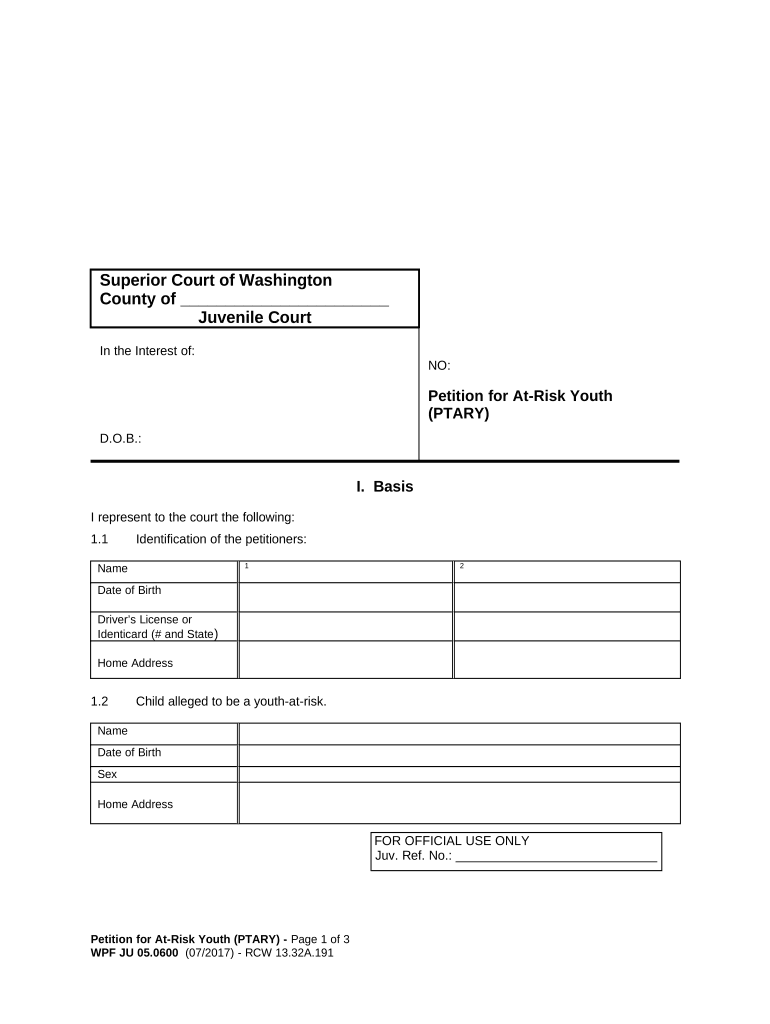
Parties

Full legal names, relationships to the child, addresses, and contact details for the child, petitioner, respondents, and any known custodial parties or service providers.

Statement of Facts

Chronological, factual allegations describing observable conduct, dates, locations, witnesses, and any prior reports or interventions supporting the claim of risk.

Requested Relief

Specific remedies sought (temporary custody, protective order, services, evaluations), with statutory basis or rule citations where applicable to justify the request.

Evidence

List of attachments such as clinical notes, school reports, photographs, police reports, or agency investigations that substantiate the factual allegations.

Verification

Signature block with declarant name, relationship, date, and any required notarization or verification language required by local court rules.

Key data elements required on the form

Child Identifiers: Name, birth date
Petitioner Details: Name, address
Respondent Details: Name, last known address
Allegation Summary: Concise risk facts
Supporting Items: List of exhibits
Signature Block: Signer name and date

Step-by-step: preparing and filing the petition

Follow these steps in order to prepare a clear petition that meets typical juvenile court intake expectations.

  • 01
    Gather facts: Assemble dates, witnesses, and documentation first.
  • 02
    Complete form: Enter fields carefully using required formats.
  • 03
    Attach evidence: Label exhibits and include a contents list.
  • 04
    File and serve: Submit to the clerk and serve parties per local rules.

How to configure an online petition workflow

Configuring a digital workflow speeds routing, signing, and evidence collection while preserving an audit trail for court review.

Form Field and Builder Configuration Use required fields and conditional logic to show only relevant sections.
Authentication Method Email link with optional SMS two-factor or ID check.
Conditional Fields Show extra fields when the petitioner selects high-risk indicators.
Document Template Preload standard petition language for consistent filings.
Notification Settings Alert clerks and counsel when filing completes.

Typical filing and court intake process

Understanding the flow from filing to initial hearing helps set expectations for timing and next steps.

  • Draft: Prepare petition and exhibits for submission.
  • File: Submit to county juvenile court clerk.
  • Service: Serve respondents and interested parties per rules.
  • Initial Hearing: Court schedules review and factfinding hearing.

Digital signing and e-submission considerations

Electronic filing and e-signatures can be accepted when they meet court and statutory standards for authenticity and retention.

  • Accepted Formats: PDF and PDF/A are preferred.
  • Authentication: Email or SMS plus ID proofing.
  • Audit Trail: Timestamp, IP, and event log.

Verify local court e-filing rules and whether the court requires original wet signatures, notarization, or specific format standards before e-submitting electronically.

Common preparation and filing mistakes to avoid

  • Incomplete factual detail: vague allegations without dates or witnesses lead to continuances or dismissal of immediate relief requests.
  • Missing exhibits: failing to attach key reports or evidence commonly results in delayed hearings and additional discovery requests.
  • Improper service: not serving respondents per local rules can render the filing ineffective and require re-service or re-filing.
  • Incorrect signer or notarization: signing before notarization or using the wrong authorized signer can void verification and prolong proceedings.

Risks and legal consequences of incorrect petitions

Dismissal Risk: Court may dismiss without prejudice
Delay in Relief: Hearing rescheduled, safety not addressed
Contempt Exposure: Improper service may lead to sanctions
Evidence Exclusion: Unauthenticated exhibits may be excluded
Privacy Violations: Improper disclosure of health records risks HIPAA issues
Financial Costs: Repeated filings and attorneys increase expense

Typical timelines and court scheduling expectations

Timing varies by jurisdiction and case urgency; emergency matters proceed faster than standard petitions, and local rules define hearing windows.

Emergency Petitions:

Clerks often review same day for immediate protective orders

Initial Hearing:

Usually scheduled within days to weeks depending on court caseload

Service Deadlines:

Service must occur in time for notices before hearings per local rules

Continuances:

Missing evidence or improper service commonly triggers continuances

Record Requests:

Document production timelines follow court schedule and discovery rules

Practical examples of how petitions are used

These condensed examples show common scenarios that give rise to a petition for at-risk youth and how courts typically respond.

School Safety Referral

A school counselor documents escalating threats over two weeks and files a petition

  • facts include dated incident reports and witness names
  • The court ordered a welfare check and temporary supervision while social services completed an investigation and recommended supportive services.

Agency Protective Action

Child welfare receives multiple reports of severe neglect and seeks temporary removal

  • agency submits medical records and intake interviews as exhibits
  • The judge granted short-term protective custody, ordered evaluation services, and set a prompt factfinding hearing.

Who can legally sign or verify the petition

Petitioner — Parent or Guardian

A parent, legal guardian, or appointed petitioner may sign and verify the petition under penalty of perjury. If the petitioner is not a parent, explain authority and provide supporting documentation such as guardianship orders.

Attorney or Agency Representative

An attorney of record or authorized representative of a child welfare agency may file and sign on behalf of the agency, with verification of authority and inclusion of contact and caseworker details.

Supporting documents and file formats to include

Assemble documents in common court-acceptable formats and provide a clear exhibit list to simplify judicial review and clerical processing.

Document Formats

Use PDF or PDF/A for filings; scanned images must be legible and bookmarked for exhibits to assist court reviewers.

Medical and School Records

Include redacted copies as exhibits when relevant, with a written explanation of material relevance to the petition allegations.

Law Enforcement Reports

Attach police or incident reports that corroborate safety concerns, and note any pending criminal matters that overlap with juvenile proceedings.

Affidavits and Declarations

Provide sworn statements from witnesses, professionals, or mandated reporters with dates, contact details, and signature verification.

Practical tips for accurate and efficient completion

Adopt consistent preparation habits that reduce errors, speed intake, and preserve confidentiality when handling sensitive youth matters.

Document chronology clearly
Present allegations in chronological order with dates and times. A clear timeline reduces judicial questions and limits unnecessary continuances.
Label exhibits consistently
Number and caption exhibits, and reference them in the petition text so the court can easily locate supporting materials during review.
Respect privacy rules
Redact nonessential personal data, follow HIPAA when including health records, and avoid broad dissemination of sensitive juvenile details.
Confirm local rules
Check county juvenile court filing requirements, e-filing standards, and whether wet signatures or notarization are required before filing.

eSignature vendor comparison for completing and signing the petition

Comparison of typical vendor starting prices and capabilities relevant to filing and signing court-related petitions; signNow is listed first as a vendor option.

signNow DocuSign Adobe Sign PandaDoc HelloSign
Starting Price $8/user/mo $15/user/mo $14/user/mo $19/user/mo $15/user/mo
Free Trial 7-day free trial, no credit card required Varies by vendor Varies by vendor Varies by vendor Varies by vendor
Bulk Send Yes Yes Yes Yes No
Audit Trail Yes Yes Yes Yes Yes
HIPAA Compliant Yes Yes Yes No No
Envelope Cap No cap 100 envelopes/user/year Varies Varies Varies

Frequently asked questions about the petition

Answers to common legal and practical questions about preparing, signing, and filing a Washington Petition for At-Risk Youth.


Need help? Contact support

be ready to get more
Join over 28 million airSlate SignNow users