Court Caption
Complete caption with court name, case number, and party designations so the clerk and judge can properly associate the counterclaim with the pending case and schedule hearings.
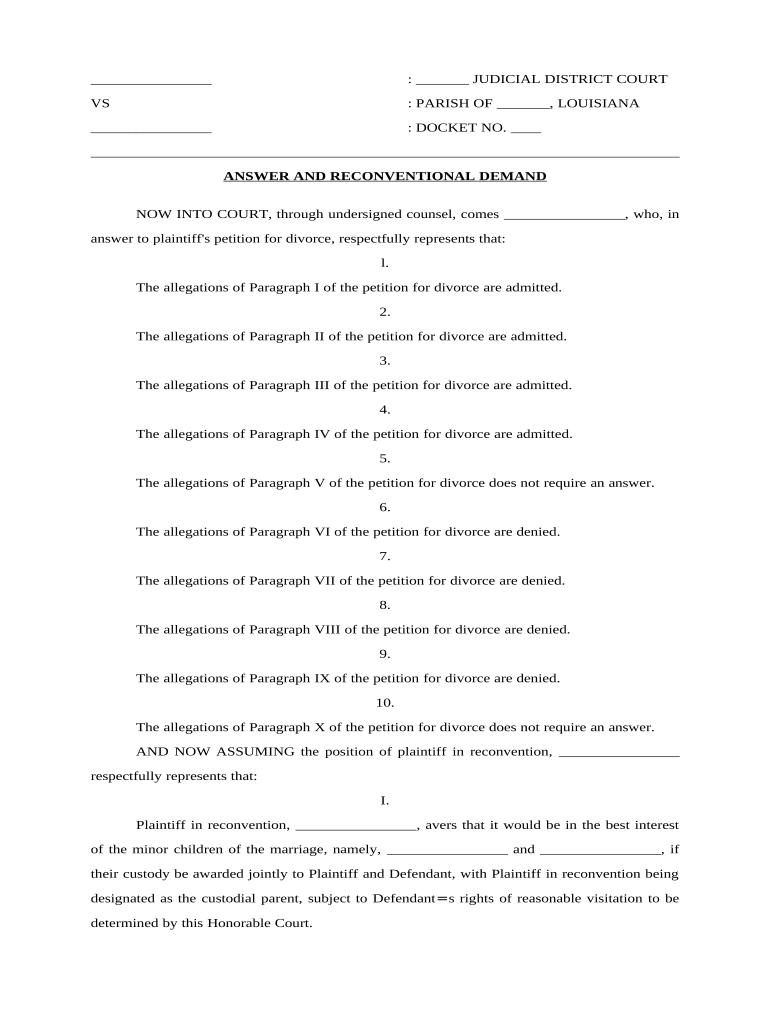
Filing a reconventional divorce lets a respondent seek divorce or other remedies within the same case, preserving procedural efficiency and allowing the court to resolve competing claims together.

The reconventional divorce is prepared by the party responding to a divorce petition, often with counsel, or by pro se respondents seeking to assert their own claims.
Outcomes depend on meeting pleading, service, and disclosure rules; parties often consult counsel to avoid procedural defects and sanctions.
A licensed attorney drafts and files the reconventional counterclaim, ensures compliance with local rules and discovery obligations, and represents the respondent at hearings and settlement negotiations.
The respondent reviews, signs, and may notarize the counterclaim and required financial disclosures; the party is responsible for truthful statements under penalty of perjury.
Complete caption with court name, case number, and party designations so the clerk and judge can properly associate the counterclaim with the pending case and schedule hearings.
Full legal names, addresses, and roles (petitioner/respondent) must match existing docket entries to avoid misfiling or service defects that can delay proceedings.
Clear factual and legal bases for the requested divorce or relief, including dates, jurisdictional facts, and any statutory grounds relied upon by the respondent.
Specific remedies sought such as divorce decree, spousal support, child custody, property division, attorneys' fees, and any temporary measures requested.
Attach sworn financial statements, asset inventories, and schedules of debts; many courts require standardized affidavits or mandatory worksheets.
Proof of service, signature block with date, and any notary or witness verifications required by local court rules for filing or enforcement.
| Field | Configuration |
|---|---|
| Signature Field | Required; capture full name and timestamp |
| Authentication | Email plus SMS code when available for signer attribution |
| Attachments | Require uploads for financial affidavits and exhibits |
| Routing | Sequential routing: respondent, counsel, clerk copy |
Use a platform that supports PDF, preserves audit trails, and integrates with cloud storage to maintain records and evidence.
Confirm local court e-filing requirements and whether the court accepts electronically executed filings before using an electronic workflow.
Often 20–30 days to file an answer or counterclaim after service, depending on state and method of service.
Courts typically set a temporary orders hearing within weeks to establish interim custody, support, or possession.
Courts issue deadlines for disclosures, financial exchanges, and depositions; adhere strictly to avoid sanctions.
Status conferences and readiness hearings occur before trial; unresolved issues may be set for trial months after filing.
Deadlines for appeals or statutory motions vary; consult local rules for exact post-judgment time limits.
Original petition initiates the action and defines initial claimed relief and parties.
Respondent files the reconventional divorce to assert their own statutory grounds and relief requests.
Court may issue interim orders addressing custody, support, or exclusive use of property pending final resolution.
Settlement or trial leads to a final judgment resolving divorce, property division, support, and custody issues.
| signNow | DocuSign | Adobe Sign | PandaDoc | HelloSign | |
|---|---|---|---|---|---|
| Starting Price | $8/user/mo | $15/user/mo | $14/user/mo | $19/user/mo | $15/user/mo |
| Free Trial | 7-day free trial | Varies by plan | Varies by plan | Varies by plan | Varies by plan |
| Bulk Send | Yes (Premium) | Yes | Yes | Yes | No |
| Audit Trail | Yes | Yes | Yes | Yes | Yes |
| HIPAA Compliant | Yes | Yes | Yes | No | No |
A court-formatted, signed PDF of the reconventional pleading, including the caption, factual allegations, and requested relief, suitable for electronic filing or clerk submission.
Affidavits, account statements, and asset lists attached as separate exhibits with exhibit labels and page numbers to support valuations and support requests.
A sworn certificate or affidavit showing how and when the opposing party was served, filed with the court to establish jurisdiction and notice.
Clerk-stamped or electronically logged confirmation showing the filing date and receipt number for case tracking and deadlines.
A respondent files a reconventional divorce after the petitioner seeks limited relief, asserting irreconcilable differences and requesting spousal support and property division.
In contested custody litigation, the respondent adds a reconventional counterclaim seeking primary residential custody and a parenting plan.