Establishing secure connection…Loading editor…Preparing document…

Referees Deed New York

This template is fully customizable. Edit the text, fill out the fields, and send it for signature. Give it a try!
Referees Deed New York

What a Referees Deed in New York Is

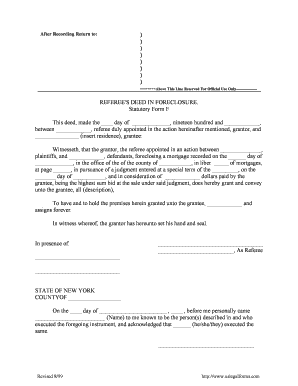
A Referees Deed in New York is the instrument a court-appointed referee or legal officer delivers to transfer real property following a judicial sale or foreclosure. It identifies the referee as grantor, names the purchaser as grantee, and describes the property, the sale authority, and any conditions imposed by the court. Because a Referees Deed arises from court proceedings, it must conform to the court order, include an appropriate notarial acknowledgement, and be drafted so the county recording office will accept it for entry in the land records.

Why a Correct Referees Deed Matters

Accurate Referees Deeds clear title, reflect the court-approved transfer, and enable the purchaser to record ownership and obtain title insurance. Errors or omissions can delay recording, raise title exceptions, and increase legal or tax exposure.

Why a Correct Referees Deed Matters

Who Commonly Prepares and Uses This Deed

Coordination among counsel, the referee, and the county recording office ensures compliance with court instructions and local recording practices.

  • Referees and court officers who must execute and deliver the deed for recording.
  • Purchasing parties or investors who receive conveyance and seek clear title.
  • Title companies and recording clerks who review the deed for acceptance and insure the transaction.

Primary Actors and Their Roles

Referee / Grantor

The court-appointed referee signs and, when required, acknowledges the deed as grantor. The referee must follow the court order's language and state any powers or limitations, and often appears before a notary public to provide a proper acknowledgement for recording.

Purchaser / Grantee

The purchaser receives the deed and is responsible for submitting it for recording. The grantee should review the deed for accurate legal description and ensure title clearing steps such as paying required recording fees and obtaining title insurance are completed.

Essential Data to Include

Grantor Name: Full legal name of the referee or appointing entity
Grantee Name: Full legal name of the buyer or transferee
Legal Description: Complete recorded property description
Court Authority: Case caption and court order reference
Consideration: Sale price or recital of consideration
Notarial Acknowledgement: Proper acknowledgement language per NY practice

Consequences of an Incorrect or Defective Deed

Recording Delay: Recording rejection or delay
Title Exceptions: Uninsurable title defects
Legal Challenges: Risk of litigation or re‑conveyance
Tax Exposure: Unresolved transfer tax issues
Financial Loss: Buyer inability to obtain financing
Void Conveyance: Potentially ineffective transfer

Common Preparation Errors to Avoid

  • Using an incomplete or imprecise legal description, which can cause the county clerk to refuse recording or create title exceptions.
  • Omitting the exact court order citation or case caption, which prevents verifying the referee’s authority to convey.
  • Failing to include or properly word the notarial acknowledgement required by New York recording practice.
  • Neglecting to check for outstanding liens, taxes, or redemption periods that must be addressed before recording.

Step-by-Step: Complete a Referees Deed

Follow a sequence that ensures legal authority, accurate property description, proper signatures, and acceptance by the county recorder.

  • 01
    Review Court Order: Confirm the referee’s authority and required language
  • 02
    Draft Deed: Insert full names, legal description, and sale recital
  • 03
    Notarize: Execute before a notary with appropriate acknowledgement
  • 04
    Record: Submit to county clerk with recording fee

Where the Deed Goes After Signing

After execution, the deed follows a standard routing: notarization, title review, county recording, and distribution of recorded copies to interested parties.

  • Notary Office: Public notary executes the acknowledgement
  • Title Company: Title examiner checks for liens and insurability
  • County Recorder: Clerk records the deed and returns the copy
  • Parties: Recorded deed provided to grantee and counsel

Key Sections a Professional Referees Deed Contains

A well-drafted Referees Deed includes discrete sections so each legal requirement is clear: identification of parties, recitals of authority, the conveyance clause, property description, exceptions/reservations, and the acknowledgement block for recording.

Parties

Identifies the referee as grantor and the purchaser as grantee using full legal names and, where applicable, corporate/formal designations to avoid ambiguity and ensure correct recording.
Recital of Authority

States the court order, case number, and date authorizing the sale so the recorder can verify the referee’s authority to convey title under the judicial proceeding.

Conveyance Clause

Transfers the property interest using clear language such as 'grants, bargains, sells and conveys' and specifies whether fee simple or other interest is conveyed.

Legal Description

Includes the precise metes-and-bounds or recorded lot/block information identical to the prior deed to avoid discrepancies during title examination.

Exceptions and Reservations

Notes any exceptions from the conveyance (e.g., easements, taxes, assessments) or affirmative reservations required by the court or law.

Acknowledgement

Contains the notary acknowledgement and any referee signature block language required by New York recording offices for judicial sales.

How to Set Up an Online Completion Workflow

For digital preparation and signatures, configure a simple workflow that mirrors the physical steps: prepare, assign signer roles, authenticate, notarize as required, and route for recording.

Step / Field Action | Responsible party
Document Preparation Draft deed template | Attorney
Signer Assignment Assign referee and notary fields | Administrator
Authentication Select signer verification (email/SMS/KBA) | Platform
Record Routing Send final PDF to title/recorder | Title agent

Digital Signing and eSubmission Considerations

Ensure the chosen platform supports notarization (in-person or RON where allowed), preserves an audit trail, and produces a record acceptable to the county clerk.

  • File Formats: Use PDF/A or standard PDF
  • Integrations: Integrate with title systems and storage
  • Authentication: Use multi-factor where required

Practical Tips for Accurate and Efficient Completion

Adopt consistent practices to reduce rejections and streamline recording.

Use Court Language Exactly
Copy the recital and authorization language from the court order verbatim to avoid ambiguity about the referee’s authority and to satisfy the recorder’s verification process.
Confirm Legal Description
Compare the deed’s legal description to the prior recorded deed and tax maps; even small discrepancies can create title insurer exceptions and delay closing.
Coordinate Notarization
Schedule the referee and notary together and confirm the county’s required acknowledgement wording to prevent the need for re-execution or supplemental affidavits.
Retain Audit Trail
If using electronic tools, preserve the signing audit trail, notarization evidence (audio-video for RON), and the court order to support recording and title insurance issuance.

Real-World Uses of a Referees Deed

These concise examples show typical scenarios where a Referees Deed is used and the outcomes parties expect.

Foreclosure Sale Conveyance

The court ordered a referee to sell property after mortgage default and entered a sale decree

  • The referee executed a Referees Deed to the winning bidder
  • The recorded deed enabled the buyer to obtain title insurance and clear the mortgage lien for resale or refinancing with minimal delay.

Judicial Partition Sale

Co-owners could not agree and asked the court to partition by sale; a referee conducted the auction under court supervision

  • The referee conveyed the sold parcel by Referees Deed
  • The buyer recorded the deed and the partition sale concluded title distribution among the original co-owners as ordered.

eSignature Vendor Pricing Snapshot for Document Workflows

Comparing common vendor starter pricing and key features helps inform choices for preparing and routing deeds, notarizations, and related documents.

signNow DocuSign Adobe Sign PandaDoc HelloSign
Starting Price $8/user/mo $15/user/mo $14/user/mo $19/user/mo $15/user/mo
Free Trial 7-day free trial Varies by vendor Varies by vendor Varies by vendor Varies by vendor
Bulk Send Yes (Business Premium) Yes Yes Yes No
Audit Trail Yes Yes Yes Yes Yes
HIPAA Compliant Yes (BAA available) Yes Yes No No

FAQs and Troubleshooting for Referees Deeds

Answers to common questions about authority, notarization, recording problems, and electronic options related to Referees Deeds in New York.


Need help? Contact support

be ready to get more
Join over 28 million airSlate SignNow users