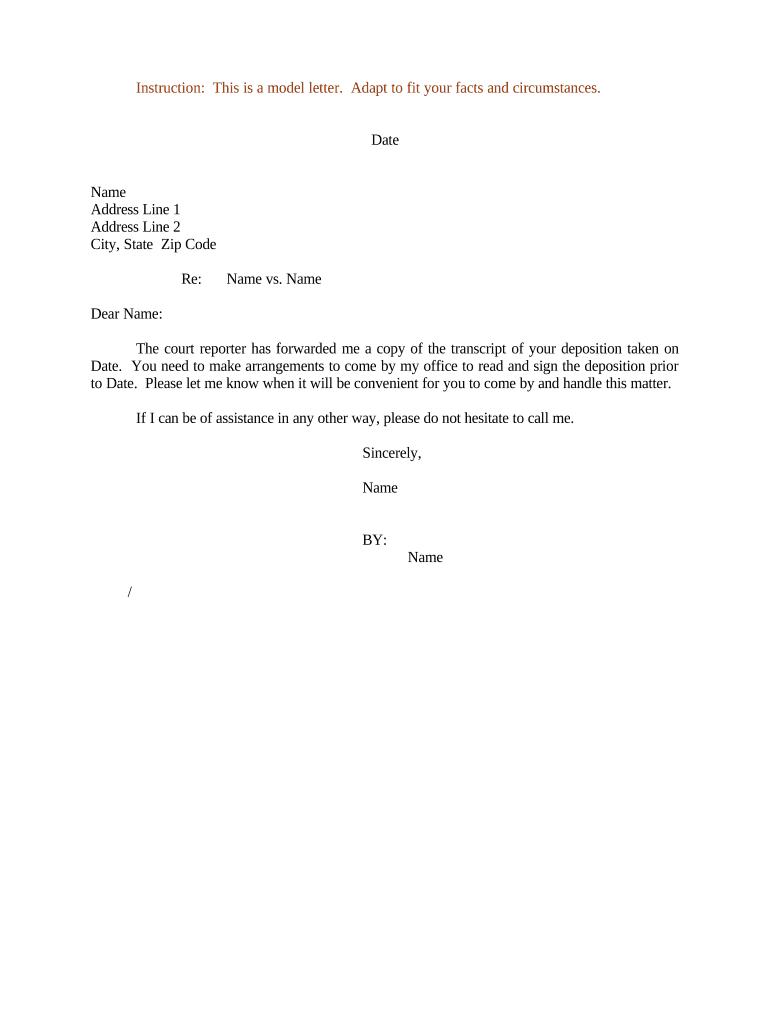
Letter Regarding Deposition Review
What a Letter Regarding Deposition Review Is
Why Use a Letter Regarding Deposition Review
This letter narrows scope, sets deadlines, and documents review requests so parties reduce discovery disputes and preserve record integrity while making obligations explicit in writing.
Who Typically Prepares or Receives This Letter
Parties involved in litigation commonly exchange deposition review letters to confirm transcript accuracy and preserve objections before filing motions or trial.
- Plaintiff and defense attorneys who manage discovery schedules and need documented review responses from deponents or opposing counsel.
- Corporate legal departments coordinating internal witness review and ensuring responses meet litigation hold and document retention obligations.
- Court reporters, deposition vendors, and paralegals who provide transcripts and handle page/line citations, errata, and official corrections.
Primary Signers and Their Roles
Litigation Attorney
A litigation attorney prepares the letter to preserve objections, set deadlines, and request corrections. They review returned errata, advise on privilege issues, and incorporate responses into motions or trial exhibits while ensuring compliance with local rules and protective orders.
Deponent / Witness
The deponent reviews cited transcript pages and either confirms accuracy or returns a signed errata sheet. Their signed response becomes part of the record and may affect impeachment use at trial; accuracy and timeliness are critical to avoid disputes.
Risks and Consequences of an Incorrect Letter
Common Preparation Mistakes to Avoid
- Failing to identify precise page and line ranges leads to ambiguous review scope and avoidable disputes about what the deponent must check.
- Sending the letter to the wrong recipient or an out-of-date address delays response and can result in missed deadlines or waived objections.
- Omitting confidentiality or privilege notices risks unintended disclosure of protected information or an inadvertent waiver of privilege.
- Not attaching the relevant transcript pages, exhibits, or a return errata form forces follow-up communications and increases administrative burden.
Example Situations Where a Review Letter Helps
Law Firm Litigation
A partner requests transcript review from a lead witness to confirm factual corrections and mark exhibits
- The witness returns a signed errata sheet within the deadline
- The firm files the errata with the court record and cites the corrected transcript in subsequent briefing to avoid impeachment disputes and establish a clear evidentiary trail.
In-House Counsel Review
Corporate counsel asks a former employee to verify testimony about contract negotiations
- The ex-employee confirms specific lines and notes minor clarifications
- Counsel retains the signed confirmation, updates the internal file, and forwards corrected excerpts to outside counsel for use in settlement discussions or motions.
Step-by-Step: Preparing and Sending the Letter
-
01Identify Transcript: Cite deposition date, reporter, pages and lines.
-
02Attach Excerpts: Include relevant pages and exhibits for review.
-
03Set Deadline: Specify a clear MM/DD/YYYY review deadline.
-
04Request Signature: Ask for signed errata or written confirmation.
How the Review Letter Process Typically Flows
-
Draft Letter: Prepare text and attach transcript excerpts.
-
Send to Recipient: Deliver by email, certified mail, or e-delivery.
-
Recipient Reviews: Deponent checks excerpts and returns errata.
-
File Response: Retain signed errata in litigation file.
Configure an Online Review Workflow
| Template | Create reusable letter templates for consistency. |
|---|---|
| Fields and Attachments | Attach transcript pages and add signature fields. |
| Signer Order | Set signer sequence for multi-party reviews. |
| Authentication | Require email or SMS verification for signers. |
| Retention Policy | Enable archival and export of completed letters. |
Technical Considerations for Digital Completion
Choose a platform that supports PDF/DOCX, audit trails, and optional stronger signer authentication for sensitive review letters.
- File Formats: PDF and DOCX supported
- Integrations: Salesforce, NetSuite, Google Workspace
- Authentication: Email, SMS, or advanced methods
Typical Deadlines and Timing Expectations
Standard Review Window:
Commonly 7–14 days for initial review
Extended Review:
Allow 30 days when exhibits require counsel review
Preservation Hold:
Immediate; preserve originals and notes
Filing Deadline:
File errata with court per local rules
Objections Window:
Raise objections promptly to avoid waiver
Key Milestones from Draft to File
1. Draft Letter
Prepare and attach transcript excerpts and errata form.
2. Send Notice
Deliver to deponent and opposing counsel, document delivery method.
3. Receive Response
Collect signed errata or written confirmation within deadline.
4. File and Archive
File errata with court and retain in case records.
How This Letter Differs From a Subpoena or Notice
| Criteria | Letter | Subpoena |
|---|---|---|
| Purpose | clarify transcript accuracy | compel attendance or documents |
| Formality | informal written request | formal court-backed order |
| Court Filing | optional | often required for enforcement |
| Auth Required | no court signature | court or clerk signature |
eSignature Vendor Comparison for Completing Review Letters
| signNow | DocuSign | Adobe Sign | PandaDoc | HelloSign | |
|---|---|---|---|---|---|
| Starting Price | $8/user/mo | $15/user/mo | $14/user/mo | $19/user/mo | $15/user/mo |
| Free Trial | Yes, 7-day trial | No | No | Yes, limited | Yes, limited |
| Bulk Send | Yes | Yes | Yes | Yes | No |
| Audit Trail | Yes | Yes | Yes | Yes | Yes |
| HIPAA Compliant | Yes | Yes | Yes | No | No |
| Envelope Cap | No cap | 100 envelopes/user/year | Varies by plan | Varies by plan | Varies by plan |
Frequently Asked Questions and Troubleshooting
-
Can this letter be e-signed?
Yes. Electronic signatures are enforceable under the ESIGN Act (15 U.S.C. ch. 96) and UETA where adopted, provided intent, consent, attribution, and record retention criteria are met.
-
What if the recipient misses the deadline?
File a notice documenting the missed deadline, attempt follow-up per local rules, and consider a motion if the response affects substantive rights or preservation obligations.
-
Should attachments be redacted?
Yes for privileged or sensitive material. Mark confidential exhibits and follow protective order terms before sharing transcript pages or exhibits with third parties.
-
Is notarization required?
Not generally required for a review request, but certain jurisdictions or specific uses may require acknowledgment; verify local practice before notarizing.
-
How to correct an error in a returned errata?
Ask the deponent for a clarified, re-signed errata; document communications and preserve originals to avoid disputes about authenticity.
-
How long should I keep the letter?
Retain the letter for the life of the case and at least three years after filing for tax or financial matters; extend retention for HIPAA or state-specific rules.