Legal Description
Precise metes-and-bounds or plat reference identifying the subdivision lots and common areas to which the Declaration applies, enabling accurate recording and title linking.
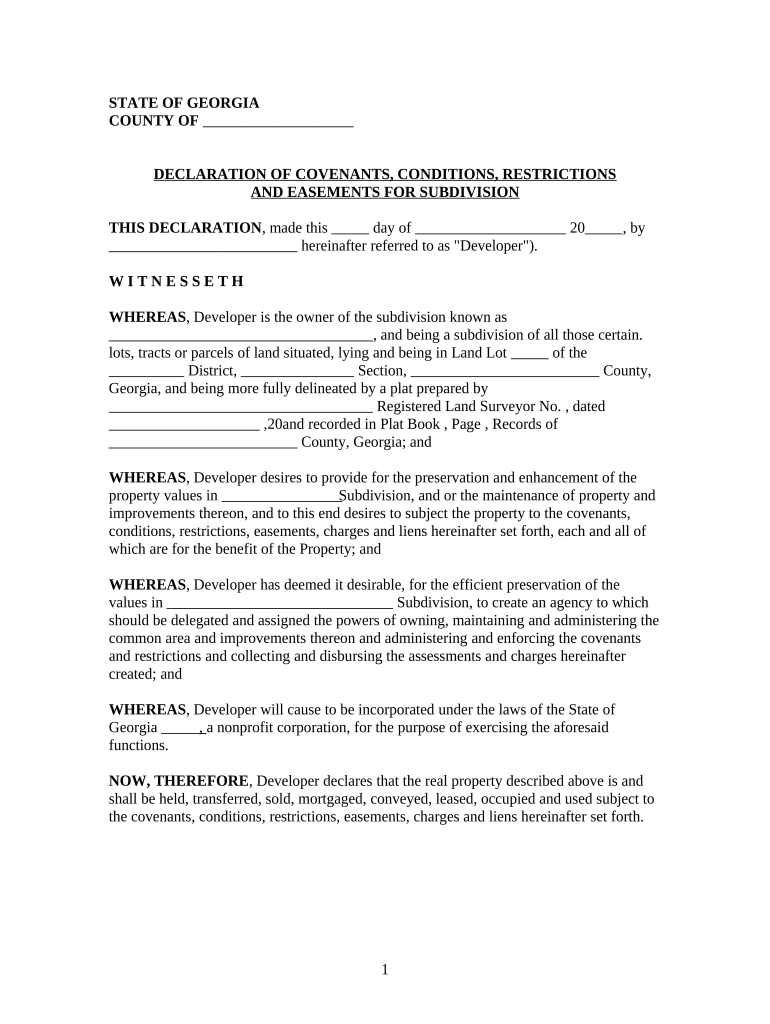
A properly drafted and recorded Georgia Declaration provides legal notice, preserves developer and community expectations, enables consistent enforcement, and clarifies who controls common elements and easements. It reduces title risk for buyers and lenders, supports resale value by setting uniform standards, and creates an enforcement path for violations while establishing dispute-resolution procedures and governing-law provisions.

Typical participants include the subdivision developer, title and closing agents, county recording office, homeowners association leaders, and mortgage lenders.
Each participant has distinct responsibilities: drafters set the rules, recorders provide public notice, and HOA bodies enforce day-to-day compliance once control transfers from the developer.
Precise metes-and-bounds or plat reference identifying the subdivision lots and common areas to which the Declaration applies, enabling accurate recording and title linking.
Enumerated restrictions on land use, structures, commercial activities, rentals, or nuisance actions, providing objective standards enforceable by the HOA or covenanted parties.
Allocation of responsibility for roads, landscaping, stormwater facilities, and common-area repairs, including budget and assessment mechanisms.
Recorded easements for utilities, access, drainage and conservation with defined scope and holder rights to prevent future encroachment disputes.
Procedures for notices, fines, lien rights, injunctive relief, and mediation or arbitration clauses to address covenant violations efficiently.
Rules and voting thresholds required to modify the Declaration, including developer reserved rights and transition to homeowner control.
| Field | Configuration |
|---|---|
| Document Format | Use a flattened PDF/A for final recording copy |
| Signer Order | Developer -> Title Officer -> Notary -> HOA Representative |
| Authentication | Email link + SMS code or ID verification for high-assurance signing |
| Audit Requirements | Capture IP, timestamp, signer email, and certificate of completion |
Ensure the chosen platform supports secure signatures, notarization (if remote notarization is used), and produces a record acceptable to the recorder.
Confirm county recording rules before e-filing: some counties require specific PDF settings, margin sizes, or original wet-ink signatures for certain instruments.
2–4 weeks for attorney drafting and internal approvals
1–2 weeks to resolve exceptions and obtain title commitment
1–7 days depending on signer availability and RON use
Same-day to 4 weeks depending on county workload
1–3 business days after receipt of recorded instrument
| signNow | DocuSign | Adobe Sign | PandaDoc | HelloSign | |
|---|---|---|---|---|---|
| Starting Price | $8/user/mo | $15/user/mo | $14/user/mo | $19/user/mo | $15/user/mo |
| Free Trial | 7-day free trial | Varies | Varies | Varies | Varies |
| Bulk Send | Yes | Yes | Yes | Yes | No |
| Audit Trail | Yes | Yes | Yes | Yes | Yes |
| HIPAA Compliant | Yes | Yes | Yes | No | No |
A mid-size development firm needed remote execution across multiple stakeholders
A portfolio manager required mobile signing capability for onsite closings
The developer or declarant signs in the capacity shown in formation documents; if a corporation, include corporate capacity (e.g., President) and, where required, corporate seal. Execution must follow entity authorization procedures to bind the entity.
After developer transfer, the homeowners association board president or authorized officer signs on behalf of the HOA per the association bylaws; signatures should show title and date to evidence authority and timelines.