Establishing secure connection…Loading editor…Preparing document…

Restraining Order

This template is fully customizable. Edit the text, fill out the fields, and send it for signature. Give it a try!
Restraining Order

What a Restraining Order Is and how it functions

A restraining order is a court-issued legal order that restricts or prohibits contact, communication, or proximity by a named respondent toward a petitioner. Typical variants include emergency (ex parte) temporary orders and longer-term final orders entered after a hearing. The order sets precise terms, duration, and service requirements and becomes enforceable once signed by a judge and served according to local court procedures. Because it is a judicial instrument, filing, issuance, and enforcement follow court rules rather than private contract processes.

Why a Restraining Order matters for safety and enforcement

A restraining order offers legally enforceable protections that deter harmful conduct, create grounds for arrest if violated, and provide immediate temporary relief while a court considers long-term remedies.

Why a Restraining Order matters for safety and enforcement

Typical users and stakeholders in a restraining order case

Typical users include individuals seeking protection, attorneys assisting victims, and court staff managing filings in civil and family courts.

  • Petitioners and survivors seeking immediate or long-term protection from harassment or abuse.
  • Family law and criminal defense attorneys preparing court filings and evidence for hearings.
  • Court clerks, advocates, and victim services who process petitions and coordinate service.

Step-by-step: from petition to enforcement

Follow these sequential steps to prepare, file, and pursue a restraining order through the appropriate court procedures and timelines.

  • 01
    Prepare Petition: Describe incidents, list requested remedies, and gather supporting evidence.
  • 02
    File Petition: File at the clerk's office or via an approved e-filing portal following local rules.
  • 03
    Hearing / Ex Parte: Attend the hearing; a judge may grant temporary relief without the respondent present.
  • 04
    Serve Respondent: Arrange personal service per local rules and retain proof of service for the record.

Typical filing-to-enforcement workflow

This flow summarizes what happens after you submit a petition through filing, judicial review, and enforcement by law enforcement.

  • Draft Petition: Complete required court forms with clear incidents and relief requested.
  • Clerk Review: Clerk accepts filings, assigns a case number, and schedules any immediate hearings.
  • Judge Decision: Judge issues a temporary or final restraining order after review and hearings.
  • Enforcement: Law enforcement enforces the order; violations can lead to arrest and criminal charges.

Technical formats and integrations relevant to electronic filing

Many courts accept PDF or PDF/A submissions and require specific metadata or notarization; requirements vary by jurisdiction and e-filing system.

  • File Formats: PDF, PDF/A, DOCX accepted in many courts
  • Authentication: Email, SMS code, or court identity proofing
  • Integrations: Connectors for case management and cloud storage

Configure an electronic workflow for petitions

Set up an e-filing workflow that matches court authentication, notarization, and routing requirements.

Field Configuration
Authentication Email or SMS code; add KBA where required
Notarization Use RON where permitted or obtain in-person notarization
Document Format PDF/A preferred for archival and court compatibility
Routing Sequential signing and filing with confirmations

Essential components of a professionally drafted restraining order

A complete restraining order includes clearly labeled sections that establish the parties, facts, required prohibitions, and enforcement mechanisms.

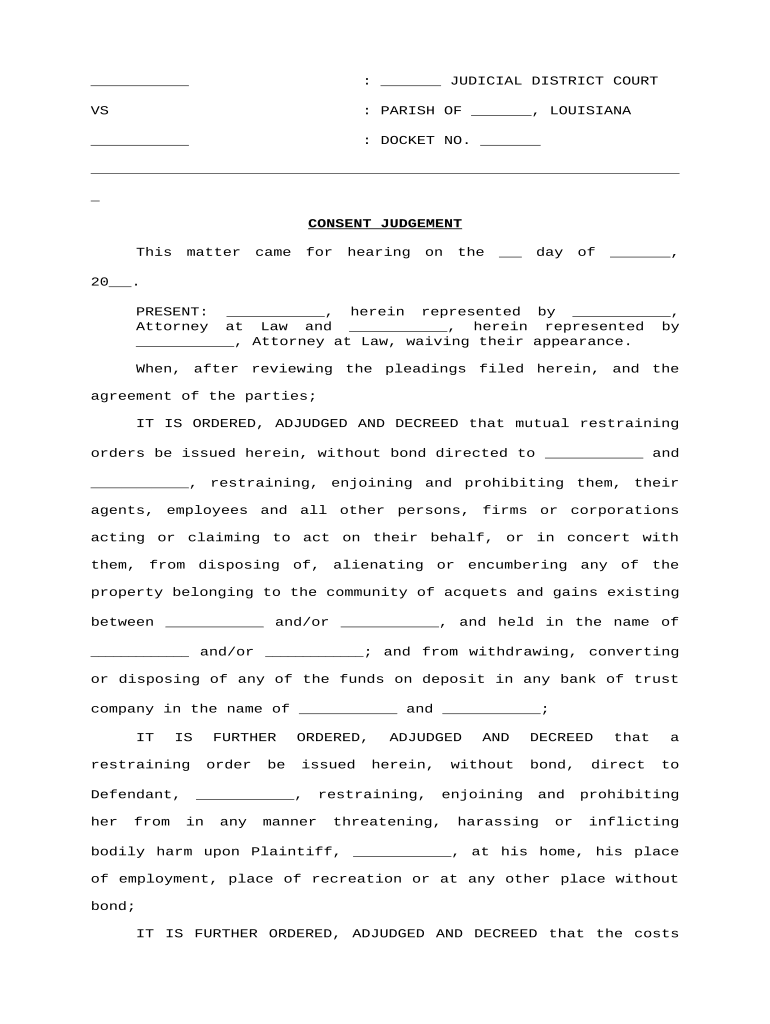
Case Caption

Identifies the court, case number, petitioner, and respondent, establishing jurisdiction and docket association; accurate party names and contact details are essential for service and recordkeeping.
Statement of Facts

Concise chronological summary of incidents with dates, locations, and witnesses. This factual section supports the court's findings and should reference attached evidence such as police reports or medical records.

Findings

Judge's factual and legal findings explaining why relief is warranted. Findings create the legal basis for relief and clarify the factual record for enforcement and appeals.

Restrictive Provisions

Precise prohibitions (no contact, stay-away distances, electronic restrictions) with measurable terms to ensure enforceability and minimize ambiguity for law enforcement and the respondent.

Duration and Renewal

Specify effective dates, expiration or review dates, and procedures for extension or termination. Clear timing limits reduce confusion and define when enforcement is in effect.

Service and Enforcement

Instructions for how the respondent must be served, required proof of service, and the consequences of violation. Include law enforcement contact and reporting procedures.

Key legal risks and potential penalties

Contempt Charges: Possible criminal penalties
False Statements: Perjury risk
Service Failure: Order unenforceable
Missed Deadlines: Relief may be denied
Incorrect Respondent: Wrong person restrained
Improper Filing: Case dismissal risk

Common mistakes people make when preparing a restraining order

  • Omitting dates, locations, or witness details in incident descriptions, which weakens the factual foundation for emergency relief and judge findings.
  • Using informal or incomplete names and contact details that prevent proper service and lead to delays or dismissal.
  • Failing to attach supporting documents such as police reports, medical records, or photographs that corroborate claims made in the petition.
  • Attempting to serve the respondent without following statutory methods for service, resulting in an unserved or unenforceable order.

Practical tips to improve accuracy and processing speed

Follow these best practices to reduce errors and help the court act quickly on your petition.

Be precise and chronological
Organize incidents in clear chronological order with MM/DD/YYYY dates and concise descriptions; courts rely on specificity to assess immediacy and risk.
Attach corroborating evidence
Include police reports, medical records, witness statements, and photos labeled by date; evidence materially strengthens emergency relief requests and the judge’s findings.
Confirm party identification
Use full legal names and known aliases, include identifying details, and verify addresses to ensure correct service and avoid restraining the wrong person.
Document service promptly
Maintain proof of service (return of service, affidavit) and file it immediately; courts require timely proof before a temporary order becomes final.

Real-world scenarios illustrating common restraining order use

Two illustrative examples show how petitioners and courts typically move from filing to protection.

Legal Aid Clinic

A survivor meets an intake advocate and documents incidents with dates and photos to file an ex parte petition

  • Petition granted temporarily pending a full hearing
  • The clinic files supporting affidavits and the clerk schedules a hearing where longer-term relief is considered.

Family Court Urgent Relief

A parent files after a threatening incident and requests custody-related protections and no-contact provisions

  • Judge issues emergency temporary order the same day
  • The respondent is served, and a contested hearing is scheduled to determine final orders.

eSignature vendor comparison for document signing and routing

Comparative pricing and feature availability for common eSignature vendors; signNow is listed first per vendor alignment and plan structures.

signNow DocuSign Adobe Sign PandaDoc HelloSign
Starting Price $8/user/mo $15/user/mo $14/user/mo $19/user/mo $15/user/mo
Free Trial 7-day free trial Varies by offer Varies by offer Varies by offer Varies by offer
Bulk Send Yes Yes Yes Yes No
Audit Trail Yes Yes Yes Yes Yes
HIPAA Compliant Yes Yes Yes No No
Envelope Cap No cap 100 envelopes/user/year Varies by plan Varies by plan Varies by plan

Frequently asked questions about filing and enforcing restraining orders

Answers to common procedural questions that petitioners and their representatives encounter when pursuing a restraining order.


Need help? Contact support

be ready to get more
Join over 28 million airSlate SignNow users