Establishing secure connection…Loading editor…Preparing document…

Letter of Interest for Academic Position

This template is fully customizable. Edit the text, fill out the fields, and send it for signature. Give it a try!
Letter of Interest for Academic Position

What a Letter of Interest for Academic Position Is and When It’s Used

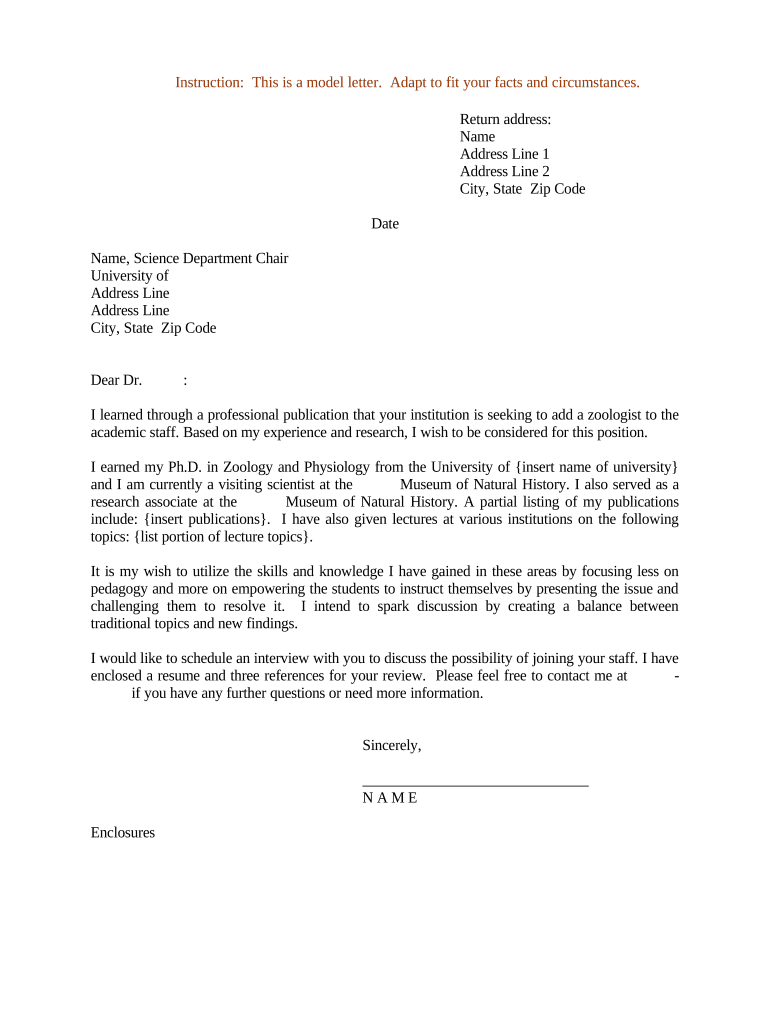
A Letter of Interest for Academic Position is a concise, professional document sent to a department chair, search committee, or hiring manager to express interest in a faculty or research role. It summarizes your academic credentials, research and teaching focus, and availability while linking the candidate profile to the department’s needs. Unlike a full application packet, it is typically shorter than a cover letter and often used to inquire about upcoming or unadvertised openings, request informational meetings, or introduce one’s candidacy ahead of formal calls for applications.

Why Sending a Letter of Interest Can Matter

A well-crafted letter signals proactive interest, clarifies fit with departmental priorities, and can prompt invitations to apply or to meet informally. It helps you stand out when positions are scarce or under development.

Why Sending a Letter of Interest Can Matter

Who Typically Sends or Receives These Letters

Academic job seekers, postdoctoral researchers, and internal faculty often use letters of interest to open communication with departments before or between formal searches.

  • Early-career researchers seeking tenure-track roles or postdoc opportunities within a targeted department.
  • Established faculty exploring lateral moves, joint appointments, or research collaborations.
  • Administrative staff and search committee chairs who collect candidate inquiries and manage pipelines.

Essential Elements to Include in a Professional Letter

Include concise sections that communicate identity, fit, and next steps so committees can quickly assess relevance.

Header

Name and contact information, institutional affiliation, and current position; use the same professional name that appears on publications and CV to avoid confusion when committees cross-check records.
Opening

One-sentence reason for writing that names the department, area of interest, and whether you respond to a specific posting or inquire about future roles.

Research Focus

Brief summary of your research agenda, methods, recent accomplishments, and potential alignment with departmental strengths or collaborative opportunities.

Teaching/Service

Concise description of teaching experience, courses you can offer, and any service or mentoring roles that demonstrate fit for the department’s mission.

Fit Statement

Two to three sentences tying your background to the department’s needs, naming specific programs, centers, or faculty where relevant to show targeted interest.

Closing

Availability for interviews or campus visits, list of attachments (CV, references), and a polite offer to provide further materials or schedule a conversation.

Required Contact and Identity Information

Full legal name: As on passport or CV
Email address: Prefer institutional email
Phone number: Include country code if international
Current position: Title and institution
Primary research area: Discipline or subfield
Attachment list: CV, references, selected publications

Step-by-Step: Writing and Sending Your Letter

Follow a short, logical sequence to prepare a clear, targeted letter and ensure it reaches the right recipients.

  • 01
    Draft opening: Address recipient and state purpose.
  • 02
    Summarize fit: Describe research and teaching alignment.
  • 03
    List attachments: Include CV and references.
  • 04
    Send and track: Email or e-submit and save evidence.

Configuring an Online Letter Submission Workflow

Set up a consistent, auditable process for sending letters and attachments through an applicant tracking system or email.

Field Configuration
Upload Template Use a standard letter template for consistency.
Attach CV/Docs Require PDF attachments to avoid formatting issues.
Signer Info Collect name, email, and institution fields.
Audit Trail Enable timestamps and delivery receipts.

Where to Send or File Your Letter of Interest

Choose the correct recipient and keep a copy; institutional routing varies by campus and department.

  • Department Chair: Primary contact for unsolicited inquiries.
  • Search Committee: Address if a committee contact is listed.
  • Human Resources: Some institutions centralize application intake.
  • Institutional Repository: Keep a personal copy for records.

Digital Delivery and Submission Considerations

Decide whether to submit by email, an online portal, or an institutional applicant system based on the department’s instructions.

  • File formats: Use PDF for attachments to preserve formatting.
  • Authentication: Institutional portals may require login.
  • Delivery receipt: Save any confirmation or timestamp.

Timing, Deadlines, and Typical Processing Expectations

Timing varies by institution and search cycle; plan to send letters well before application deadlines or at the start of the academic hiring season.

Academic hiring season:

Most campus searches cluster in September–February for fall start dates.

Rolling inquiries:

Letters can be sent year-round for unadvertised openings.

Portal deadlines:

Follow posted application deadlines when applying formally.

Processing time:

Committees may take weeks to respond after initial contact.

Follow-up timing:

Wait two to three weeks before a polite follow-up message.

Common Mistakes to Avoid

  • Sending a generic, untargeted letter that fails to explain specific departmental fit reduces the chance of follow-up.
  • Using an informal tone or including irrelevant personal details can undermine professional credibility.
  • Attaching poorly labeled files or incorrect CV versions causes confusion and may remove you from consideration.
  • Failing to confirm recipient or address leads to misdirected inquiries and lost opportunities.

Risks of Inaccurate or Improper Letters

Reputational harm: Errors can damage professional standing
Missed deadlines: Late submissions may be ineligible
Privacy exposure: Including protected data risks FERPA/HIPAA
Visa complications: Inaccurate availability dates affect immigration
Duplicate records: Multiple versions can confuse committees
Data loss: No retention plan may lose proof of submission

Real-World Examples of When a Letter Helps

Representative scenarios show how concise letters can open opportunities or clarify candidacy alignment.

University Faculty Inquiry

A postdoc writes to a biology department chair describing overlap with an active lab

  • The chair notes complementary methods and requests a research statement
  • The candidate is invited to submit a formal application and meet with potential collaborators on campus within six weeks.

Medical School Introduction

A clinician-researcher describes translational work and interest in joint appointments

  • The department requests recent publications and a short teaching statement
  • This leads to an initial phone interview and an invitation to present a seminar.

eSignature Vendors: Pricing and Basic Capabilities for Submitting Letters

Comparison of common eSignature vendors and their starting prices or notable limitations when routing letters and attachments electronically.

signNow DocuSign Adobe Sign PandaDoc HelloSign
Starting Price $8/user/mo $15/user/mo $14/user/mo $19/user/mo $15/user/mo
Free Trial 7-day free trial Varies Varies Varies Varies
Bulk Send Yes Yes Yes Yes No
Audit Trail Yes Yes Yes Yes Yes
HIPAA Compliant Yes Yes Yes No No

Frequently Asked Questions About Letters of Interest

Answers to common questions about suitability, digital submission, supporting documents, and follow-up etiquette.


Need help? Contact support

be ready to get more
Join over 28 million airSlate SignNow users