Establishing secure connection…Loading editor…Preparing document…

Nonresident Decedent Affidavit of Domicile

This template is fully customizable. Edit the text, fill out the fields, and send it for signature. Give it a try!
Nonresident Decedent Affidavit of Domicile

What the Nonresident Decedent Affidavit of Domicile Is

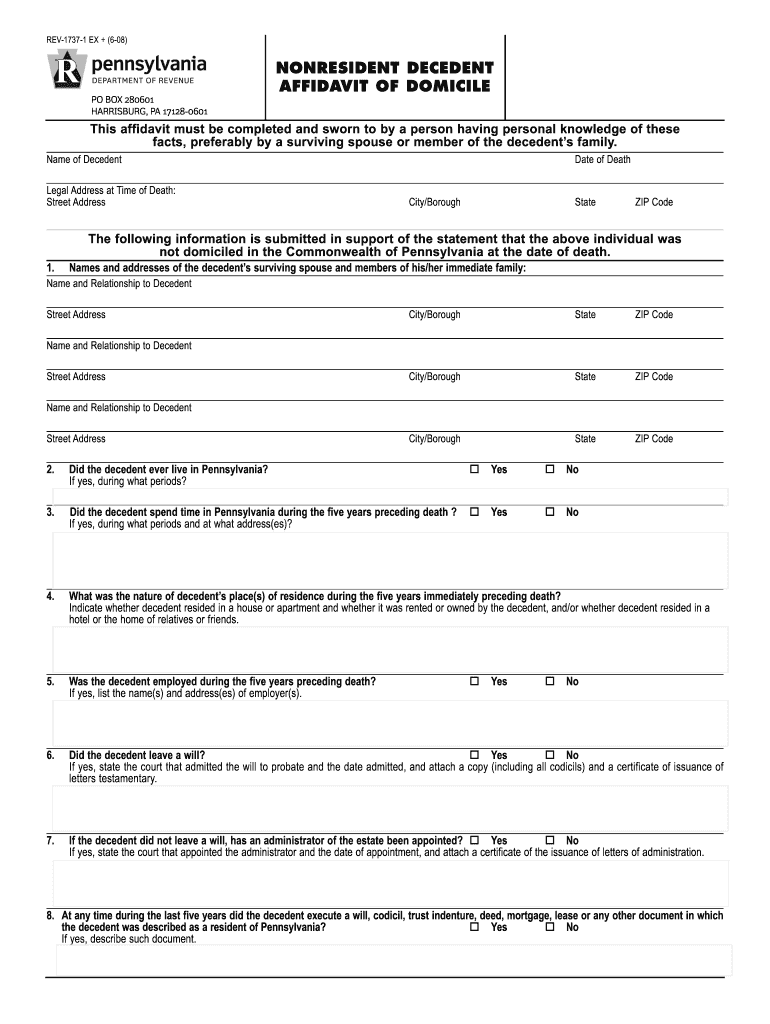
The Nonresident Decedent Affidavit of Domicile is a sworn statement used to confirm the decedent's last legal domicile when the decedent died outside the state where property or assets must be transferred. It documents identifying information about the decedent, the date and place of death, and the affiant's basis for knowledge, and is presented to payors, transfer agents, financial institutions, or probate courts to enable transfer of intangible property or to clear title without full probate administration.

Why this affidavit matters for transferring out-of-state assets

An accurate affidavit establishes the decedent's legal residence for probate and tax purposes, reduces delay when transferring bank accounts or securities, and offers a sworn, notarized record that payors and custodians commonly accept in lieu of formal probate in the decedent's home state.

Why this affidavit matters for transferring out-of-state assets

Who typically completes or receives this affidavit

The affidavit is completed by someone with direct knowledge or custody rights and is presented to institutions or courts that require proof of domicile before releasing assets.

  • Personal representative or executor who administers the decedent's estate and needs to transfer nonresident assets.
  • Bank or brokerage compliance officer verifying authority to pay or re-title accounts to beneficiaries.
  • Funeral director or title company facilitating transfer of tangible property or clearing title after death.

Choose the person who has both personal knowledge and legal authority to swear to domicile facts; institutions may require additional documentation or a court order.

Typical signers and stakeholders

Personal Representative

A court-appointed executor or administrator authorized to act for the estate; often prepares the affidavit, attaches proof of death and identity, and signs under oath before a notary or other authorized official.

Financial Institution Officer

A compliance or trust officer at a bank, brokerage, or transfer agent who reviews the affidavit, verifies notarization, and determines whether additional probate or letters testamentary are required to release assets.

Essential information included in the affidavit

Decedent name: Full legal name
Date of death: MM/DD/YYYY
Last domicile: Street, city, state, ZIP
Affiant identity: Name and relationship
Attaching documents: Death certificate, ID
Notarial statement: Oath and notary seal

Step-by-step: Completing the affidavit

Follow these steps to prepare a clear, legally sufficient affidavit before presenting it to banks or transfer agents.

  • 01
    Identify parties: List decedent and affiant names exactly.
  • 02
    State domicile facts: Describe last permanent home and intent to remain.
  • 03
    Attach proof: Include certified death certificate and ID.
  • 04
    Notarize: Sign before a notary public or authorized official.

Where to file and how the affidavit is used

Affidavits are used by payors and title holders to verify domicile; they are submitted to institutions rather than filed universally in one government office.

  • Financial institution: Provide to banks or brokers to release or re-title accounts.
  • Transfer agent: Submit to securities transfer agents for stock certificate transfer.
  • Probate court: Use when the court requests proof of domicile for ancillary probate.
  • Record keepers: Keep original notarized copy with estate files.

Key parts of a professional Nonresident Decedent Affidavit of Domicile

A well-crafted affidavit is concise, factual, and supported by documents; it clearly states the affiant's basis for knowledge and contains the notarization language required by the receiving institution or state law.

Caption

Case name or identifying header that states the document is an Affidavit of Domicile for a nonresident decedent, useful for institutional intake.
Statement of facts

Clear, numbered statements that set out the decedent's last domicile, dates, and reasons for concluding domicile rather than mere residence.

Affiant declaration

A concise paragraph where the affiant explains their relationship and source of knowledge, stating they swear or affirm the facts under penalty of perjury.

Document attachments

List and attach certified death certificate, government ID, letters testamentary if available, and any residence evidence requested by institutions.

Notary block

Jurisdiction-appropriate notarial wording, signature lines, and the official seal area to ensure acceptance by payors and transfer agents.

Distribution note

Optional line identifying institutions to receive the affidavit and any special delivery or copies required for recordkeeping.

Configuring an online workflow for this affidavit

Set up the document so parties can review, sign, notarize, and receive final copies with an audit trail for institutional acceptance.

Field Configuration
Signature method Digital signature with visible signature and audit trail
Authentication Email plus optional SMS or ID proofing for stronger identity match
File format PDF/A preferred for long-term retention and archiving
Routing Affiant -> Notary (if remote) -> Institution copy recipients

Technical and platform considerations for electronic completion

Choose a platform that supports notarization workflows, audit trails, and secure storage to meet institutional and legal expectations.

  • File types: PDF, DOCX supported
  • Integrations: Connects with cloud storage and CRM
  • Security: TLS in transit, AES-256 at rest

Verify the receiving institution accepts electronically notarized or digitally signed affidavits and retain copies according to legal retention rules.

Timing and expected processing steps

Timing varies by institution and state; prepare the affidavit as soon as a transfer or claim is initiated, and expect verification steps by payors or transfer agents.

Prepare promptly:

Create affidavit when a transfer is requested to avoid hold-ups.

Bank verification window:

Banks may take days to weeks to validate supporting documents.

Transfer agent review:

Securities transfer agents often require certified document copies.

Probate involvement:

Court involvement may be required if institution rejects affidavit.

Record retention:

Keep notarized originals as institutions may request originals later.

Common mistakes to avoid

  • Using informal language or vague terms about domicile rather than precise statements of permanent home and intent.
  • Failing to attach a certified death certificate or attaching an uncertified copy that institutions will not accept.
  • Providing partial or inconsistent names and dates that trigger additional identity verification and slow processing.
  • Omitting notarization or using incorrect notary wording for the receiving jurisdiction, causing rejection by payors.

Risks and legal consequences of errors

Rejection: Document may be rejected by institutions
Delayed transfer: Assets remain frozen pending additional proof
Tax consequences: Incorrect domicile may affect state tax obligations
Fraud exposure: Inaccurate statements can trigger fraud inquiries
Notary invalidation: Improper notarization can void acceptance
Civil liability: Affiant may face legal claims for false statements

How to download, save, and bundle supporting documents

Save final signed affidavits and attachments in universally accepted formats and maintain an audit trail to satisfy institutional and legal review.

Preferred format

Save as PDF/A for long-term archiving; preserves appearance and metadata across systems.

Editable copy

Keep a DOCX or form template copy for future revisions and redaction before sharing widely.

Supporting bundle

Create a single PDF package with affidavit, certified death certificate, ID, and letters testamentary where applicable.

eSignature compatibility

Export signed PDFs with embedded audit trail and notary certificate for institutional acceptance.

Practical tips for accurate and efficient completion

Adopt consistent preparation steps to reduce rework and institutional objections when transferring nonresident decedent assets.

Confirm document requirements
Contact the receiving payor or transfer agent before drafting to learn required wording, attachments, and whether originals are needed.
Use certified attachments
Obtain certified copies of the death certificate and any court-issued appointment letters to avoid institution requests for originals.
Standardize signatures
Sign in the presence of a notary with clear printed names and dates; include signer contact details for quick verification.
Keep audit trail
If using electronic workflows, ensure the platform captures timestamps, IP addresses, and proof-of-consent records for legal evidence.

Usage examples showing typical scenarios

These examples illustrate common, real-world reasons to prepare a Nonresident Decedent Affidavit of Domicile.

Out-of-State Bank Account

An executor needed to close a bank account in another state

  • the executor attached a certified death certificate and notarized affidavit
  • the bank accepted the affidavit and released funds after verifying the notary and affiant identity, avoiding ancillary probate in the account state.

Transfer of Securities

A beneficiary sought transfer of stock held by an out-of-state transfer agent

  • they provided a notarized affidavit plus letters testamentary
  • the transfer agent re-titled shares after document review, saving months usually needed for court-ordered ancillary probate.

How this affidavit compares to related documents

Compare the Nonresident Decedent Affidavit of Domicile with similar estate or transfer instruments to choose the correct path for asset release.

Criteria Nonresident Affidavit Small Estate Affidavit
Notarization Required often yes
Probate Court Filing no (often) usually yes
State-Specific Form
Typical Use asset release to payors simplified probate for small estates

eSignature vendor comparison for affidavit workflows

Pricing and compliance features vary between providers; select a plan that supports notarization, audit trails, and any required compliance such as HIPAA or 21 CFR Part 11.

signNow DocuSign Adobe Sign PandaDoc HelloSign
Starting Price $8/user/mo $15/user/mo $14/user/mo $19/user/mo $15/user/mo
Free Trial 7-day free trial Varies by plan Varies by plan Varies by plan Varies by plan
Bulk Send Yes Yes Yes Yes No
Audit Trail Yes Yes Yes Yes Yes
HIPAA Compliant Yes Yes Yes No No
Envelope Cap No cap 100 envelopes/user/year Varies by plan Varies by plan Varies by plan

Frequently asked questions about the affidavit

Answers to common questions about signing, notarization, electronic submission, and handling corrections for a Nonresident Decedent Affidavit of Domicile.


Need help? Contact support

be ready to get more
Join over 28 million airSlate SignNow users