Establishing secure connection…Loading editor…Preparing document…

Revocation of Prenuptial Agreement Hawaii

This template is fully customizable. Edit the text, fill out the fields, and send it for signature. Give it a try!
Revocation of Prenuptial Agreement Hawaii

What the Revocation of Prenuptial Agreement Hawaii Is

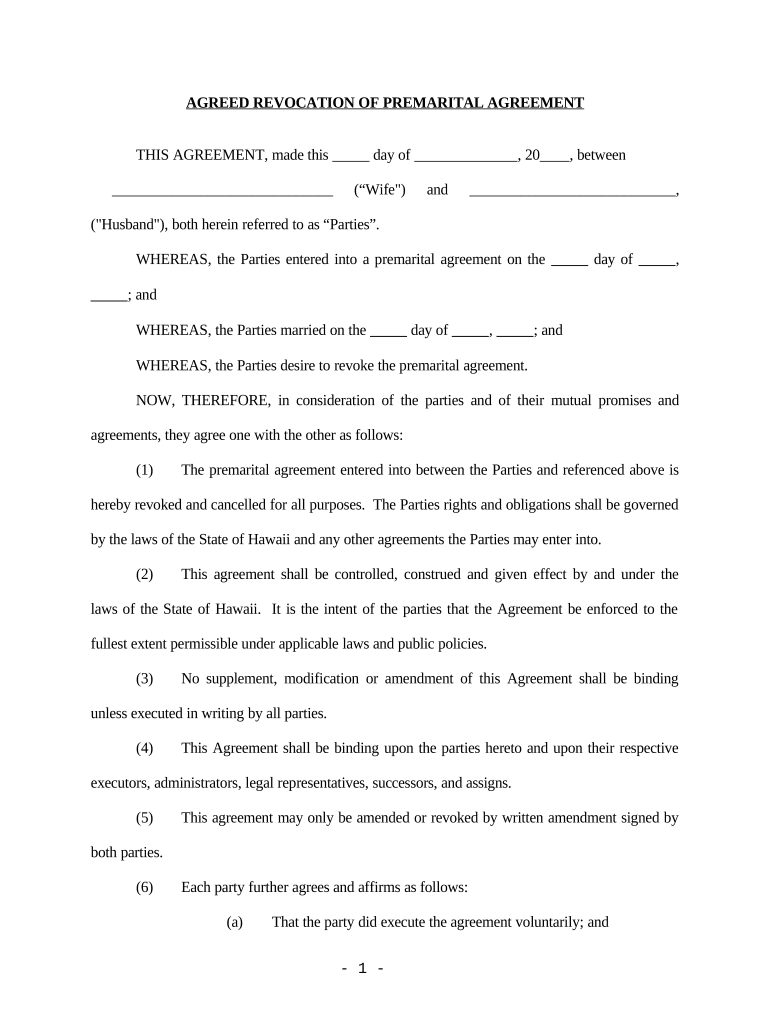
A Revocation of Prenuptial Agreement Hawaii is a written instrument used by both parties to cancel a previously executed prenuptial agreement under Hawaii practice. It records mutual intent to terminate the prenuptial contract, identifies the original agreement and parties, and states an effective revocation date. The document should be signed by both spouses and, where appropriate, notarized or witnessed to strengthen evidentiary weight. Electronic signatures may be valid under the ESIGN Act (15 U.S.C. ch. 96) and state UETA rules when no statutory exception applies.

Why a Formal Revocation Matters

A formal revocation documents mutual consent to terminate the prenup, reduces later disputes, and clarifies estate and financial planning. A signed revocation creates a clear record for courts, financial institutions, and advisers.

Why a Formal Revocation Matters

Who Typically Completes This Revocation

Typical users include married couples, family law attorneys, and estate planners who need a documented mutual termination of a prenup.

  • Individual spouses seeking to mutually cancel a prior prenuptial agreement.
  • Family law attorneys preparing a clear, court-ready revocation document for clients.
  • Estate planners updating estate documents after a marriage or other life change.

Representative Users and Roles

Family Law Attorney

Family law attorneys use the revocation template to document clients' mutual termination of prenuptial agreements, ensure language anticipates disclosure or unconscionability defenses, and add notary or witness blocks to strengthen admissibility in court proceedings.

Married Party

Private individuals execute the revocation to adjust estate planning and financial accounts; they typically coordinate notarization, counsel review, and distribution of executed copies to relevant institutions.

Core Elements to Include in the Revocation

A professional Revocation of Prenuptial Agreement Hawaii should contain specific identifiers, mutual intent language, signature blocks, and recordkeeping directions to avoid ambiguity and support enforceability.

Parties

Identify both spouses with full legal names, current addresses, and contact details; include any previous names used in the original agreement for clarity in court filings.
Reference

Cite the original prenuptial agreement by execution date, signing location, and any docket or recording numbers so the revocation unambiguously applies to that instrument for future reference.

Intent

State clear mutual language that both parties intend to revoke the prior agreement in full and avoid residual or ambiguous survivorship language that could cause disputes.

Effective Date

Specify the effective date in MM/DD/YYYY format; this date governs termination of duties and influences any subsequent claims or statute of limitations.

Signatures

Provide signature blocks for both parties with printed names and dates; include a notary acknowledgment and witness lines if state practice or institutions require them.

Recordkeeping

Describe where originals will be kept, who receives copies, and the retention period; clear distribution reduces later disputes and supports admissibility.

Step-by-Step: How to Complete the Revocation

Follow these sequential steps to prepare, sign, and document a valid revocation of a prenuptial agreement in Hawaii.

  • 01
    Identify Agreement: Reference original prenup date, parties, and filing location if applicable.
  • 02
    Draft Revocation: State mutual intent to revoke and include a clear effective date.
  • 03
    Signatures: Both parties sign and date; consider notarization for added authenticity.
  • 04
    Record Retention: Keep original and distribute copies to attorneys and relevant institutions.

Execution Workflow Overview

A clear execution workflow reduces errors: prepare the document, verify identity, obtain signatures, notarize if needed, and distribute certified copies.

  • Prepare Document: Draft revocation, reference original agreement, set effective date.
  • Identity Check: Verify signer IDs; use notarization or robust e-authentication.
  • Signing: Collect wet or e-signatures from both parties.
  • Distribution: Send executed copies to counsel and retain originals.

How to Configure a Digital Signing Workflow

Set up an online workflow to capture signatures, optional notary steps, and automatic delivery of executed copies to counsel or institutions.

Field Configuration
Signer Authentication Methods Email link with optional SMS code and ID verification recommended for higher assurance.
Notary Integration Include remote online notarization (RON) or in-person notary steps where required by state law.
Document Fields Place signature, initial, date, and witness fields; mark notarization block clearly.
Notifications Auto-notify parties and counsel when execution completes and store certificate of completion.

Platform and Format Requirements for eSigning

Electronic signing options must meet state authentication rules; select tools that support notarization, audit trails, and secure storage.

  • Formats: PDF and DOCX supported.
  • Integrations: Works with Google Workspace, Microsoft 365.
  • Authentication: Supports SMS codes, KBA, and SSO.

Timelines and Key Dates to Watch

Key timing considerations for a Revocation of Prenuptial Agreement Hawaii include selecting an effective date, completing notarization, and meeting retention obligations for evidentiary purposes.

Effective Date Entry:

Enter the effective date using MM/DD/YYYY; it controls when obligations end.

Signing Deadline Recommendation:

Sign promptly to reduce the chance of contested revocation claims later.

Notarization Timing:

Notarize at signing or immediately after execution to preserve acknowledgement.

Distribution Timeline:

Provide copies to counsel and financial institutions immediately after execution.

Record Retention Start:

Retention typically begins on the effective date or execution date.

eSignature Pricing and Feature Snapshot for Document Execution

Comparison of common eSignature features and typical starting prices for platforms often used to execute or notarize revocation documents.

signNow DocuSign Adobe Sign PandaDoc HelloSign
Starting Price $8/user/mo $15/user/mo $14/user/mo $19/user/mo $15/user/mo
Free Trial 7-day free trial Varies Varies Varies Varies
Bulk Send Yes Yes Yes Yes Yes
Audit Trail Yes Yes Yes Yes Yes
HIPAA Compliant Yes Yes Yes No No

Practical Examples of Using a Revocation

Examples illustrate common scenarios where a signed revocation simplifies estate planning and reduces litigation risk.

Couple Mutual Revocation

After ten years of marriage both spouses agreed to revoke their prenup to simplify estate planning.

  • They signed a written revocation before a notary.
  • The notarized revocation, copies to counsel, and updated beneficiary forms reduced ambiguity and prevented later estate disputes by providing clear evidence of mutual intent and updating account records accordingly.

Attorney-Assisted Revision

A client sought to revoke a prenup after material financial changes and engaged counsel for negotiation and drafting.

  • Counsel prepared a targeted revocation and coordinated notarization.
  • Attorney review ensured disclosure obligations were addressed, the revocation avoided unintentionally altering related agreements, and documented consent minimized litigation risk.

Best Practices for a Clean, Enforceable Revocation

Follow these best practices to reduce ambiguity, authenticate signers, and create durable records that hold up in review or litigation.

Use Clear Mutual Intent Language
Draft a plain-language statement that both parties expressly revoke the specific prenuptial agreement, identify the original instrument by date and parties, and avoid blanket phrasing that could affect unrelated documents.
Confirm Identity, Capacity, and Consent
Verify both signers have legal capacity and are signing voluntarily. Use notarization or strong electronic authentication and note counsel presence to support absence of coercion claims.
Keep Detailed Records, Copies, and Distribution Logs
Retain the original executed document, notarization acknowledgements, witness signatures, and a distribution log specifying who received copies and when to support admissibility.
Use Narrow, Targeted Language to Limit Impact
Phrase the revocation to cancel only the intended prenup provisions, and attach the original agreement or exhibit referencing affected clauses to avoid accidental repeal of related instruments.

Common Preparation Pitfalls to Avoid

  • Failing to precisely identify the original prenuptial agreement, such as omitting the execution date or signing location, can create ambiguity about which instrument is being revoked and invite litigation.
  • Using vague or overly broad language like 'void all prior agreements' without specifying the prenup may unintentionally affect unrelated contracts, estate planning documents, or beneficiary designations.
  • Relying solely on casual email exchanges or informal messages may not meet ESIGN evidentiary requirements unless intent, consent, and reliable retention are demonstrably captured.
  • Not verifying signer identity or omitting notarization or witnesses in jurisdictions that value physical acknowledgment increases the likelihood of later authenticity challenges.

Security and Compliance Considerations

Encryption: TLS 1.2/1.3; AES-256 at rest
Certifications: SOC 2 Type II, ISO 27001
HIPAA: HIPAA-compliant with BAA available
ESIGN/UETA: Meets ESIGN Act and UETA standards
Access Controls: Multi-factor and role-based controls
Audit Trail: Detailed timestamps and signer IP logs

Risks and Potential Consequences of Errors

Invalid Form: Missing signatures may void revocation
Tax Consequences: Unaddressed financial clauses can trigger disputes
Court Challenge: A one-party revocation invites litigation
Notary Omission: Lack of notarization weakens evidence
Recording Errors: Wrong instrument referenced causes confusion
Data Breach: Improper storage risks privacy violations

Frequently Asked Questions about Revocation of Prenuptial Agreement Hawaii

Answers to common questions about validity, notarization, witness requirements, and what to do if a party disagrees with a revocation.


Need help? Contact support

be ready to get more
Join over 28 million airSlate SignNow users