Establishing secure connection…Loading editor…Preparing document…

Revocation of Prenuptial Agreement Wisconsin

This template is fully customizable. Edit the text, fill out the fields, and send it for signature. Give it a try!
Revocation of Prenuptial Agreement Wisconsin

What the Revocation of Prenuptial Agreement Wisconsin Is

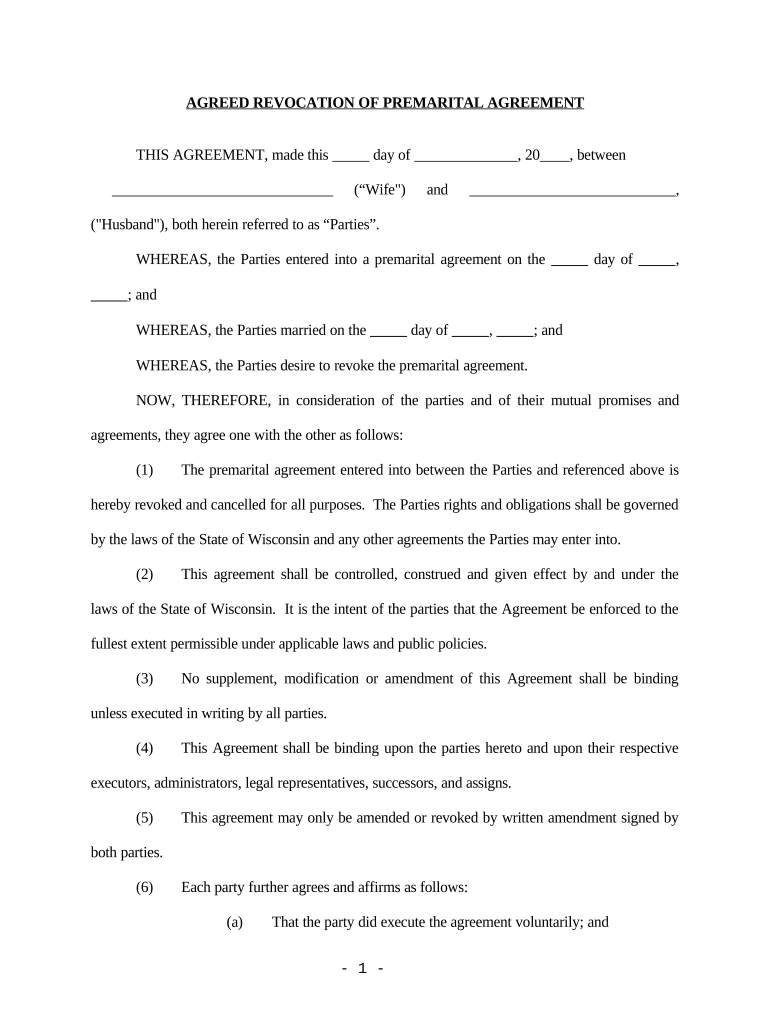
A Revocation of Prenuptial Agreement Wisconsin is a written document used when both parties intend to cancel or terminate an existing prenuptial agreement under Wisconsin law. It records mutual consent to rescind the prenup, identifies the original agreement, and clarifies whether any obligations or property allocations survive the revocation. The revocation should be clear, signed by the parties, and dated to create an enforceable record; parties often choose notarization or witness acknowledgement to reduce later disputes about authenticity.

Why a Formal Revocation Matters and Its Legal Effect

A formal revocation provides clear evidence that both parties agree to end the prenuptial agreement, reducing future litigation risk and ambiguity about rights. Using a written, signed revocation helps courts and third parties verify intent and timing, supports record retention, and complements electronic evidence under ESIGN and UETA where permitted.

Why a Formal Revocation Matters and Its Legal Effect

Who Typically Prepares or Signs This Revocation

Proper completion ensures enforceability and creates a clear record for courts, financial institutions, and estate planners.

  • Couples who mutually agree to rescind the prenup without court litigation
  • Divorce attorneys or family law counsel acting on client instruction
  • Estate or financial planners documenting changes to marital property arrangements

Core Elements to Include in a Professional Revocation

A complete revocation includes precise identification of the original agreement, a mutual statement of rescission, effective date, signatures, and any transitional provisions for assets or obligations.

Identification

Reference the original prenuptial agreement by date, parties, and any recording or exhibit numbers so the revocation unambiguously targets the correct document.
Mutual Rescission

A clear joint statement that the parties mutually revoke and terminate the specified prenuptial agreement, describing scope and extent of the revocation.

Effective Date

A specific effective date expressed as MM/DD/YYYY that determines when the agreement ceases to have legal effect and guides subsequent conduct and retention.

Surviving Terms

Identify any clauses from the original agreement that expressly survive revocation, such as confidentiality, indemnity, or property holdbacks, if parties intend them to remain binding.

Signatures

Signed and dated execution blocks for both parties; include printed names and, when practical, notary or witness acknowledgement to strengthen evidentiary weight.

Notary/Witness

Space for notarization or witness signatures and journal entries when required or recommended by local practice to reduce later disputes about authenticity.

Required Information and Fields at a Glance

Party Names: Full legal names
Original Agreement: Date and identification
Effective Date: MM/DD/YYYY
Signature Lines: Signed and dated
Notary Block: Notary acknowledgement
Witness Lines: If state requires

Step-by-Step: How to Complete the Revocation Form

Follow these sequential steps to prepare a clear, enforceable revocation of a prenuptial agreement in Wisconsin.

  • 01
    Identify agreement: Enter original prenup date and parties.
  • 02
    State rescission: Write an explicit mutual rescission clause.
  • 03
    Set effective date: Use MM/DD/YYYY format for clarity.
  • 04
    Sign and notarize: Both parties sign; notarize if available.

How to Customize and Complete the Revocation Online

Configure an online workflow that preserves legal intent, signer attribution, and an audit trail for later verification.

Upload document template PDF or DOCX accepted.
Place signature fields Assign signer roles to each party.
Add date fields Require MM/DD/YYYY input format.
Enable authentication Use email, SMS, or stronger methods.
Preserve audit trail Capture IP, timestamps, and actions.

Where to File or Submit the Revocation

A revocation is primarily an agreement between the parties; filing depends on surrounding legal needs or third-party requirements.

  • Keep original: Each party retains an original signed copy.
  • Provide to counsel: Give copies to attorneys and financial advisors.
  • Record if needed: Record with registry only if prenup affected title.
  • Court filing: File with court only if tied to litigation.

Digital Signing and eSubmission Requirements

Use a compliant eSignature workflow that preserves the audit trail, stores executed copies securely, and offers notary or RON integration when required or recommended by local practice.

  • Intent and Consent: Capture signer intent and acceptance.
  • Attribution: Record signer identity and method.
  • Retention: Provide tamper-evident signed copy.

Timelines, Deadlines, and Processing Expectations

Understand effective timing and retention expectations so the revocation operates as intended and relevant parties are notified in a timely manner.

Effective upon signing:

Revocation typically becomes effective when properly signed by both parties.

Deliver copies promptly:

Provide executed copies to counsel and financial institutions immediately.

Notary/RON timing:

If notarized remotely, retain audio-video session records per state rules.

Court deadlines:

File only if required by litigation or settlement timelines.

Record retention:

Keep executed copies according to retention guidance below.

Common Mistakes to Avoid When Preparing a Revocation

  • Failing to identify the original agreement clearly, which can create ambiguity about which prenup is revoked and invite litigation.
  • Using vague language like 'intend to terminate' instead of an explicit mutual rescission statement with an effective date.
  • Allowing only one party to sign or using initials instead of full signatures, which can undermine enforceability.
  • Neglecting to preserve executed copies, audit trails, or notarization evidence when disputes later arise.

Risks of an Incorrect or Incomplete Revocation

Unenforceable Revocation: May be set aside by a court
Continued Obligations: Original prenup may still bind parties
Property Disputes: Leads to asset allocation litigation
Tax Consequences: Improper reporting or withholding risks
Authentication Disputes: Signature authenticity may be contested
Record Loss: Missing executed copy impairs proof

How Organizations and Counsel Use Revocations in Practice

Real-world examples illustrate common workflows where a signed revocation reduced future disputes and clarified asset administration.

Tim Martin

When a couple changed property plans, they executed a mutual revocation

  • signNow recorded signatures and timestamps
  • The parties gave signed copies to counsel, avoided litigation, and updated estate plans accordingly to match post-revocation intentions.

John Butler

A fertility clinic client revised personal asset arrangements and revoked an old prenup

  • the revocation included notarization and retained audit trail
  • Counsel relied on the executed revocation during later estate planning and beneficiary updates without contest.

eSignature Solutions for Executing a Revocation — Pricing Overview

Compare basic pricing and feature signals across common eSignature vendors when choosing a platform to execute and retain a revocation securely.

signNow DocuSign Adobe Sign PandaDoc HelloSign
Starting Price $8/user/mo $15/user/mo $14/user/mo $19/user/mo $15/user/mo
Free Trial 7-day trial Varies Varies Varies Varies
Bulk Send Yes Yes Yes Yes Yes
Audit Trail Yes Yes Yes Yes Yes
HIPAA Compliant Yes Yes Yes No No

Frequently Asked Questions About Revoking a Prenuptial Agreement in Wisconsin

Answers to common questions that arise when parties prepare, sign, or submit a revocation of a prenuptial agreement in Wisconsin.


Need help? Contact support

be ready to get more
Join over 28 million airSlate SignNow users