Establishing secure connection…Loading editor…Preparing document…

Safety Training Attendance Documentation

This template is fully customizable. Edit the text, fill out the fields, and send it for signature. Give it a try!
Safety Training Attendance Documentation

What the Safety Training Attendance Documentation Is

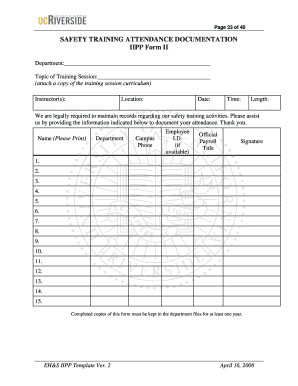
Safety Training Attendance Documentation is a formal record that logs who attended a safety training session, when it occurred, the topics covered, and any certifications or competencies issued. Employers use it to demonstrate compliance with workplace safety obligations, to support incident investigations, and to track recurring training schedules. Records typically include the course title, date, trainer name, attendee names and IDs, start and end times, signatures or e-signatures, and notes on accommodations or absences. Proper documentation helps meet regulatory expectations and supports internal audits and insurance reviews.

Why Accurate Attendance Records Matter

Clear attendance documentation establishes proof of training, helps satisfy regulatory recordkeeping requirements, reduces liability in incident reviews, and supports workforce competency tracking for ongoing safety programs.

Why Accurate Attendance Records Matter

Who Typically Prepares and Uses These Records

Organizations responsible for workplace safety create and maintain attendance documentation to meet regulatory, contractual, and insurance needs.

  • Safety managers and EHS teams who schedule, deliver, and retain training records for compliance.
  • Human resources for employee files, qualifications tracking, and discipline or accommodation decisions.
  • Third-party training providers and contractors who must demonstrate attendee lists and completion verification.

Step-by-step: Completing an Attendance Record

Follow a consistent sequence when creating attendance documentation so records are complete, auditable, and easily searchable during reviews.

  • 01
    Prepare roster: Create session header with course, date, location, trainer, and objectives.
  • 02
    Capture details: Record full legal name, employee ID, and employer or contractor affiliation.
  • 03
    Obtain signature: Collect handwritten or electronic signatures with date and method indicated.
  • 04
    Store record: Save final signed copy to secure records with retention tags.

Essential components of a professional attendance record

A comprehensive attendance form is structured to provide immediate context, verify identity, and support later retrieval for audits or investigations.

Session Header

Course title, learning objectives, location, date range and session ID to uniquely identify each training event for tracking and reporting.
Trainer Details

Full name, credentials, company, and contact information so verifier can confirm instructor qualifications and content delivery.

Roster Table

Attendee rows with full name, employee ID, role, contact, arrival time, and departure time to show presence and participation.

Signature Area

Designated fields for signature, date, and signature method; include space for witness or supervisor initials where required.

Verification Notes

Fields for accommodations, deviations from agenda, competency check results, or remedial actions taken during the session.

Record Metadata

Fields for document owner, retention tag, document version, and audit trail reference for chain-of-custody and retention compliance.

Supporting templates and export options

Design templates and export formats that make distribution, printing, and system ingestion straightforward while preserving the audit record.

Printable Sign-in Sheet

A one‑page roster optimized for in-person sessions that prints clearly and includes lines for handwritten names, times, and signatures.

Certificate Template

Optional completion certificate populated from attendance fields to confirm competency and training hours for credentialing.

CSV Export

Export attendee rows as CSV for HR or LMS import, preserving IDs, timestamps, and completion status for downstream systems.

PDF Audit Copy

Final signed copy saved as PDF/A with embedded audit trail to support long‑term retention and legal review.

How electronic attendance and signing typically flows

Electronic workflows reduce friction while retaining evidentiary data needed to prove who attended and when.

  • Upload template: Author the form and place required fields for names, IDs, and signatures.
  • Assign signers: Add recipient emails or generate a secure signing link for attendees.
  • Authenticate signer: Use email, SMS, or stronger methods to attribute signatures to individuals.
  • Capture audit: Record timestamps, IP address, and action log with final signed document.

Typical eSubmission configuration for attendance workflows

Configure your workflow settings to collect required data and to produce an auditable final record.

Field Configuration
Signer Authentication Email link or SMS code authentication for attendee attribution.
Auto Date Stamping Enable automatic date/time stamps at signing to ensure accurate timestamps.
Conditional Fields Show remedial training fields only when attendees mark 'incomplete'.
Retention Tagging Apply a retention label (e.g., 5 years) to automate archival policies.

Platform and file-format considerations

Ensure the eSignature platform supports required file types, integrations, and authentication methods before using it for attendance records.

  • File Types: PDF, DOCX, and fillable forms supported.
  • Integrations: Connects with HR, LMS, and storage systems.
  • Authentication: Email, SMS, KBA, or enterprise SSO.

Key retention and timing considerations

Meeting statutory and internal deadlines ensures records are available for inspections, audits, and incident response.

Immediate Filing:

Submit attendance records to HR within 7 business days of the session.

OSHA Record Retention:

Maintain injury and training-related records for at least 5 years (29 CFR §1904.33).

HIPAA Retention:

If records include protected health information, retain for 6 years (45 CFR §164.530(j)).

Annual Review:

Conduct yearly audits of training records and update retention tags.

Tax/Payroll Linkage:

Keep attendance tied to payroll or certification dates for at least 3 years when tax-relevant.

Typical milestones from scheduling to archival

Track phases from training setup through archival so each stage has an accountable owner.

01

Schedule Training

Assign trainer and publish session details to participants.

02

Record Attendance

Capture attendee data and signatures during the session.

03

Validate & Store

Quality-check entries, finalize signed PDF, and store in secure repository.

04

Audit & Archive

Run periodic audits and move records to long-term archive per policy.

Common pitfalls to avoid

  • Incomplete attendee entries where nicknames or initials prevent definitive identity verification during audits or incident investigations.
  • Missing or unclear signature method entries that leave attribution ambiguous and weaken evidentiary value.
  • Inconsistent date/time formats across records that complicate automated sorting, reporting, and cross-referencing with incident timelines.
  • Storing signed files only locally without secure backup or retention tagging, risking loss during device failures or personnel changes.

Security and compliance features to verify

Encryption in transit: TLS 1.2 / 1.3
Encryption at rest: AES-256
Audit capability: Detailed timestamp and IP logs
HIPAA readiness: BAA available
Regulatory standards: ESIGN, UETA, 21 CFR Part 11
Certifications: SOC 2 Type II, ISO 27001

Consequences of incomplete or missing records

OSHA citations: Potential fines and corrective orders
Insurance disputes: Claim denials for lack of proof
Contract noncompliance: Breach consequences under client agreements
Legal exposure: Weakened defense in litigation
Data privacy breaches: HIPAA or state privacy violations
Operational gaps: Missed retraining and increased risk

How a formal attendance document compares with a basic sign-in sheet

Compare key capabilities so you choose a format that meets legal, audit, and operational needs.

Criteria Safety Training Attendance Documentation Basic Sign-in Sheet
Legally enforceable
eSignature friendly varies
Notarization needed
Detailed audit trail

Vendor pricing and feature snapshot for eSignature use with attendance forms

Compare introductory pricing and core attributes relevant to safety training attendance documentation; signNow is listed first for direct comparison.

signNow DocuSign Adobe Sign PandaDoc HelloSign
Starting Price $8/user/mo $15/user/mo $14/user/mo $19/user/mo $15/user/mo
Free Trial 7-day free trial Varies Varies Varies Varies
Bulk Send Yes Yes Yes Yes Varies
Audit Trail Yes Yes Yes Yes Yes
Envelope Cap No cap 100 envelopes/user/year Varies Varies Varies

Common questions and practical answers

Frequently asked questions address eSignature validity, correcting errors, retention obligations, and signer authentication for attendance records.


Need help? Contact support

be ready to get more
Join over 28 million airSlate SignNow users