Establishing secure connection…Loading editor…Preparing document…

Letter Notifying Claimants of Estate Administration

This template is fully customizable. Edit the text, fill out the fields, and send it for signature. Give it a try!
Letter Notifying Claimants of Estate Administration

What the Letter Notifying Claimants of Estate Administration Is

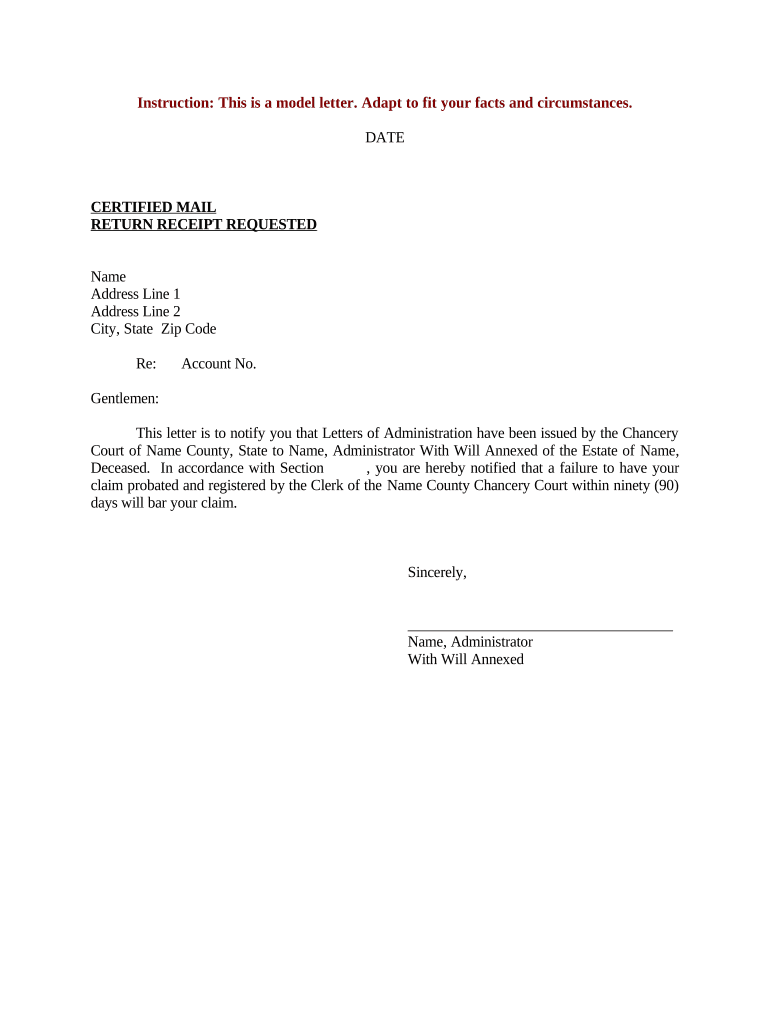
A Letter Notifying Claimants of Estate Administration is a formal notice sent by a personal representative, executor, or probate attorney to known or potential creditors and claimants that an estate is open for administration. The letter identifies the estate and personal representative, explains how and where to submit claims, and states the deadline and method for filing a claim. It may be used alongside a published notice to unknown creditors and helps set the timeline for reviewing and resolving creditor claims during probate.

Why this Notice Matters for Estate Administration

Sending a clear notice protects the estate by identifying creditors, limiting late claims, and documenting the administrator’s compliance with probate procedures and creditor-notice obligations under state probate rules and general notice practices.

Why this Notice Matters for Estate Administration

Who Typically Prepares and Sends This Notice

Executors, personal representatives, and probate attorneys commonly prepare these letters to begin creditor-claim processes and preserve estate assets.

  • Personal representatives and executors who administer the decedent’s estate and handle creditor claims and distributions.
  • Probate attorneys who draft, review, and serve notices to ensure statutory compliance and reduce exposure to late claims.
  • Creditor representatives and claims departments that receive notices to evaluate and file proof-of-claim documents.

The notice identifies who will accept and review claims, creating a defensible record should disputes arise during probate.

Step-by-Step: Preparing and Sending the Notice

Follow these steps to prepare a compliant and trackable notice for claimants.

  • 01
    Gather Documents: Collect death certificate, court docket, and creditor lists.
  • 02
    Draft Notice: Include estate ID, deadlines, and submission instructions.
  • 03
    Authenticate Signer: Have the personal representative sign and date the letter.
  • 04
    Send & Track: Deliver by required methods and keep mailing proof.

Key Components to Include in a Professional Notice

A well-structured notice reduces dispute risk. Include precise identifiers, clear claim instructions, and signature data to form a defensible record for the probate file.

Document Header

Title the letter clearly (e.g., Letter Notifying Claimants of Estate Administration), list the probate court and case number, and include the decedent’s full legal name to tie the notice to court records.
Personal Representative Details

Supply the name, mailing address, telephone number, and email for the estate’s personal representative or the attorney accepting claims on behalf of the estate.

Claim Submission Steps

Describe required proof-of-claim content, attachments, whether a signed affidavit is necessary, and acceptable delivery methods (mail, email, portal).

Deadline and Timeframe

State the exact claim deadline in MM/DD/YYYY format and whether statutes or local rules affect the timeline so claimants know when claims are barred.

Consequences

Explain that failure to timely present a claim may result in denial or disallowance under applicable probate statutes and that the estate may distribute assets after the claims period.

Signature Block

Provide a dated signature block for the personal representative and, if used, the probate attorney, with printed name and title to show authority.

Required Information Elements at a Glance

Estate Identifier: Decedent name
Court Reference: Probate case number
Representative: Executor name
Claimant Details: Name and contact
Deadline: MM/DD/YYYY
Submission Method: Mail/email/portal

How to Configure an Online Notice Workflow

Set up an e-delivery workflow to sign, send, and log notices while maintaining a clear audit trail.

Field Configuration
Document Template Use a reusable template with placeholders for estate and claim data
Signature Method Choose e-signature with audit trail or wet signature as required
Authentication Select email or SMS code for signer verification
Retention Policy Store signed copies and delivery receipts for required retention period

Delivery and Technical Options for Sending Notices

Notices may be delivered by mail, publication, or electronically; choose methods that satisfy local probate rules and create durable proof of delivery.

  • Email Delivery: Fast, provides an electronic receipt
  • Certified Mail: Proof via return receipt
  • Publication: Used when claimants are unknown

For electronic workflows, ensure platform supports PDF, Word, and audit-trail exports and integrates with case management or cloud storage systems for secure retention.

Where to File or Send the Notice and Claims

Identify formal destinations for notices and claims so submitters know where to send documentation and administrators can track incoming responses.

  • Probate Court: File required court notices or case updates with the probate clerk
  • Estate Representative: Send claims to the personal representative’s address for review
  • Claims Portal: If available, accept attachments and proofs via a secure web portal
  • Published Notices: Publish in local paper when unknown creditors must be informed

Typical Timelines and Response Expectations

Timelines for presenting claims vary by state and case type; state statute and probate court rules set limits, so specify the controlling deadline in the notice.

Statutory Claim Periods:

Varies by state; often 90 days to 6 months

Published Notice Timing:

Allow time for publication and statutory response window

Claim Review Period:

Administrator typically evaluates claims within 30–90 days

Estate Distribution:

Distribution may proceed after creditor deadlines expire

Court Deadlines:

Comply with any probate-court scheduling or hearing dates

Common Mistakes to Avoid When Preparing the Notice

  • Using an ambiguous deadline or format that leaves claimants uncertain about when claims are due and may lead to disputes.
  • Failing to include the probate case number or court name, which makes it difficult for claimants to verify the estate and submit accurate claims.
  • Omitting clear submission instructions or required attachments, causing incomplete claims and extra administrative work to request missing documents.
  • Neglecting to keep proof of mailing or electronic delivery receipts, weakening the estate’s record if a claim dispute goes to court.

Risks and Consequences of an Incorrect or Missing Notice

Late Claims: May be allowed
Denial of Claims: Claims may be barred
Personal Liability: Executor risk for negligent distributions
Court Sanctions: Possible sanctions for noncompliance
Increased Costs: Additional attorney fees and administration expense
Competing Claims: Litigation risk among creditors

eSignature Pricing and Feature Comparison for Sending Notices

This comparison shows starting prices and common features for eSignature vendors that administrators use to sign, send, and track estate notices.

signNow DocuSign Adobe Sign PandaDoc HelloSign
Starting Price $8/user/mo $15/user/mo $14/user/mo $19/user/mo $15/user/mo
Free Trial 7-day free trial Yes Yes Yes Yes
Bulk Send Yes Yes Yes Yes No
Audit Trail Yes Yes Yes Yes Yes
HIPAA Compliant Yes Yes Yes No No
Envelope Cap No envelope cap 100 envelopes/user/year Varies by plan Varies by plan Varies by plan

Frequently Asked Questions About Notice Letters and Claims

Answers to common questions about legal validity, deadlines, electronic delivery, and correcting errors when notifying claimants about estate administration.


Need help? Contact support

be ready to get more
Join over 28 million airSlate SignNow users