Establishing secure connection…Loading editor…Preparing document…

Letter Regarding Response in Opposition to Motion

This template is fully customizable. Edit the text, fill out the fields, and send it for signature. Give it a try!
Letter Regarding Response in Opposition to Motion

What the Letter Regarding Response in Opposition to Motion Is

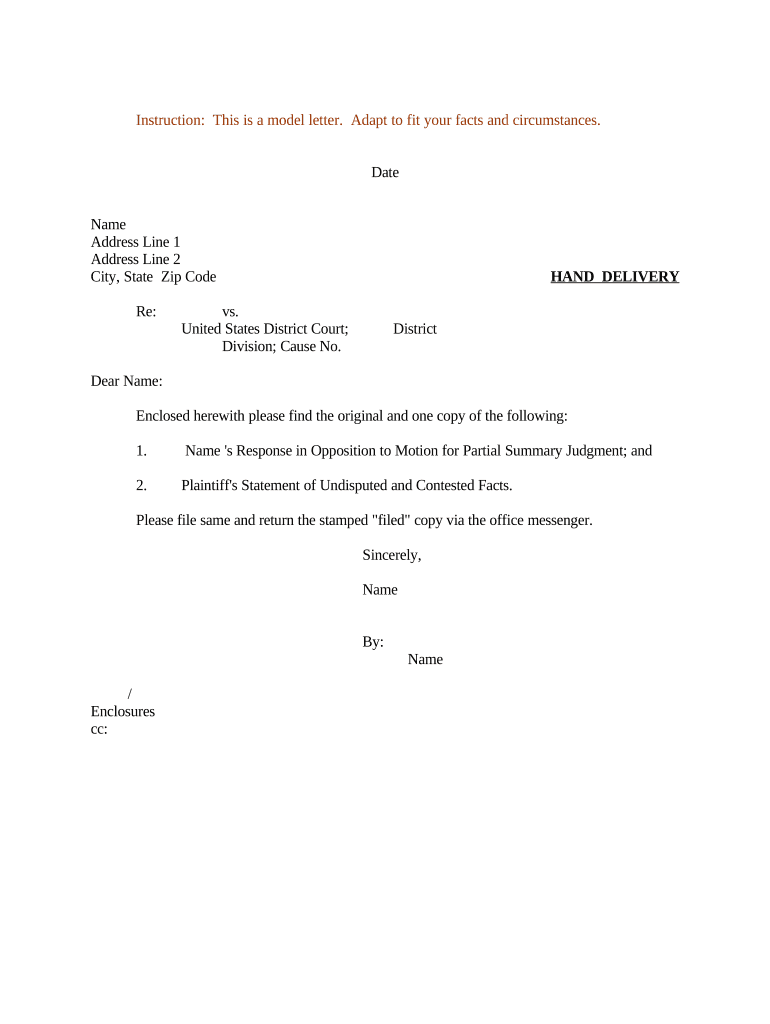
A Letter Regarding Response in Opposition to Motion is a formal written filing or correspondence submitted by a party opposing a motion in a civil matter. It explains factual and legal reasons why the motion should be denied or limited, cites controlling authority, and may point to evidentiary issues, procedural defects, or jurisdictional concerns. The letter typically accompanies or substitutes for a longer memorandum in jurisdictions that allow shorter submissions, and it must comply with the court's format, page limits, signature rules, and local filing procedures.

Why a Clear, Compliant Opposition Letter Matters

A focused, properly formatted response preserves the record, protects your procedural rights, and gives the judge a concise roadmap of legal and factual objections in support of denial.

Why a Clear, Compliant Opposition Letter Matters

Who Prepares and Files This Letter

Tailor the letter to who will sign it and the recipient court; courts differ on length, citation format, and required attachments.

  • Litigators and law firms preparing court-ready oppositions and case law citations for the judge
  • In-house counsel coordinating with outside counsel to preserve company defenses and evidence
  • Self-represented litigants (pro se) submitting concise objections consistent with local rules

Core Components to Include in a Professional Opposition Letter

A complete letter addresses court and case metadata, identifies the specific motion being opposed, summarizes key objections, cites authority, attaches necessary exhibits, and includes a proper signature block and certificate of service.

Court Caption

Start with the full court caption, case number, and judge designation so the clerk and judge can immediately identify the docket entry you oppose and link the letter to the correct file.
Motion Identification

State the motion title, filing date, docket number, and moving party; identify the exact relief sought so the court can match objections to claims.

Summary Argument

Provide a short, focused summary of the reasons to deny the motion that highlights the strongest legal and factual points without repeating the entire brief.

Legal Citations

Cite controlling statutes, rules, or precedent; include pinpoint citations and explain why the cited authorities apply to the facts at issue.

Evidentiary Points

Flag admissibility issues, missing foundation, or factual disputes and identify exhibits or declarations that undermine the movant's assertions.

Signature & Service

Include the printed name, bar number if required, contact information, date, and a certificate of service describing how and when opposing counsel and the court were served.

Required Fields and Information Checklist

Case Caption: Full caption
Docket Number: Exact number
Motion Title: Precise title
Responding Party: Plaintiff or defendant
Date Filed: MM/DD/YYYY
Service Method: eFile/email/hand

Step-by-Step: Drafting and Submitting the Opposition Letter

Follow a clear sequence to draft, review, sign, and submit the letter so it meets court rules and preserves appellate rights.

  • 01
    Prepare Draft: Summarize objections and cite authority succinctly.
  • 02
    Attach Exhibits: Include only relevant exhibits with exhibit labels.
  • 03
    Confirm Local Rules: Check page limits, margins, and font requirements.
  • 04
    File and Serve: E-file where required and serve opposing counsel.

How to Customize and Complete the Letter Online

Set up a digital workflow that enforces required fields, handles attachments, and captures an audit trail before filing or printing.

Field Configuration
Court Caption Field Required, auto-fill from template
Attachments Upload PDF exhibits, limit file size
Signature Block Enable role-based signer and date field
Audit Trail Enable IP, timestamp, and download log

Where to File, Send, and Serve the Opposition Letter

Routing depends on whether the case is in federal court, state court, or an administrative tribunal and on local e-filing mandates.

  • Federal Court: E-file via CM/ECF where required
  • State Court: Follow state or county e-filing rules
  • Administrative Agency: Use agency portal or permitted mail service
  • Service on Opposing Counsel: Email or e-service per local rule

Distribution and eSubmission Options

Maintain electronic evidence of filing and service such as a filing receipt, proof of transmission, and an audit trail for potential disputes.

  • E-filing Portals: CM/ECF or state portal
  • Secure Email: Encrypted attachments recommended
  • Certified Mail: Useful when e-filing is unavailable

Common Deadlines and Timing Considerations

Deadlines for opposing a motion vary by jurisdiction and motion type; confirm local rules and compute time under Federal Rule of Civil Procedure 6.

Typical Response Window:

Often 14–21 days depending on court rules

Summary Judgment:

District rules commonly set specific briefing schedules

Reply Deadlines:

Replies usually due 7–14 days after opposition

Emergency Motions:

Expedited schedules can be hours to days

Compute Time:

Use FRCP 6 for business days and extensions

Common Preparation Mistakes to Avoid

  • Failing to cite controlling precedent or relying on nonbinding authority without explanation
  • Submitting exhibits without proper authentication or failing to reference them in the argument
  • Omitting the certificate of service or using an incorrect service method under local rules
  • Missing the filing or opposition deadline, which can waive objections or lead to denial of relief

Consequences of an Incorrect or Untimely Letter

Waiver Risk: Claims may be deemed waived
Adverse Ruling: Motion may be granted by default
Sanctions: Court may impose monetary sanctions
Evidence Excluded: Unauthenticated exhibits may be rejected
Appeal Issues: Preservation of issues may fail
Professional Liability: Counsel risks malpractice exposure

eSignature Vendor Comparison for Preparing and Signing Legal Letters

A neutral comparison of common eSignature plan characteristics to help legal teams assess platform fit for drafting and executing opposition letters.

signNow DocuSign Adobe Sign PandaDoc HelloSign
Starting Price $8/user/mo $15/user/mo $14/user/mo $19/user/mo $15/user/mo
Free Trial 7-day free trial Varies by vendor Varies by vendor Varies by vendor Varies by vendor
Bulk Send Yes Yes Yes Yes No
Audit Trail Yes Yes Yes Yes Yes
HIPAA Compliant Yes Yes Yes No No
Envelope Cap No envelope cap 100 envelopes/user/year Varies by plan Varies by plan Varies by plan

Real-World Examples of Opposition Letters

Sample scenarios illustrate how opposition letters function across case types and organizational settings.

Defense Counsel Example

Company faced a motion to compel arbitration

  • Counsel identified controlling circuit precedent
  • The concise opposition highlighted arbitrability facts, attached declarations, and resulted in denial of the motion without an evidentiary hearing.

Pro Se Litigant Example

An individual opposed a summary judgment motion

  • Focused on disputed facts and missing affidavits
  • The court permitted limited discovery after finding genuine factual disputes that precluded summary judgment.

Frequently Asked Questions About the Opposition Letter

Answers to common practical and procedural questions when preparing, signing, and filing a Letter Regarding Response in Opposition to Motion.


Need help? Contact support

be ready to get more
Join over 28 million airSlate SignNow users