Establishing secure connection…Loading editor…Preparing document…

Letter Requesting Alias Summons for Publication

This template is fully customizable. Edit the text, fill out the fields, and send it for signature. Give it a try!
Letter Requesting Alias Summons for Publication

What the Letter Requesting Alias Summons for Publication Is

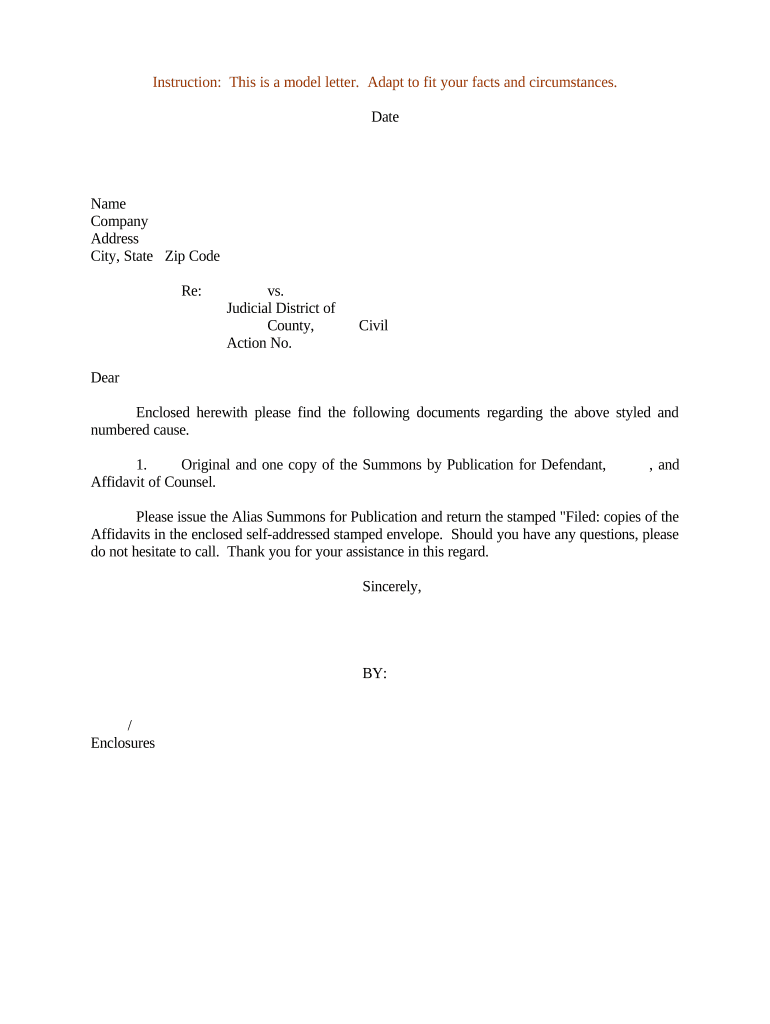
A Letter Requesting Alias Summons for Publication is a formal court filing or cover letter submitted by a plaintiff or plaintiff's counsel when initial personal service of a summons cannot be completed and the court has authorized service by publication. The letter summarizes efforts to locate the defendant, requests an alias (second) summons to be issued for publication in a designated newspaper or court-approved medium, and attaches supporting affidavits or process server logs that document good-faith attempts at service.

Why this letter matters for effective case service

A clear, well-documented request helps the court determine whether substituted service by publication is warranted and expedites issuance of an alias summons. It preserves procedural rights by showing diligent attempts at personal service and reduces the risk of later challenges to jurisdiction. Ensure the letter follows local court rules and includes required supporting affidavits and factual details.

Why this letter matters for effective case service

Who typically prepares and files this request

Parties involved in preparing and filing the letter vary depending on case context and jurisdiction.

  • Plaintiff or plaintiff’s attorney — Prepares the letter, compiles service attempts, and files with the clerk for alias summons issuance.
  • Process servers or investigators — Provide sworn affidavits and service logs demonstrating diligent efforts to locate the defendant.
  • Court clerk or filings staff — Reviews the submission for compliance with local rules before issuing an alias summons or scheduling publication.

Confirm which party the local rules require to file documents and whether counsel must be registered for electronic filing in that court.

Step-by-step process to prepare and submit the request

Follow these sequential steps to produce a complete letter and supporting package for court review and alias summons issuance.

  • 01
    Gather proofs: Collect process server logs, return receipts, and any forwarding address information.
  • 02
    Draft the letter: State facts, summarize attempts, and request an alias summons for publication.
  • 03
    Attach affidavits: Include sworn statements from servers or investigators with notarization if required.
  • 04
    File with court: Submit pleadings per local e-filing rules or deliver to the clerk for manual processing.

How the alias summons publication workflow generally proceeds

This sequence outlines the typical flow from failed service attempts to completion of service by publication.

  • Attempted Service: Personal service attempts are documented and dated per process server reports.
  • Court Submission: Letter and affidavits are filed requesting alias summons issuance for publication.
  • Alias Issued: If approved, the clerk issues an alias summons specifying publication requirements.
  • Publication: Summons published in court-approved media for the required period and frequency.

Typical document and e-filing setup to support the request

Prepare these items before filing to meet common e-filing system requirements and court preferences.

Field Configuration
Case Caption Exact party names and docket number used in metadata
File Types PDF/A preferred for affidavits and exhibits
Signature Method Electronic signature acceptable where permitted by court
Exhibit Labels Number and title exhibits consistently (Exhibit A, B, etc.)

Digital filing and signing considerations

Courts differ on electronic submission and e-signature acceptance for affidavits and letters requesting alias summons.

  • E-filing: Many courts accept PDF uploads through their e-filing portals.
  • eSignatures: Some jurisdictions accept ESIGN/UETA-compliant electronic signatures on affidavits; verify local rule.
  • Attachments: Embed PDFs and include a separate exhibit index for clarity.

Confirm local court rules on electronic affidavits, required notarization, and accepted publication venues before submitting to avoid rejection.

Essential elements to include in a professional request letter

A complete letter should be concise, factual, and supported by sworn evidence; the following elements are routinely required or strongly recommended.

Case Header

Complete court caption and docket number placed at the top to ensure the filing is associated with the correct matter and processed by the clerk.
Statement of Attempts

A chronological summary of service attempts with dates, times, and locations showing reasonable diligence before seeking publication.

Affidavit of Service Attempts

A signed, sworn affidavit from the process server describing each attempt and confirming facts under penalty of perjury.

Request Language

Clear, direct request that the court issue an alias summons for service by publication and specify the proposed publication medium.

Publication Details

Proposed newspaper or court-designated publication, suggested frequency and duration, and a timeline for publication to begin.

Signature Block

Attorney or party signature with contact information, bar number if applicable, and date of signing to validate the submission.

Data and document items to include with the letter

Case Caption: Exact names
Docket Number: Court-assigned ID
Service Dates: Attempt dates
Affiant Identity: Server name
Proposed Media: Named publication
Signature: Signed and dated

Risks and consequences of an incomplete or inaccurate request

Request Rejection: Delays or denial of alias summons
Service Void: Published summons may be later challenged
Judgment Risk: Default judgments vulnerable to attack
Sanctions: Potential procedural sanctions
Extra Costs: Additional filing and publication fees
Waived Rights: Missed opportunity to seek alternative service

Common pitfalls to avoid when preparing the request

  • Failing to attach complete affidavits from the process server, leaving gaps in the timeline that undermine claims of diligent effort.
  • Requesting publication without confirming that the proposed newspaper or medium is court-approved in the relevant jurisdiction.
  • Using vague language about attempts at service instead of providing specific dates, times, and locations supported by evidence.
  • Omitting required notarization or local-form formalities for affidavits and declarations, resulting in the clerk returning the filing.

Typical timing and publication scheduling considerations

Check local rules for publication timing and any statutory minimums; courts often require publication to occur for a defined period before service is complete.

Filing Promptly:

File the request as soon as reasonable efforts at personal service are exhausted to preserve timeline.

Publication Frequency:

Many courts require weekly publication for a specified number of consecutive weeks.

Start Date:

Publication often must begin only after the alias summons is issued by the clerk.

Proof of Publication:

Publisher affidavit confirming run dates must be filed after completion.

Service Completion:

Service by publication is typically deemed complete on the final required publication date.

Comparison of common eSignature providers for document signing and filing

Use an ESIGN/UETA-compliant eSignature provider that meets your jurisdiction’s requirements; signNow is listed first for direct comparison with other common vendors.

signNow DocuSign Adobe Sign PandaDoc HelloSign
Starting Price $8/user/mo $15/user/mo $14/user/mo $19/user/mo $15/user/mo
Free Trial 7-day free trial Varies Varies Yes, limited Yes, limited
Bulk Send Yes Yes Yes Yes No
Audit Trail Yes Yes Yes Yes Yes
HIPAA Compliant Yes Yes Yes No No

Example scenarios showing how a letter is used

Two practical examples illustrate common fact patterns where an alias summons for publication is requested.

Case Study 1

A landlord cannot locate a former tenant after multiple certified mail returns and door knocks over four weeks.

  • The landlord files a letter documenting dated attempts and attaches the process server affidavit.
  • The court issues an alias summons and orders publication in the county legal notices for three consecutive weeks; a publisher affidavit later confirms compliance and the court deems service complete.

Case Study 2

A creditor loses contact with a debtor who moved and left no forwarding address despite skip-tracing.

  • The creditor submits a detailed letter and investigator report demonstrating exhaustive searches.
  • The court authorizes publication in a statewide legal notice, the summons runs per schedule, and the creditor later files proof of publication to proceed with default proceedings.

Practical tips for a clean, court-ready submission

Adopt these practices to reduce the chance of rejection and to strengthen the evidentiary record supporting publication.

Document everything contemporaneously
Record dates, times, and actions immediately after each attempt; contemporaneous notes are more credible than reconstructed timelines and support affidavits.
Use clear, unambiguous language
State facts plainly and avoid argumentative or speculative phrasing; courts favor precise factual accounts over broad assertions of inability to locate.
Confirm publisher eligibility
Verify that the proposed newspaper meets statutory or local rule criteria for public notices to prevent a later challenge to the validity of publication.
Keep originals intact
Retain original server logs, correspondence, and proof of publication to respond promptly to any post-judgment service disputes.

Frequently asked questions about requests for alias summons by publication

Answers to common questions that arise when drafting, filing, or defending a request for an alias summons for publication.


Need help? Contact support

be ready to get more
Join over 28 million airSlate SignNow users