Establishing secure connection…Loading editor…Preparing document…

Letter of Understanding Regarding Proposed Contract

This template is fully customizable. Edit the text, fill out the fields, and send it for signature. Give it a try!
Letter of Understanding Regarding Proposed Contract

What the Letter of Understanding Regarding Proposed Contract Is

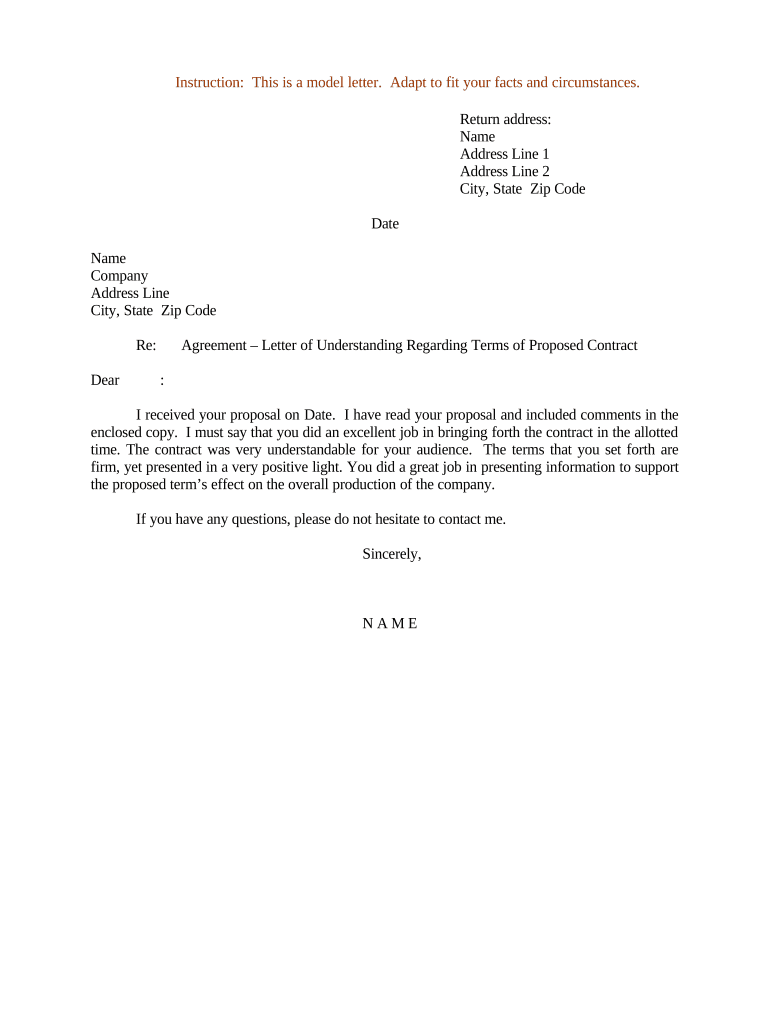
A Letter of Understanding Regarding Proposed Contract is a concise, written summary of material terms negotiated before final contract execution. It typically outlines scope of work, deliverables, fees or consideration, proposed schedule, key obligations, contingencies, confidentiality expectations, and any items reserved for later negotiation. The letter helps align parties on core points, reduces misunderstandings during drafting, and creates a dated record of intent that may guide subsequent contract language. While often nonbinding in whole, certain clauses (confidentiality, exclusivity, or interim obligations) can be drafted to be legally enforceable.

Why a Letter of Understanding Matters in Contract Negotiations

Use a Letter of Understanding to document negotiated terms, preserve negotiating positions, speed drafting, and reduce later disputes; it offers clarity for legal review and procurement while allowing flexibility before final contract language is signed.

Why a Letter of Understanding Matters in Contract Negotiations

Which roles commonly prepare or review this letter

The letter reduces back-and-forth during drafting and provides a clear reference for stakeholders who will perform or manage the contract.

  • Business development and sales teams who need an agreed summary for internal approvals and pricing sign-offs.
  • Procurement and contracting specialists who convert the agreed terms into a formal purchase or services contract.
  • Legal counsel and outside attorneys who verify enforceability and identify risky clauses before final drafting.

Typical signers and document owners

Contracting Officer

A contracting officer or authorized procurement representative usually signs for the buyer side; they verify scope, budget availability, and compliance with procurement rules before any binding commitments are made.

Business Representative

A business owner, project lead, or authorized vendor signatory signs for the seller side; they confirm deliverables, pricing, timing, and any conditions precedent to full contract execution.

Essential sections to include in a professional Letter of Understanding

A clear structure reduces ambiguity and speeds conversion to a final contract; include identifiable headings so legal and operational teams can find key terms quickly.

Parties

Identify full legal names and business types for each party, with primary contact information and mailing addresses for notices.
Scope Summary

Concise description of goods or services, deliverables, major milestones, and any exclusions to limit scope creep during drafting.

Payment Terms

State price, billing frequency, payment methods, deposits, retainers, and any conditions for invoicing or withholding.

Schedule

Key dates including effective date, milestones, performance period, and any deadlines for interim approvals or acceptance testing.

Conditions

List conditions precedent such as financing, regulatory approvals, due diligence findings, or third-party consents required before binding obligations.

Legal Provisions

Note which provisions are intended to be binding (confidentiality, exclusivity, or interim obligations) and state governing law and dispute resolution preferences.

Step-by-step: completing a Letter of Understanding

Follow these sequential steps to create a clear, enforceable letter and reduce negotiation cycles.

  • 01
    Draft terms: Summarize core commercial points agreed in meetings.
  • 02
    Mark binding items: Clearly label any clauses intended to be binding now.
  • 03
    Review legally: Have counsel confirm phrasing and risk allocation.
  • 04
    Execute and distribute: Have authorized signers sign and circulate copies to stakeholders.

How the Letter of Understanding fits into contract workflows

This is a transitional document between negotiation and formal contracting; use it to accelerate drafting and approvals.

  • Negotiation capture: Record agreed points for drafting the final contract.
  • Internal approvals: Use the letter to obtain budget or executive sign-off.
  • Draft conversion: Legal uses the letter to prepare the definitive agreement.
  • Interim obligations: Enforceable interim clauses may be relied on before final contract.

Digital workflow settings to streamline completion

Configure these fields and routing options to ensure consistent execution and auditability when using an eSignature platform.

Field Configuration
Signature Field Required; signer must date signature
Initials Field Optional; use for multi-page acknowledgment
Authentication Email plus SMS code for moderate assurance
Audit Trail Enable full IP, timestamp, and action history

Technical and platform considerations for e-signing

Maintain copies in a secure repository with audit logs so executed letters remain discoverable and reproducible for compliance or dispute purposes.

  • File formats: Use PDF or DOCX to preserve layout and text fidelity
  • Integrations: Connect to CRM or document storage for automated archiving
  • Authentication: Use SMS or KBA for higher-assurance signer verification

Common pitfalls to avoid when preparing this letter

  • Using vague scope language that invites differing performance expectations and disputes later.
  • Failing to label whether specific clauses are binding now or are only negotiation notes.
  • Mismatching party names or failing to use the legal entity name required for enforcement.
  • Overlooking conditions precedent with no deadlines, which can delay final contract formation.

Consequences of errors or omissions

Contractual ambiguity: Dispute exposure
Unauthorized signatory: Voidable obligations
Missing conditions: Performance risk
Incorrect dates: Statute timing issues
Non-compliance: Regulatory fines
Improper retention: Evidence gaps

Typical timelines and deadlines to define in the letter

Specify clear deadlines to avoid ambiguity: set response windows, condition satisfaction dates, milestone deliveries, and a definitive execution date for the final agreement.

Response window:

Specify number of days for acceptance or counter-offer

Condition deadlines:

Set calendar dates for permits, approvals, or financing

Milestone dates:

Define delivery and acceptance checkpoints

Execution target:

Propose a target date for signing the definitive contract

Expiration:

State when the letter’s terms lapse if not accepted

Key milestones from negotiation to contract signing

Track these sequential milestones so stakeholders know the expected path and decision points before final execution.

01

Proposal Submitted

Initial commercial terms and pricing shared with the counterparty

02

Letter Drafted

Core points captured and binding clauses identified

03

Internal Approval

Finance and legal sign-off obtained

04

Contract Execution

Definitive agreement signed and returned by all parties

eSignature vendor pricing snapshot for signing Letters of Understanding

Compare typical starting price and key capabilities when choosing an eSignature provider for managing Letters of Understanding and similar pre-contract documents.

signNow DocuSign Adobe Sign PandaDoc HelloSign
Starting Price $8/user/mo $15/user/mo $14/user/mo $19/user/mo $15/user/mo
Free Trial 7-day free trial Yes Yes Yes Yes
Bulk Send Yes Yes Yes Yes No
Audit Trail Yes Yes Yes Yes Yes
HIPAA Compliant Yes Yes Yes No No

Example scenarios showing practical use of the letter

Two common scenarios illustrate when a Letter of Understanding helps protect parties and speed contracting.

Real Estate Transaction

A buyer and seller summarize purchase price and inspection period in a Letter of Understanding to align expectations before drafting the purchase agreement.

  • The letter sets a 14-day inspection deadline and earnest money amount.
  • As a result, both parties avoid repeated renegotiation during contract drafting and provide brokers and lenders a clear timeline for closing preparations.

Professional Services Engagement

A vendor and client record scope, milestones, and payment schedule before the full services agreement is drafted.

  • The letter specifies interim deliverables and a 30-day payment term.
  • This enables the vendor to mobilize resources while legal completes the definitive contract, reducing start-up delays and clarifying invoicing procedures.

Practical tips for clear, enforceable Letters of Understanding

Adopt consistent drafting habits and internal review steps to reduce disputes and accelerate conversion to a definitive contract.

Be explicit about binding terms
State clearly which clauses are intended to be binding (for example, confidentiality or exclusivity) and which are preliminary to avoid unintended obligations.
Use precise measurement language
Quantify deliverables, timelines, and acceptance criteria to reduce interpretation differences between parties and simplify final contract drafting.
Confirm signer authority
Include a signer’s title and authority statement; have organizations attach a board resolution or authorization when required.
Preserve an audit trail
Use an eSignature platform that records timestamps, IP addresses, and signer authentication to support enforceability and evidentiary needs.

Security, compliance, and technical controls to look for

Encryption: TLS 1.2/1.3 in transit; AES-256 at rest
Certifications: SOC 2 Type II and ISO 27001
Regulatory Fit: ESIGN and UETA compliant
Healthcare: HIPAA support with BAA available
Audit Trail: Comprehensive IP and timestamp history
Accessibility: WCAG 2.0 Level AA support

Frequently asked questions about Letters of Understanding

Answers to common concerns about enforceability, e-signing, notarization, and modifications for Letters of Understanding.


Need help? Contact support

be ready to get more
Join over 28 million airSlate SignNow users