Establishing secure connection…Loading editor…Preparing document…

Sample Questions in a Behavioral Interview

This template is fully customizable. Edit the text, fill out the fields, and send it for signature. Give it a try!
Sample Questions in a Behavioral Interview

What the Sample Questions in a Behavioral Interview Are

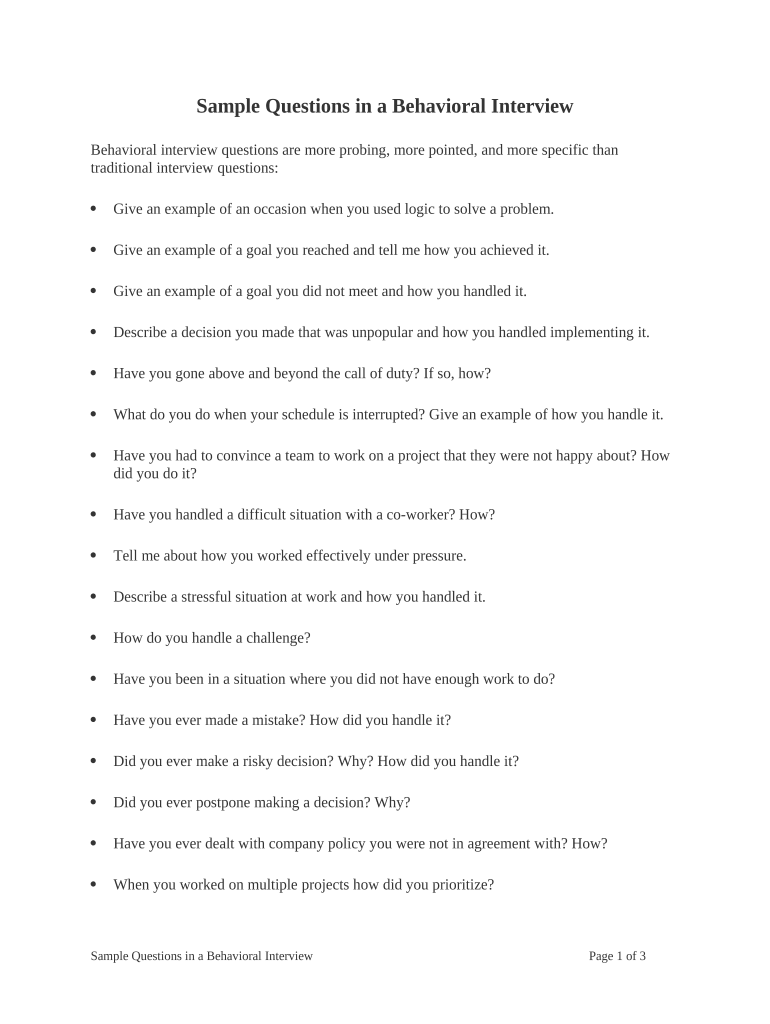
Sample Questions in a Behavioral Interview are a curated list of scenario-based prompts designed to elicit evidence of a candidate's past behavior, skills, and decision-making. These questions focus on concrete examples (projects, challenges, interactions) and ask candidates to describe the Situation, Task, Action, and Result. Hiring teams use them to compare candidates on competencies such as teamwork, problem solving, adaptability, and leadership. A consistent set of sample questions helps reduce bias, improves comparability across interviews, and supports defensible hiring documentation when combined with structured scoring.

Why Using These Sample Questions Improves Interview Quality

Structured behavioral questions produce comparable answers and more reliable evidence of past performance, which correlates with future job behavior. They help interviewers probe for specifics rather than generalities and reduce reliance on impression-based judgments.

Why Using These Sample Questions Improves Interview Quality

Who Typically Uses Sample Behavioral Questions

Teams that commonly use behavioral question sets include hiring managers, interview panels, HR generalists, and recruiters seeking objective candidate assessments.

  • Hiring managers evaluating role-fit and on-the-job competency using consistent scoring rubrics.
  • Interview panels coordinating across multiple rounds to ensure fair, comparable evaluation.
  • HR and talent acquisition teams standardizing questions for compliance and training.

Using a shared question bank with clear rating criteria supports fairness, reduces variation between interviewers, and documents hiring decisions for auditability.

Core Components of Effective Behavioral Question Sets

A professional set of sample behavioral questions pairs each prompt with a competency, a scoring guide, and suggested follow-up probes to ensure consistent evidence gathering across interviewers.

Competency Link

Each question maps to a defined competency such as teamwork, problem solving, or customer focus so answers can be scored against the same skill framework.
STAR Prompt

Prompts are phrased to elicit Situation, Task, Action, and Result details, encouraging candidates to provide measurable outcomes and concrete timelines.

Follow-Up Probes

Suggested follow-ups ask for clarifying details (scope, constraints, collaborators) to validate the candidate's role and the answer's depth.

Scoring Rubric

A short rubric defines what constitutes low, acceptable, and high responses for each competency making ratings more objective and easier to calibrate.

Timebox Guidance

Each question includes a recommended timing (e.g., 5–7 minutes) to keep interviews on schedule and allow comparable depth across candidates.

Behavioral Examples

Bank of sample answers or red-flag indicators help interviewers recognize incomplete, evasive, or off-topic responses during evaluation.

Step-by-Step: Using Sample Questions During an Interview

Follow a short, repeatable sequence to run a behavioral interview that produces comparable evidence and reliable ratings across candidates.

  • 01
    Introduce the Format: Explain STAR structure and time limits briefly.
  • 02
    Ask the Prompt: Read the question verbatim to each candidate.
  • 03
    Probe for Detail: Use follow-ups to confirm the candidate's specific actions.
  • 04
    Score and Document: Apply the rubric immediately and record supporting notes.

How a Behavioral Question Flows in Practice

This compact workflow shows the interviewer actions from prompt to recorded decision, helping panels align on timing and documentation.

  • Present Question: Share the prompt and timebox expectations.
  • Candidate Response: Listen for Situation, Action, and Result details.
  • Clarifying Probes: Ask targeted follow-ups for attribution.
  • Immediate Scoring: Rate using rubric and capture one-line evidence.

Configuring a Digital Question Bank and Interview Workflow

Standardize settings for consistent delivery, scoring, and recordkeeping when using an online tool or ATS to deploy behavioral question sets.

Field Configuration
Question Order Fixed or randomized per role; fixed order aids comparability.
Access Controls Role-based access for interviewers and admins only.
Scoring Visibility Hide other raters' scores until all have submitted.
Audit Trail Enable timestamped notes and score history retention.

Technical Considerations for Running and Saving Interviews

Choose tools that let interviewers display prompts, enter ratings, and save time-stamped notes for auditability.

  • Device Support: Desktop and mobile compatible.
  • Export Options: CSV and PDF support.
  • Access Control: Role-based permissions.

For teams that also need secure signature capture or formal candidate acknowledgment forms, consider platforms that offer audit trails, records retention, and integrations with HRIS systems while ensuring compliance with data privacy rules.

Practical Guidance for Interviewers

Adopt simple habits to improve consistency, reduce bias, and keep a defensible record of hiring decisions when using behavioral questions.

Use the same questions across candidates
Asking an identical core set reduces selection bias, facilitates direct comparison between candidates, and supports equitable treatment. Deviations should be limited to role-specific probes only.
Calibrate scoring with short training
Conduct a brief rater calibration session with sample answers so interviewers align on rubric interpretations and avoid drift in ratings over time.
Document concrete evidence
Record a short factual note (who, what, outcome) to support each score; narrative notes reduce later disagreements and form the basis for lawful hiring justification.
Protect candidate data
Limit access to stored responses, retain records only as long as necessary, and follow applicable privacy laws to avoid unauthorized disclosure of sensitive personal information.

Common Mistakes to Avoid

  • Asking leading or hypothetical questions that invite opinion rather than concrete evidence undermines the behavioral approach and reduces reliability.
  • Using different questions or rubrics between interviewers prevents valid comparisons and can create apparent bias in hiring decisions.
  • Failing to timebox questions allows inconsistency in depth across candidates and risks favoring those who speak more at length.
  • Recording only impressions without factual notes makes it difficult to justify decisions and complicates later review or compliance checks.

Legal and Compliance Risks to Consider

Discrimination Risk: Avoid questions probing protected characteristics.
Privacy Risk: Do not collect unnecessary personal data.
Recording Consent: Obtain required consent before audio/video recording.
Inconsistent Documentation: Creates exposure in discrimination claims.
Retention Noncompliance: Improper storage may violate state or sector rules.
Unauthorized Access: Access violations risk breach notification.

How Different Teams Use Behavioral Questions

Real-world examples show how question sets adapt to role complexity and regulatory sensitivity across teams.

Tech Product Manager Panel

Interviewers used a set of six scenario prompts emphasizing cross-functional conflict resolution and execution.

  • Panelists followed a 3-level rubric to score impact and ownership.
  • The team retained time‑stamped notes in the ATS to explain the hire and to support onboarding tasks aligned to identified skill gaps.

Healthcare Hiring Committee

Nurses and managers used behavioral prompts focused on patient safety and escalation.

  • Follow-up probes emphasized confidentiality and compliance.
  • Responses were stored with limited access; retention aligned with HIPAA requirements and institutional recordkeeping policies to protect PHI.

Comparing eSignature Options for Interview Workflows

When interview processes require candidate acknowledgments or signed forms, compare basic pricing and compliance features across providers; signNow is listed first per standard comparison convention.

signNow DocuSign Adobe Sign PandaDoc HelloSign
Starting Price $8/user/mo $15/user/mo $14/user/mo $19/user/mo $15/user/mo
Free Trial 7-day free trial, no card required Varies by vendor Varies by vendor Varies by vendor Varies by vendor
Bulk Send Yes (Business Premium) Yes Yes Yes No
Audit Trail Yes Yes Yes Yes Yes
HIPAA Compliant Yes (BAA available) Yes Yes No No

Frequently Asked Questions About Sample Behavioral Questions

Practical answers to common issues interviewers and hiring teams encounter when adopting behavioral question sets.


Need help? Contact support

be ready to get more
Join over 28 million airSlate SignNow users