Establishing secure connection…Loading editor…Preparing document…

Letter from Wedding Planner to Videographer

This template is fully customizable. Edit the text, fill out the fields, and send it for signature. Give it a try!
Letter from Wedding Planner to Videographer

What the Letter from Wedding Planner to Videographer Is

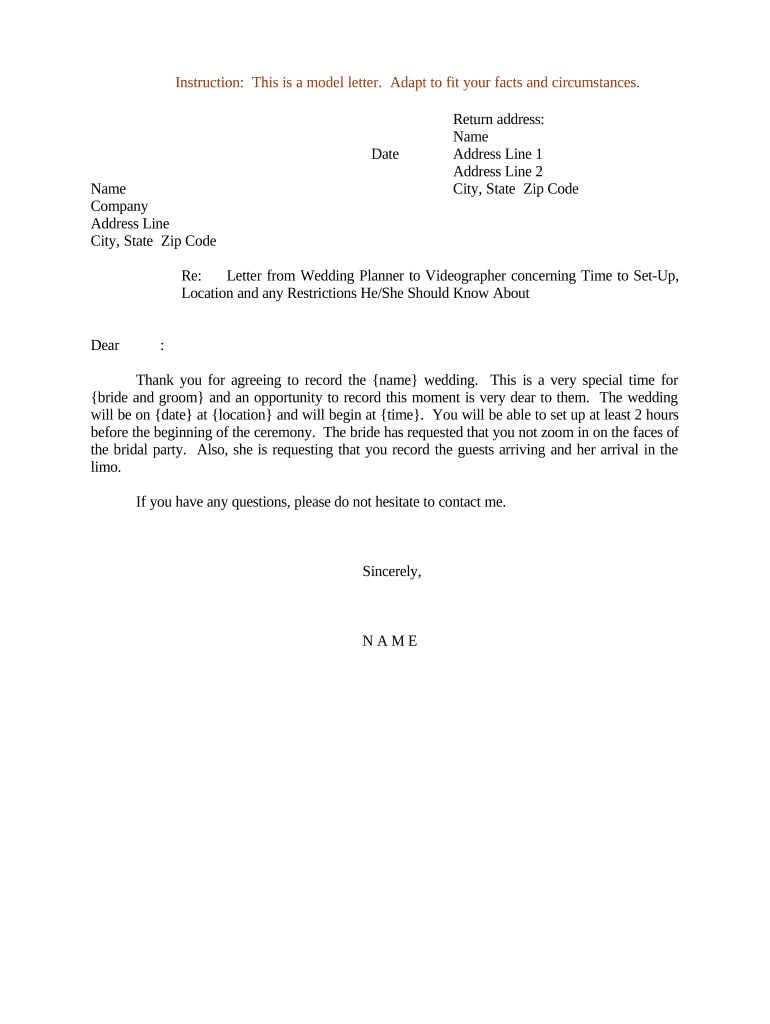
A Letter from Wedding Planner to Videographer is a written instruction and confirmation document that outlines event date, schedule, shot list, deliverables, payment terms, access and contact details. It clarifies responsibilities, requests permissions or releases, and documents expectations for footage usage and turnaround. The letter can be delivered in paper or electronic form and may be incorporated into a service contract or attached as an exhibit to a larger agreement, providing a clear reference for both parties before the event.

Why a Clear Letter Matters for the Shoot

A concise, well-structured letter reduces misunderstandings, documents agreed deliverables and payment milestones, and supports timely production of final video assets. It establishes access and location details and creates a record that can be relied on if scheduling changes or disputes arise.

Why a Clear Letter Matters for the Shoot

Who Typically Prepares and Receives This Letter

The letter is generally prepared by the wedding planner or coordinator and addressed to the contracted videographer, with copies to venue managers and other vendors as needed.

  • Lead wedding planner or coordinator — primary sender confirming event logistics and vendor expectations.
  • Contracted videographer or video team — recipient confirming availability, resources, and delivery commitments.
  • Venue or site manager — copied when access, load-in times, or parking instructions are required.

Copies may also go to the couple, photographer, or key venue contacts to keep all parties aligned on timing, access, and deliverable expectations.

Step-by-step: Create and Send the Letter

Follow these sequential steps to prepare a complete, practical letter that the videographer can act on immediately.

  • 01
    Identify parties: List planner, videographer, client names and roles.
  • 02
    State event details: Include date, venue, arrival and wrap times.
  • 03
    List deliverables: Specify final file types, cut types, and delivery dates.
  • 04
    Confirm logistics: Note parking, load-in, contacts, and backup plans.

How the Letter Fits Into Event Workflow

The letter formalizes details that feed into booking, day-of coordination, and post-production handoffs.

  • Booking: Confirms reservation and deposit terms.
  • Pre-event coordination: Sets walk-through and final shot-list deadlines.
  • Day-of operations: Documents arrival, parking, and site contact.
  • Post-production: Defines editing scope and delivery timeline.

Common workflow settings when sending the letter electronically

Configure your digital workflow to capture consent, confirm receipt, and track delivery of the signed letter.

Field Configuration
Sender Planner or authorized coordinator
Signer Videographer as primary signer
Authentication Email link or SMS code
Receipt Automatic copy to planner and client

Platform considerations for electronic delivery and signature

Choose a platform that supports trackable delivery, signer authentication, and secure storage for signed letters.

  • Document formats: PDF and DOCX supported
  • Authentication: Email link or SMS code
  • Audit trail: Timestamp and IP recorded

Ensure your chosen service meets any required compliance standards for personal data and retains a tamper-evident audit trail so the letter can be reproduced for future reference.

Security and compliance items to note

Encryption: TLS 1.2/1.3 in transit
At-rest protection: AES-256 encryption
Audit Trail: Tamper-evident signatures recorded
HIPAA: BAA required for PHI
ESIGN/UETA: Electronic signatures legally valid
Access controls: Role-based signer authentication

Penalties and common legal risks

Miscommunication: Schedule conflicts or missed shots
Payment disputes: Withheld or delayed final payment
Copyright issues: Unclear ownership of footage
Privacy breaches: Unauthorized sharing of footage
Invalid authorization: Unsigned or unsupported consent
Operational delays: Late delivery or editing delays

Common mistakes to avoid when drafting the letter

  • Vague deliverables: failing to define final file types, resolution, or number of edits leads to differing expectations and scope disputes during post-production.
  • Missing logistics: omitting load-in times, parking instructions, or point-of-contact details causes day-of delays and can reduce coverage quality.
  • Unclear rights: not specifying usage rights, licenses, or transfer of copyright can create legal disputes over social media or commercial reuse.
  • No fallback plan: skipping contingency instructions for weather, timing changes, or additional shooter requests leaves the team unprepared.

Practical tips for a reliable, enforceable letter

Adopt these practices to improve clarity, reduce disputes, and streamline day-of operations and post-production handoffs.

Be explicit about deliverables
List exact deliverables, formats, resolutions, and the number of edited versions or revisions allowed. State whether raw footage is included and the expected delivery timeline to avoid misunderstandings during editing and handoff.
Specify rights and usage
Clearly state who owns the raw footage and final edits, license scope for social and commercial use, duration of rights granted, and any required credit or attribution for promotional materials.
Confirm logistics and contacts
Provide precise arrival times, load-in locations, parking passes, on-site contact names and cell numbers, and contingency plans for weather or schedule shifts to ensure smooth coordination.
Record confirmations electronically
Use an authenticated electronic delivery with a complete audit trail or a signed paper copy. Retain the executed letter and related attachments for the retention period applicable to your business.

Real-world examples: how similar letters are used

Two condensed examples show how concise letters reduce confusion and set clear expectations for videographers.

Hospitality Venue Shoot

A planner confirms arrival at 10:00 AM, load-in at service entrance and parking pass included.

  • Key point: provide venue contact.
  • The letter included a 14-day delivery deadline for rough cuts, stated that the venue requires a signed access form, and listed payment terms with a 50% deposit to secure the booking and balance due seven days before the event.

Small Backyard Wedding

The planner noted limited parking and noisy neighbors; asked for discreet camera setups.

  • Key point: list constraints.
  • The letter requested a short highlight reel within 21 days, granted the couple non-exclusive social media rights, and asked the videographer to confirm willingness to shoot family-only portraits at 30 minutes after the ceremony.

Key components to include in the letter

Ensure the letter covers all operational, legal, and scheduling items that affect the videographer's performance and deliverables.

Parties

Full legal names of planner, videographer, and client; include business entity names and primary contact details for clarity.
Event logistics

Event date, venue address, arrival time, ceremony time, reception schedule, load-in locations, and parking instructions.

Shot list

Priority moments, must-have shots, ceremony specifics, and any restricted zones or vendor coordination notes for the videographer.

Deliverables

Specify final video types, resolution, file format, number of rounds of edits, and expected delivery dates for drafts and final files.

Payment

Deposit amount, balance due date, accepted payment methods, late fee terms, and whether travel or accommodation is reimbursed.

Usage rights

State who retains copyright, whether rights are transferred or licensed, geographic scope, and duration of permitted uses.

How to save and share the completed letter

Choose formats and storage that preserve layout, signatures, and metadata for reliable retrieval and evidence of agreement.

PDF/A

Export a flattened, print-ready PDF to preserve text, images, and signature appearance while keeping metadata intact for records.

DOCX

Retain an editable DOCX copy for future amendments and version control, noting any tracked changes before finalizing.

Signed copies

Store a signed PDF with the audit trail or a scanned paper copy if notarized; keep both for redundancy.

Cloud backups

Use secure cloud storage with access controls and retention settings to ensure long-term availability of signed letters.

Typical timing and deadlines to include

Set and communicate key dates to allow videographers sufficient time for prep, travel, and editing.

Send letter before event:

30–60 days recommended to confirm booking and logistics.

Deposit due:

Due at booking or within 7 days to secure services.

Final shot list due:

14 days before event to allow planning.

Venue walk-through:

7 days before event for final coordination.

Balance due:

Typically due 7 days before event or day of.

Pricing comparison: common eSignature vendors (signNow first)

Simple vendor comparison for common plan features and starting prices; use this as a baseline for selecting an eSignature provider for sending and signing vendor letters.

signNow DocuSign Adobe Sign PandaDoc HelloSign
Starting Price $8/user/mo $15/user/mo $14/user/mo $19/user/mo $15/user/mo
Free Trial 7-day free trial — no card Varies by plan Varies by plan Varies by plan Varies by plan
Bulk Send Yes Yes Yes Yes No
Audit Trail Yes Yes Yes Yes Yes
HIPAA Compliant Yes Yes Yes No No

Who signs and authorizes the letter

Wedding Planner — Authorized Sender

The planner or authorized coordinator signs to confirm logistics, scope, and payment terms. The planner's signature binds coordination commitments and acknowledges responsibility for communicating venue rules and third-party vendor contacts.

Videographer — Primary Signer

The videographer signs to acknowledge acceptance of schedule, deliverables, and payment terms. Their signature confirms availability, resource allocation, and agreement to any usage or licensing provisions included in the letter.

Common questions about using this letter

Answers to frequent questions about legal validity, signatures, changes, and storage to help planners and videographers avoid common issues.


Need help? Contact support

be ready to get more
Join over 28 million airSlate SignNow users